
The Off-Camera Perspective: Teaching Students to See Forgotten Historic POV
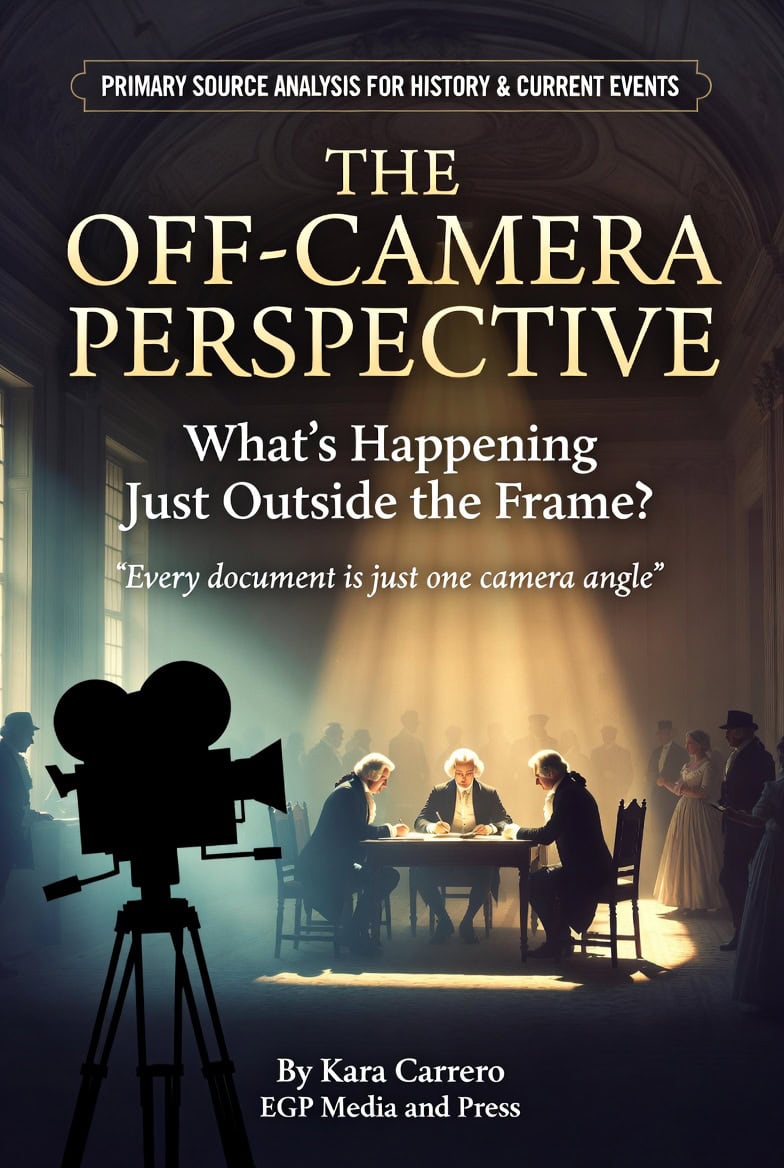
Picture this: You’re watching a movie scene where a king signs a treaty in his grand hall. The camera focuses on his face, his ornate quill, the gilded document. The soundtrack swells. This is history being made.
But what if you could grab that camera and swivel it 90 degrees?
Suddenly you’d see the scribe who spent three days drafting that treaty: exhausted, ink-stained, never mentioned. Turn it another 90 degrees and you’d see the servants who prepared the hall, the guards who stood silent witness, the translator who made the negotiations possible.
Now spin the camera 180 degrees…completely around. You’d see the people this treaty affects most: the villagers who’ll be taxed to fund it, the soldiers who’ll die enforcing it, the indigenous communities whose land it redistributes without their consent.
They were always there. They just weren’t in the frame.
This is what I call “The Off-Camera Perspective” and it’s the missing piece in how we teach students to read historical documents.
- The Other side of "Whose Pen Is This?"
- Why This Matters More Than Ever
- The Three Camera Angles Every Student Should Learn
- How This is Different from "Whose Pen Is This?"
- The Cinematographer's Lens: A Real Classroom Example
- Three Ways to Use This Framework in Any Classroom or Homeschool
- FREE DOWNLOAD: 26-Page "Off-Camera Perspective" Toolkit
- The Bottom Line: History Has No Single Camera Angle
- About This Framework
The Other side of “Whose Pen Is This?”
Teaching students to question authorship is critical. My “Whose Pen Is This?” framework helps students ask: Who wrote this? What’s their bias? What did they gain from this account?
That’s essential detective work.
Sometimes the author isn’t the problem. Sometimes the problem is what the author couldn’t see or chose not to film.
Let me explain with a real example.
The Letter That Taught Me to Look Off-Camera
If we teach the Constitutional Convention using James Madison’s notes—detailed, meticulous, brilliant primary sources. And we analyze his perspective, questioning his Federalist bias, doing everything right.
We can still see that Dr. Madison kept writing about ‘the people’ and ‘representation.’ But there were actual people in that room who weren’t allowed to vote, including everyone who served them food.
It’s not a matter of whether Madison was lying. It is questioning what he couldn’t see from where he sat and what he had no incentive to notice.
So this is not just about “Whose pen is this?” seeing who wrote history but “What’s happening just outside the frame?” to try to uncover what those stories actually were and not simply that they existed.
Why This Matters More Than Ever
We live in a world where everyone is a documentarian. Your children and students scroll through feeds where everyone is filming their own version of reality, choosing their angle, their lighting, their edit.
They need to understand: A document, any document, is just one camera angle on a much larger scene.
This isn’t about calling every historical figure a villain. It’s about teaching students to ask:
- Who else was in the room?
- Who was affected but not consulted?
- What would this look like from the doorway? From the street? From the other side of the ocean?
This is historiography—the study of how history is written and who gets to write it. And it’s one of the most powerful critical thinking skills we can teach.
The Three Camera Angles Every Student Should Learn
I’ve developed what I call “The Panning Lens Tool” which is a way to systematically examine perspectives at different angles from the document.
The Center Frame: “In Focus”
The Question: Who is directly named and speaking in this document?
This is the obvious stuff: the person holding the pen, the people they’re addressing, the events they’re describing.
Example: In the Declaration of Independence, the “In Frame” perspectives are the Founding Fathers, King George III, and the British Parliament.
The 90° Turn: “Just Off-Camera”
The Question: If you turned the camera 90 degrees, who else is in the room but not speaking?
These are the people who contributed labor, support, or presence without being named. They were there, but they weren’t holding the pen.
Example: The scribes who wrote the copies. The enslaved people who served the delegates. The wives and children waiting at home. The Continental soldiers enforcing this new independence.
Teaching Tip: This is where students often have their first “aha!” moment. “Wait, someone had to cook their meals…” “Someone had to carry those messages…” They start seeing the infrastructure of history.
The 180° Turn: “Not Even in the Room”
The Question: Who is affected by this document but wasn’t allowed in the building?
These are the people who had no voice, no access, no representation but who would live (or die) with the consequences.
Example: Indigenous nations whose land the new country claimed. Enslaved people whose freedom was not even considered. Women who would be “represented” by men. Loyalists who would be persecuted. Future generations who would inherit this framework.
The Power Move: This is where historiography gets real. Students start asking: “How would this document be different if it were written by someone from this outer circle?”
How This is Different from “Whose Pen Is This?”
Let me be clear about the distinction:
| “Whose Pen Is This?” | “The Off-Camera Perspective” |
|---|---|
| Questions the author’s bias | Questions the author’s view |
| “What did they gain from this version?” | “What couldn’t they see from where they sat?” |
| Assumes intention and agenda | Assumes limited perspective and structural blindness |
| Asks: “Can we trust this source?” | Asks: “What’s missing from this source?” |
| Author-focused | Scene-focused |
You need both.
Sometimes the author is deliberately misleading (use “Whose Pen Is This?”). Sometimes the author is truthfully reporting what they saw—but what they saw was limited by where they stood (use “The Off-Camera Perspective”).
The Cinematographer’s Lens: A Real Classroom Example
Let’s look at Andrew Jackson’s 1830 message to Congress about Indian Removal.
In Frame: Andrew Jackson, Congress, “benevolent” policy, “civilization,” “voluntary migration”
90° Turn:
- The translators who explained the treaties
- The soldiers who would enforce removal
- White settlers eager for the land
- Jackson’s own advisors who warned against this
- The treaty negotiators who used coercion
180° Turn (this is where it can get powerful):
- The Cherokee Nation who had their own written constitution
- The thousands of children who would die on the Trail of Tears
- The Creek, Chickasaw, Choctaw, and Seminole peoples
- The elders who kept oral histories
- Future generations who would inherit stolen land
“How would this speech be different if it were written by someone from the 180° circle?”
That’s historiography. That’s seeing the full scene.
Three Ways to Use This Framework in Any Classroom or Homeschool
Strategy #1: The Frame-of-Reference Lens Exercise
Give students a physical cut-out “viewfinder” (like a camera frame). Have them move it around the document, literally highlighting different participants.
The prompt: “Each time you move the frame, ask: ‘Who is being spoken ABOUT but not spoken TO?'”
What this does: Makes the concept physical and visual. Students literally see how changing the focus changes the story.
Strategy #2: The “Missing Documentary” Project
After analyzing a document with the Panning Lens Tool, have students create the “missing footage”… a document written from a 90° or 180° perspective.
Examples:
- A diary entry from an enslaved person at Mount Vernon on the day Washington wrote about “liberty”
- A letter from a factory worker’s child during a Gilded Age industrialist’s speech about “progress”
- A field report from a Vietnamese farmer during LBJ’s Gulf of Tonkin address
What this does: Students practice perspective-taking based on historical evidence, not imagination. They must research what these people would have known, feared, and wanted.
Strategy #3: The Current Events Application
This framework isn’t just for history. Use it with modern primary sources:
- A corporate press release about layoffs (Who’s off-camera? The workers. The families. The communities.)
- A political speech about immigration policy (Who’s off-camera? The immigrants themselves. The children. The workers who employ them.)
- A news article about a new development (Who’s off-camera? The displaced residents. The construction workers. The future tenants.)
What this does: Shows students this is a life skill, not just a history skill. Every source has a frame. Every frame excludes someone.
FREE DOWNLOAD: 26-Page “Off-Camera Perspective” Toolkit
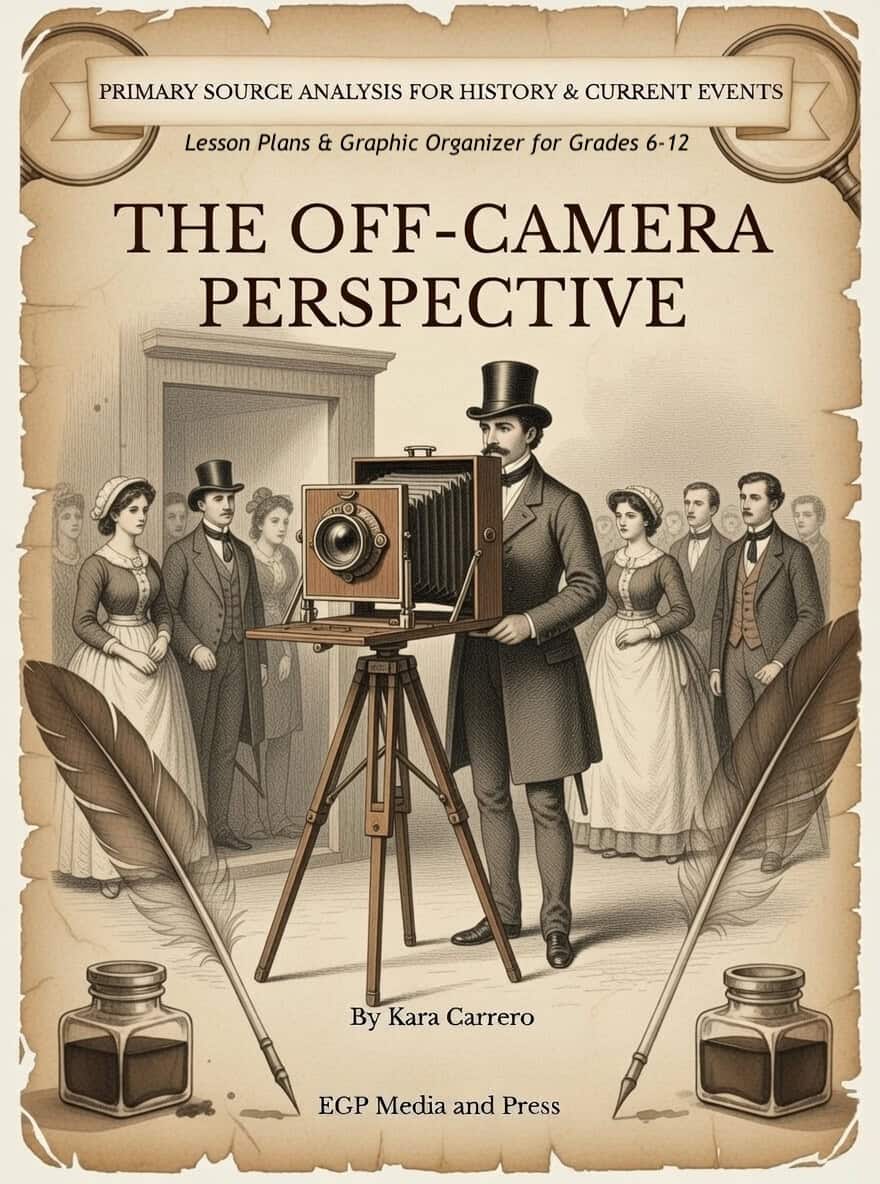
I’ve created a complete teaching toolkit to help you implement this framework immediately. It includes:
The Cinematographer’s Lens Graphic Organizer
- Visual “Panning Lens Tool” with concentric circles for the three camera angles
- Cut-out “Frame-of-Reference Lens” students can physically move around documents
- Omission Analysis chart
- Historiography reflection prompts
Complete Lesson Plans
- Two step-by-step guides
- Sample documents with answer keys
- Discussion prompts
- Extension activities
- Assessment rubric
Implementation Guide
- Tips for introducing the cinematography metaphor
- Age-appropriate variations (elementary through AP level)
- Cross-curricular applications
- Pairing guide: When to use “Whose Pen Is This?” vs. “Off-Camera Perspective”
The Bottom Line: History Has No Single Camera Angle
When we teach students to ask “Whose pen is this?” we’re teaching them to question the photographer.
When we teach students to ask “What’s off-camera?” we’re teaching them to question the photograph itself.
Both matter. Both are essential.
Because the truth is, history isn’t written by people with perfect vision from perfect vantage points. It’s written by people standing in one spot, looking in one direction, with their own limited field of view.
Our job as educators? Teach students to grab that camera and pan around the whole scene.
To notice not just who’s holding the pen, but who’s standing in the doorway. Who’s waiting in the street. Who’s not even allowed in the building.
That’s historiography. That’s how we raise students who don’t just consume history; they interrogate it, complicate it, and ultimately understand it more fully than any single document could ever show.
About This Framework
The Off-Camera Perspective framework was developed by Kara Carrero as a companion to the “Whose Pen Is This?” authorship framework. Together, they provide a complete approach to primary source analysis that examines both the author’s agenda and the limits of their perspective. These tools have been classroom-tested from middle school through AP US History.
Related Resources:
- Whose Pen Is This? Teaching Students to Question Who Writes History
- History is Evidence: A Step-by-Step Guide to Primary Source Analysis
- Context Over Condemnation: Teaching Against Presentism
For members and supporters
Get access to the Download Dashboard
Printable PDFs in course format for history, literature, and cross-curricular studies. Download what fits your students, print it, and start teaching.
- Course-style PDFs. Structured, ready-to-print studies that guide students from the first page to the last.
- Grab what you need. Choose the studies that fit your students and download them from one dashboard.
- New downloads as it grows. More are added over time, so there is always something new to print.
$5 a month
See what is inside Already a member? Open your dashboardPrefer to start free? Many challenges also arrive as simple emails when you subscribe.

This is a really helpful way to dig deeper into history – thank you!! Just curious, what ages do you recommend this for? In my experience younger kids don’t really have the capacity for complex thinking like this…
In homeschooling my own children, I typically begin teaching history with primary sources, current events, and more robust higher-level analytical thinking in 3rd grade. They may have basic exposure before that, but actual evaluation starts in grades 3-5. Additionally, I have used many of these frameworks extensively in both homeschool and traditional school settings for grades 6-12.
oops i just saw in the image – 6th grade and up, is that correct?
You can use it in lower grades – I have done this for as low as third. I have labeled it 6-12 just because that’s the most applicable and relevant recommendation.
Excellent read. I’ll keep this in mind for when we kids are a little older. Thank you so much for writing this!
This is very helpful!! I believe all students could benefit from this but also adults could learn from this type of thinking. Thank you for sharing it.