History is Evidence: A Step-by-Step Guide to Primary Source Analysis
Picture this: Twenty-five tenth-graders walk into my World History classroom to find an ordinary object sitting on each desk. A soda can.
Before anyone could crack it open, I stopped them: “Imagine you’ve never seen this before. You’re on an archaeological dig 500 years in the future, and you just unearthed this mysterious cylinder. What can you figure out about the civilization that created it?”
This was the day my students became archaeologists.
The room went silent. Then, slowly, hands started reaching for the cans… not to drink, but to investigate.
“There’s a barcode,” one student observed. “That means this society valued organization and tracking systems.”
“Look! A recycling symbol,” another added. “They cared about reusing materials. Or at least they said they did.”
Then came the breakthrough: “The nutrition label! This tells us it was something people consumed. And look at the sugar content. Maybe this society had a sweet tooth, or maybe they didn’t care about health?”
In fifteen minutes, my students had moved from passive learners to active analysts. They weren’t memorizing facts about a civilization; they were reading the evidence that civilization left behind.
That’s when I knew: history isn’t a story to memorize. History is a mystery to solve.

Why Most Students Shut Down When They See Primary Sources
Here’s the uncomfortable truth: despite our best intentions, most students see primary sources as homework obstacles rather than treasure maps.
I call it “Primary Source Fatigue.” It looks like this:
- A student sees a letter from 1776 and immediately thinks, “This is too hard.”
- The language feels foreign. The context is missing. The handwriting is illegible.
- They skim for a quote to cite and move on, never actually interrogating what the document reveals.
The real problem? We haven’t given them the right questions to ask.
Think about it: We hand students a 300-year-old diary entry and say, “Analyze this.” But what does that even mean? Without a framework, students default to summary mode—retelling what they read rather than investigating what it means.
Related: Whose Pen is This? Teaching Students to Question Who Writes History
The Three Reasons Students Struggle with Analysis:
1. The “Gulp” Factor When a source looks intimidating (old language, unfamiliar context, dense text), students psychologically check out before they even begin.
2. The Missing Toolkit We teach students what primary sources are, but we rarely teach them how to systematically question them.
3. The One-Size-Fits-All Trap A political cartoon requires different analysis skills than a personal letter. A photograph needs different questions than a government document. Yet we often use the same generic worksheet for everything.
The Solution: Give Students a Detective’s Toolkit (Not Another Worksheet)
Remember the soda can exercise? Here’s what made it work: I gave students specific things to look for.
Instead of “analyze this artifact,” I asked:
- What symbols do you see, and what might they represent?
- What does this object tell you about what this society valued?
- What’s missing that you’d expect to find?
Structured questions unlock analysis.
That’s why I developed The History Detective’s Toolkit a suite of investigation frameworks designed to match the source type to the right questions. No more generic “document analysis” that works for nothing. These are targeted, memorable acrostics that turn students into methodical investigators.
The Four Investigation Frameworks (Choose Your Tool Based on the Evidence)
1. C.L.U.E.S. Framework™ (For Elementary & Physical Artifacts)
Best for: Young students, hands-on objects, archaeological artifacts, museum visits
The Questions:
- C – Color & Condition: What does the appearance tell you? Is it worn, pristine, decorated?
- L – Labels & Language: What writing or symbols do you see? What do they communicate?
- U – Use & Function: How was this object used? Who used it?
- E – Era & Environment: When and where might this have come from?
- S – Significance: Why would someone keep or create this?
Why it works: Perfect for that soda can activity. Elementary-friendly language. Gets students observing before interpreting.
2. V.I.S.I.O.N. Framework™ (For Visual Sources)
Best for: Photographs, political cartoons, propaganda posters, paintings, advertisements… and sometimes artifacts like soda cans.
The Questions:
- V – Visual Elements: What do you literally see? Colors, composition, focal points?
- I – Intended Audience: Who was meant to see this? How can you tell?
- S – Symbols & Subtext: What symbols or metaphors are being used?
- I – Intent & Impact: What was the creator trying to make you think or feel?
- O – Omissions: Who or what is missing from this image?
- N – Now vs. Then: How would this be received differently today?
Why it works: Visual sources are emotional manipulation tools. This framework teaches students to decode the psychology behind the image.
3. S.O.U.R.C.E. Framework™ (For Written Documents)
Best for: Letters, diary entries, speeches, newspaper articles, government documents
The Questions:
- S – Sender & Situation: Who created this? What was happening when they wrote it?
- O – Objective & Omissions: Why did they create it? What’s missing?
- U – Underlying Assumptions: What did the author assume the reader already knew or believed?
- R – Recipients & Reaction: Who was the intended audience? How might they have responded?
- C – Context & Connections: How does this fit into the bigger historical picture?
- E – Evidence & Evaluation: What proves your interpretation? Can you trust this source?
Why it works: This is your workhorse framework for traditional document analysis. Works from middle school through AP level with age-appropriate question complexity.
Teacher Tip: Start with something familiar—use the S.O.U.R.C.E. Framework on a text message or email to show students they already know how to think this way.
4. T.R.A.C.E. Framework™ (For Conflicting Evidence & Advanced Analysis)
Best for: High school, AP courses, comparing multiple accounts, detecting bias
The Questions:
- T – Timeline: When was this created relative to the event?
- R – Reliability Check: Is this firsthand or secondhand? What’s the chain of information?
- A – Author’s Agenda: What did the creator gain or lose by presenting it this way?
- C – Corroboration: What other sources support or contradict this account?
- E – Evidence Trail: What documentation exists? Can you follow the paper trail back?
Why it works: Teaches students to be skeptical consumers of information—a skill they desperately need in the misinformation age.
Related: How to teach Historical Contextualization to combat Presentism
Three Implementation Strategies That Actually Work
Strategy #1: Start with the Physical (Use What They Can Touch)
Before you hand students a Declaration of Independence transcript, hand them a modern artifact.
Try the “Mystery Object” warm-up:
- Place an everyday item on each desk (phone case, pencil, sticky note, mask)
- Use the C.L.U.E.S. Framework to analyze it
- Have students present: “Based on this evidence, what can you conclude about our society?”
What this does: Removes the intimidation factor. Students realize they already know how to observe and infer—they just need practice applying it to historical contexts.
Strategy #2: Model the “Think-Aloud” Investigation
Choose a famous document (I love using the Gettysburg Address or a MLK letter excerpt). Project it on the board.
Walk through the S.O.U.R.C.E. Framework™ out loud:
“Okay, let’s start with S – Sender & Situation. Who wrote this? Abraham Lincoln. When? 1863, in the middle of the Civil War, after a devastating battle. That context matters—he’s not writing from a place of victory, but from a graveyard.
Now O – Objective. Why is he giving this speech? Well, he needs to convince a war-weary nation to keep fighting. But look at what’s missing—he never once mentions slavery directly in this speech. Why? Who is his audience…”
What this does: Students see the detective work in real-time. They learn that analysis isn’t magic, it’s systematic questioning.
Strategy #3: Teach Them to Hunt in the Shadows
Here’s the secret weapon most teachers miss: The most important evidence is often what’s NOT there.
The “Omissions” question is your power move:
- Why doesn’t this plantation owner’s diary mention enslaved people by name?
- Why doesn’t this women’s suffrage poster include Black women?
- Why doesn’t this Cold War document mention nuclear weapons?
What this does: Teaches students that silence is a choice. What someone doesn’t say reveals their worldview, their fears, their blind spots.
Your Free History Detective’s Toolkit Download
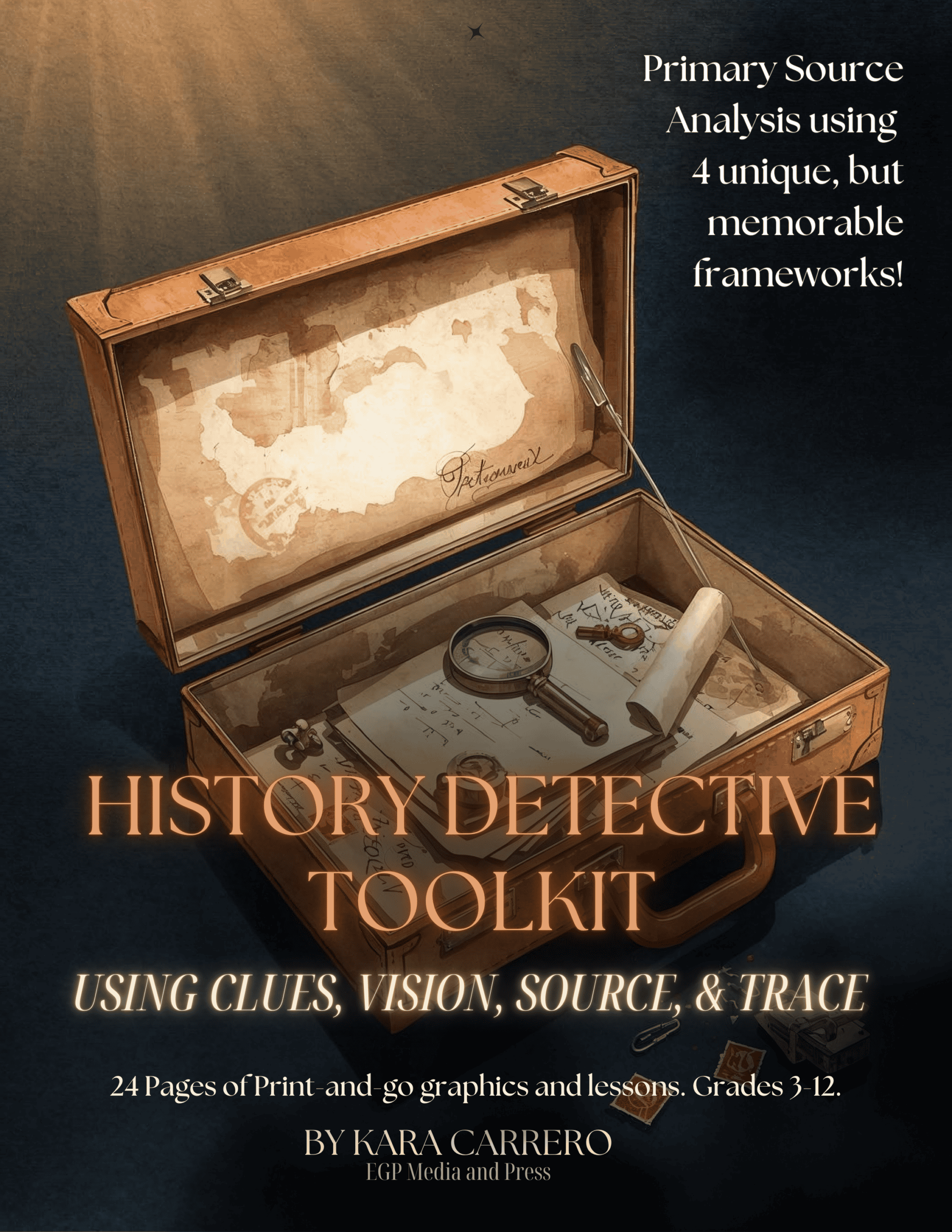
I’ve created a complete set of printable investigation guides designed to look like classified dossiers. Each framework comes on an 8.5×11 reference sheet students can keep in their binders all year. This is a 24-page free download.
What’s included:
✅ Soda Can Archaeology Lesson Plan
✅ C.L.U.E.S. Investigation Guide (artifact analysis)
✅ V.I.S.I.O.N. Decoder Sheet (visual source analysis)
✅ S.O.U.R.C.E. Analysis Checklist (written document investigation)
✅ T.R.A.C.E. Evidence Tracker (advanced corroboration)
✅ Bonus: “Case Closed” Summary Template for student reports
Each guide features:
- “Top Secret” aesthetic with checkboxes and case file styling
- Grade-level adaptable language
- Space for evidence documentation
- Teacher implementation tips on the back
🔍 Download the Complete History Detective’s Toolkit for Free
The Bottom Line: Real Historians Ask Questions. Great Historians Ask These Questions.
History isn’t a list of dates to memorize. It’s a collection of evidence waiting to be interrogated.
When we give students the right investigative tools—frameworks that match the source type, questions that unlock analysis, and permission to be skeptical—we transform them from passive consumers of narratives into active seekers of truth.
And in a world drowning in misinformation, that might be the most important skill we can teach.
Now it’s your turn: Try one of these frameworks this week and let me know how it goes in the comments. What “cold case” will your students crack first?
About the Toolkit
The History Detective’s Toolkit was developed by Kara Carrero, a former high school World History teacher and creator of project-based learning resources at EGP Media and Press. These frameworks have been classroom-tested with students from elementary through AP level.

Can’t wait to do this with my grandkids! Such great information here for them as they embark on their homeschool studies!
This is very cool! I have six children ages 6,8,11,13,14,15 and this looks amazing to use, really for everyone! Thank you for creating this thorough resource
This is so helpful, and I love that it teaches critical thinking. I’m saving this for our homeschool lessons.