
Context Over Condemnation: Teaching Against Presentism + PDF Download
Ask a student to describe a historical figure like Thomas Jefferson or Marcus Aurelius, and you’ll typically get one of two extremes:
- The Hagiography: They were a flawless hero who could do no wrong.
- The Villainization: They were a “bad person” because they held views or took actions that we find abhorrent today.
Both of these approaches are educational dead ends.
The first ignores the reality of human nature; the second ignores the reality of historical context. Neither builds critical thinkers.
As we move toward the 250th anniversary of the United States and as we navigate an increasingly polarized world, our students don’t need more “good vs. evil” stories. They need a scholarly framework to handle complexity. They need to understand the Two-Sided Coin of history and the academic discipline of Historical Contextualization.
The Intellectual Trap: Presentism
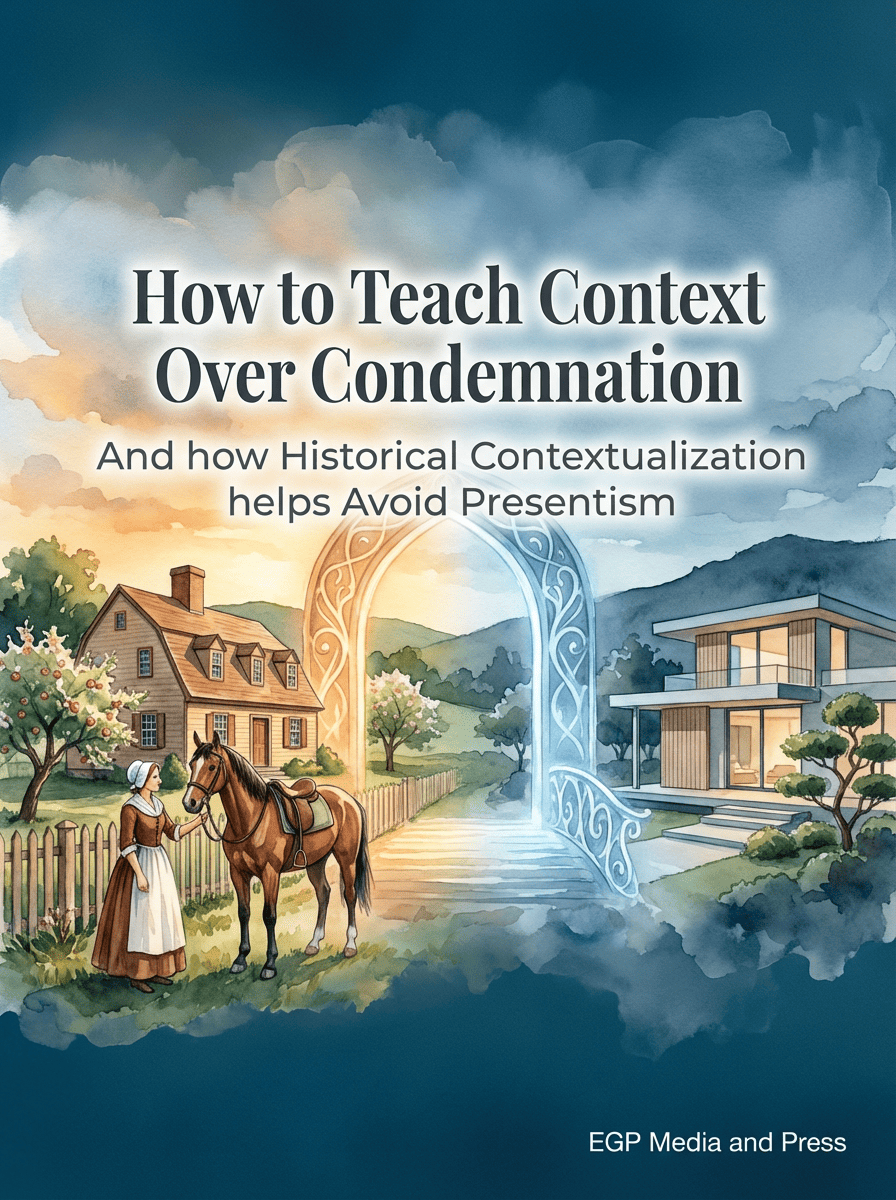
The greatest barrier to understanding history is Presentism—the tendency to interpret the past through the lens of modern-day values, technology, and social norms.
When we judge a 13th-century King for not being a 21st-century democrat, we aren’t practicing history; we are practicing chronological snobbery. To truly understand the past, we must switch our lens from Judgment to Investigation.
I’ve developed a 3-part framework to help students (and parents) navigate what I call the “Messy Middle” of history.
The Two-Sided Coin
Think of every historical figure as a coin. One side is the Shine—their contributions, their vision, and their genius. The other side is the Scratches—their failings, their contradictions, and their human flaws.
- The Shine: Thomas Jefferson’s “All men are created equal.”
- The Scratches: Thomas Jefferson’s status as a lifelong slaveholder.
The scholarly challenge is teaching students that both sides are the same coin. We don’t erase the Shine because of the Scratches, and we don’t ignore the Scratches because of the Shine. We teach the whole coin.
The Question for Students: “Does a person’s failure to live up to their own ideals make those ideals less true? Or does it show us how difficult it is to change a world?”
The Vise-Grip of Context
If Pillar 1 identifies the what, Pillar 2 explains the why. Historical figures didn’t live in a vacuum; they lived in a Vise-Grip of pressures that limited their choices.
To avoid the trap of Presentism, we must investigate the three “handles” of the vise:
- The Legal Handle: What was the law of the land? (e.g., Jefferson’s legal inability to manumit slaves due to inherited debt and Virginia law).
- The Economic Handle: Did their survival—or the survival of their society—depend on the system they were in?
- The Cultural Handle: What was the “moral baseline” of their neighbors?
When students analyze the “Vise-Grip,” they move from saying “He was a bad person” to “He was a person caught in a system that made the ‘right’ choice nearly impossible.”
The “Third Way” Reflection
This is where history becomes a lesson in character and ethics. Once we understand the pressures (the Vise-Grip) and the contradictions (the Coin), we ask the student to step into the time machine.
The Scholarly Prompt: “If you were standing in their shoes—with no modern internet, no modern laws, and everyone you knew telling you ‘this is normal’—could you have found a ‘Third Way’ out? What would it have cost you?”
This isn’t about excusing the past.
It’s about building empathy for the difficulty and complexity of being human. It prepares students to look at their own lives and ask: “What will people 200 years from now think is ‘wrong’ about how I live today?”
Moving From Statues to Sources
We see this framework most clearly when we look at the primary sources. For example, in our Drafting the Declaration unit, students don’t just read the final version. They read the deleted clause where Jefferson attacked the slave trade.
They see the “Shine” of his intent and the “Scratches” of the political compromise that led to its removal. They see the Vise-Grip of a Continental Congress that feared losing the Southern colonies if they kept the clause in.
This is where real history happens. Not in a list of names and dates, but in the tension between who we want to be and the world we actually live in.
Ready to become a History Detective?
If you want to move your homeschool or classroom past surface-level history, I’ve created a robust tool to help you start.

Download the “Time Machine Rule” Mini-Lesson & Worksheet. Inside, you’ll find:
- The Master Data Table: A scholarly look at figures from Antiquity to the 20th Century (Aristotle, Charlemagne, Jefferson, and more).
- The “Vise-Grip” Audit: A student manual page to help kids analyze the pressures of any era.
- The “Two-Sided Coin” Graphic Organizer: A visual tool to help students map out the complexity of historical figures.




Such a great way to look at history!!