How one revolutionary art movement can unleash creativity and teach art history from preschool through high school
Imagine a moment where an 8-year-old grabs a bright purple marker to confidently color a tree trunk. “Trees aren’t purple!” Might be what’s screaming in your head. They are if we want them to be wild; they are if we let color be the most important part of the art and not the subject!
This is the same sentiment that shook the art world in 1905 when Henri Matisse and his fellow “Fauves” declared that color didn’t need to represent reality—it could express pure emotion.
This is the allure of teaching Fauvism in a multi-age homeschool. Whether your child is 3 or 17, the core principle is deliciously rebellious: use whatever colors make you feel something, regardless of what “should” be realistic. But the depth of exploration? That’s where we can create profound learning experiences that span art history, color theory, emotional expression, and creative confidence.
What Exactly is Fauvism?
Before we dive into our family’s colorful adventures, let me give you the foundation. Fauvism was a revolutionary art movement that erupted in Paris around 1905-1910. The name literally means “wild beasts” (les fauves in French), coined by an art critic who was shocked by the bold, non-naturalistic colors these artists used.
It was short-lived, yet profound.
Led by artists like Henri Matisse, André Derain, and Maurice de Vlaminck, the Fauves broke free from Impressionist subtlety and Post-Impressionist structure. They said, “What if grass could be red? What if faces could be green? What if color could show how we feel about something rather than just how it looks?”
The key principles of Fauvism:
Bold, pure colors straight from the tube (no subtle mixing)
Color for emotional expression, not realism
Simplified forms and loose brushwork
Strong, confident mark-making
Joy and spontaneity over careful planning
This movement lasted only about five years, but it changed art forever by proving that color could be completely divorced from reality and still create powerful, meaningful artwork.
Why Fauvism Works Brilliantly for Multi-Age Learning
I’ve taught my children about many art movements, but Fauvism has a unique advantage: it gives children permission to break rules they didn’t even know existed. A toddler’s instinct to make the sky purple? That’s not “wrong”—that’s Fauvism! A teenager frustrated with realistic representation? Fauvism says “express your feelings through color instead!”
The movement naturally scaffolds across ages:
Ages 2-6: Focus on color freedom and emotional expression
Ages 7-12: Add historical context and deliberate color choices
Ages 13-18: Explore the psychological impact of color and art’s role in breaking social conventions while also applying color theory they started learning during Pointillism.
Fauvism for Ages 2-6: Color Liberation Station
For our youngest learners, Fauvism is about one thing: permission to use any color anywhere. This age group naturally gravitates toward bright, pure colors anyway—we just need to celebrate it instead of correcting it.
What works:
Large-format coloring pages with familiar subjects (houses, trees, animals)
Crayons, markers, or paint in pure, bright colors
“Wild Color Wednesday” where traditional color rules don’t apply
Simple instruction: “Color this however makes you happy!”
The lesson: Colors can show feelings, not just reality.
Project Ideas:
Wild Animal Self-Portraits: Have them draw themselves as their favorite animal using whatever colors express their personality
Emotion Trees: Draw a tree for each emotion—happy tree might be pink and yellow, angry tree might be red and black. This makes for great Social-Emotional Learning!
My Wild House: Color a house outline using colors that show how home feels to them
Fauvist Art Movement Application for Ages 4-8: Introducing the “Wild Beasts”
This is where we add context while maintaining creative freedom. I introduce them to Henri Matisse (he’s perfect for this age—approachable and often painted familiar subjects like goldfish and dancers).
Materials we use:
Tempera paint in primary colors plus white
Large brushes for bold strokes
Heavy paper or canvas boards
Pictures of Matisse’s “Woman with a Hat” and “The Green Line”
The breakthrough moment: When they see Matisse’s green-faced portrait and realize that a famous artist also colored faces “wrong”—and people put it in museums!
Project Ideas:
Fauve Family Portraits: Paint family members using unexpected colors for skin, hair, clothes
My Wild Bedroom: Draw their room but color everything the way it feels rather than looks
Animal Kingdom Reimagined: Paint pets or favorite animals in completely non-realistic colors
Historical connection: Tell them about the 1905 Paris art show where people were so shocked by these “wild” colors that they gave the artists a mean nickname—but the artists liked it so much they kept it!
Learning to embrace Fauvism for Ages 6-12: Color Theory Meets Emotional Expression
Now we can dive deeper into why the Fauves made their color choices and introduce more sophisticated concepts while maintaining the joy and freedom.
Advanced concepts to introduce:
Complementary colors and their emotional impact
Warm vs. cool color families and their psychological effects
How different cultures associate different meanings with colors
The difference between local color (what we see) and arbitrary color (what we feel)
Project Ideas:
Emotion Color Wheels: Create color wheels showing which colors represent different feelings
Before/After Landscapes: Paint the same scene twice—once realistic, once Fauve
Music Paintings: Listen to different types of music and paint what the colors sound like
My Day in Colors: Create a visual diary showing morning, afternoon, and evening in colors that match their moods
The science connection: This is perfect for discussing how color affects our brains and emotions—turning art into psychology and neuroscience lessons.
Learning to be Fauvist for Ages 8-16: Historical Context and Artistic Rebellion
Older children can understand Fauvism’s place in art history and its role as artistic rebellion. This connects beautifully to discussions about social change, cultural movements, and individual expression.
Historical concepts to explore:
Why 1905 Paris was ready for artistic revolution
How Fauvism influenced later movements like German Expressionism
The role of art in challenging social conventions
How new paint tube technology enabled plein air painting and pure color experimentation
Project Ideas:
Revolutionary Art Statements: Create artwork that challenges a “rule” (not just color rules—maybe perspective, proportion, or subject matter)
Fauve Photography: Take photographs and digitally manipulate them to use non-realistic colors
Contemporary Fauvism: Apply Fauve principles to modern subjects (cityscapes, technology, social media)
Art Critic Responses: Research actual 1905 reviews of Fauve exhibitions and create modern equivalents
Literature connections: Read about the artists’ lives, letters, and manifestos. Discuss how artistic expression connects to personal freedom and social change.
Practicing Fauvism Ages 10-18: Advanced Techniques and Art Analysis
The oldest students can create sophisticated Fauve-inspired works while analyzing the movement’s lasting impact on modern and contemporary art.
Advanced techniques:
Color mixing to create pure, saturated hues
Brushwork techniques for emotional expression
Composition principles in non-realistic work
Understanding how Fauvism influenced later movements
Project Ideas:
Master Study Remixes: Take classical artworks and recreate them with Fauve color principles
Personal Mythology: Create a series depicting personal stories or family history using Fauve techniques
Social Commentary: Use bold color and simplified forms to comment on contemporary issues
Exhibition Curation: Research and “curate” a virtual Fauve exhibition with artist statements
A defining moment for my nearly 13 year old was when we asked AI to take her picture and improve on it to make it more fauvist like Matisse and Derain… and it made no changes. It showed her that despite her disinterest in the style (art is subjective, so that’s fine!) that she completely understood it and applied the concepts. (More on using AI to help with art projects here: Teaching Analytical Thinking by Applying Impressionist Art and AI Tools)
You can see in the above screenshots that we did find a way to help her refine the analysis. She took from the second conversation the idea to add some yellow highlights.
The Reality: What Actually Works (and What Doesn’t)
Let me be honest about what I’ve learned through colorful trial and error:
What works:
Starting with permission to “break rules” rather than technical instruction
Showing examples of famous Fauve works before starting projects
Having abundant materials so kids don’t feel they need to conserve
Emphasizing process and emotional expression over technical skill
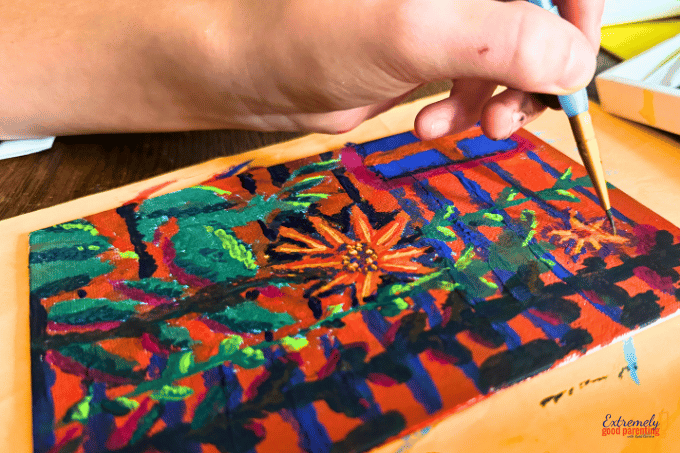
Taking photos of works in progress—the bold colors photograph beautifully!
Connecting to their current interests (Fauve Pokemon, anyone?)
What doesn’t work:
Expecting subtle color relationships from young children
Starting with too many historical facts before hands-on creation
Limiting color choices (the whole point is abundance!)
Comparing their work to realistic representations
Rushing the exploration phase
Cross-Curricular Connections: Making it a Full Unit Study
Psychology: How colors affect emotions and behavior, color therapy, cultural color associations History: Early 20th-century social changes, World War I’s impact on art, colonial influences in French culture Science: Color theory, light wavelengths, how the eye perceives color, paint chemistry Geography: Paris neighborhoods, French Riviera landscapes, colonial territories that influenced Fauve artists Literature: Reading period poetry, artist biographies, art criticism from the era Music: Listening to early 20th-century music while painting, discussing how different arts influence each other
Age-Appropriate Expectations
Ages 2-5: Focus on color joy and creative freedom. Success = happy engagement with bright colors Ages 6-9: Introduce basic concepts about feelings and colors. Success = thoughtful color choices with simple reasoning Ages 10-13: Explore historical context and color theory. Success = understanding why Fauves made specific choices Ages 14+: Analyze cultural impact and create sophisticated original works. Success = connecting artistic rebellion to broader social movements
Building Confidence Through Color
One unexpected benefit of our Fauvism adventures has been the boost to creative confidence. Children who previously worried about “getting colors right” suddenly discovered that there IS no right, only expressive choices. This translates beyond art into creative problem-solving in other subjects.
My 10-year-old, who used to ask for approval before making any color choice, now confidently explains her decisions: “I made the mountains purple because that’s how mysterious feels to me.” That’s sophisticated artistic thinking!
Resources for Extending the Learning
Through our family’s colorful experiments, I’ve developed two resources that support families wanting to dive deeper into Fauvism and modern art education:
A quick Fauvist Art Mini Unit Study
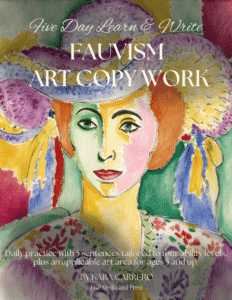
My Fauvism-specific copywork and art gallery project provides age-differentiated handwriting practice featuring key facts about the movement, artist biographies, and guided art appreciation activities. It’s perfect for adding educational structure to your wild color experiments while building fine motor skills and art vocabulary.
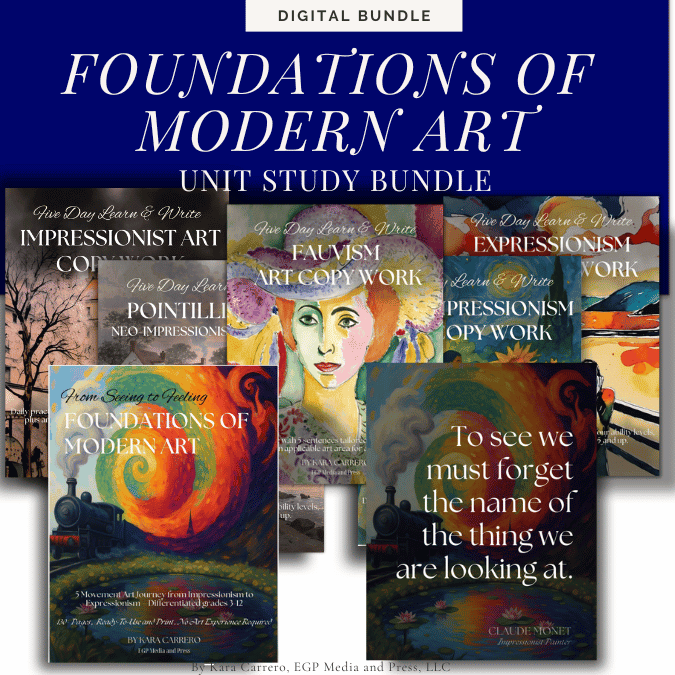
The Foundations of Modern Art complete bundle places Fauvism in context as part of the broader revolution in early 20th-century art. This curriculum shows how Fauvism connects to Impressionism, influences Expressionism, and contributes to the complete transformation of how we think about art. With over 130 pages of materials for grades 3-12, it turns individual art projects into a comprehensive understanding of how modern art developed.
Both resources grew directly from my realization that hands-on art creation becomes exponentially more meaningful when children understand the historical context and can see how individual movements connect to create the rich tapestry of art history.
Making Memories Through Wild Colors
As I write this, I can see evidence of our Fauvism adventures throughout our home including a purple tree on the refrigerator, my 12-year-old’s Fauve landscape hanging in the hallway, and paint-splattered smocks hanging on hooks that tell the story of many colorful afternoons.
But more than the artwork, I see the lasting impact in how my children approach creative challenges. They’ve learned that there’s power in breaking conventions, that personal expression matters more than external approval, and that sometimes the most beautiful solutions are the ones that initially seem “wrong.”
Fauvism taught them that art, and by extension, all creative thinking, doesn’t have to follow predetermined rules. Whether they’re solving math problems, writing stories, or navigating social situations, they’ve internalized the Fauve principle: sometimes the most authentic response is the one that comes from your own inner vision rather than external expectations.
And when they’re adults looking back on their childhood, I hope they remember not just the purple trees and orange faces, but the feeling of being encouraged to trust their own creative instincts and express their authentic selves through bold, joyful color.
That’s the real legacy of those “wild beasts” is not just revolutionary art, but revolutionary permission to be courageously, authentically creative.
My daughter can easily add and subtract; however she only consistently can identify numbers 1, 3, and 8. She’s ready to learn more in depth concepts and topics; however, her learning style and needs dictate what we can do. So instead of spend a lot of money on a pre-constructed kindergarten curriculum kit, I did my…
Teaching fine arts to young kids is a fun way to get them interested in a variety of activities and expand their interests. In fact, that is one of the main reasons that we personally love learning by theme because it exposes my toddler to the vast world that we live in and expands her appreciation…
Homemade musical instruments are a way to get kids involved in the process of open-ended play. Whether they are involved in the steps it takes to make the musical instrument or not, the creativity in making ordinary objects part of music helps them see the world a little differently. In fact, knobby puzzle pieces have…
While many of us have seen different busy board options, have you thought about all of the great everyday learning tools just laying around your house that can be used on or off a busy board. Recently I scoured our house for random items such as buckles, clips, zippers, and more that are common in…
“… and the BIG Jenn bear stomps into the room. CRASH. BANG! BOOOOOMMMM!” I hear my husband say from the next room as my oldest giggles with sheer glee as she winds down for bed. They’re making up stories again and her little creative juices are flowing. I can only imagine what kinds of dreams…
Teaching the alphabet is part of every parent-child relationship. Whether we just feel inclined to sing the ABCs constantly, or make it more fun, it is something that we all do regardless of whether we even intend on implementing more of a tot school routine. For us, when we took time to focus on the…
Your saved items live in this browser and clear eventually. Add your email to save them permanently to an account (and get notified if they go on sale).