Control + Alt + Parenting: Rebooting the Tech Conversation for the AI Generation
Remember when our biggest tech worry was screen time? Or maybe teaching our kids not to believe everything they read online?
Those conversations were important, but friends, we’re in a completely different world now. Technology isn’t just changing fast. It’s evolving at warp speed. And if we keep parenting tech the same way we did five years ago, we’re going to find ourselves completely outpaced.
Our kids won’t just be unprepared. They’ll be vulnerable.
It’s time for a control+alt+parenting moment. Time to reboot the entire tech conversation.
Related: Is Screen Time Bad for Kids? What Research Says About Technology as a Parenting Tool
According to Common Sense Media, 56% of students were already using AI tools over a year ago. That number has undoubtedly skyrocketed since then. But here’s what stopped me in my tracks: only 18% of parents even knew their kids were using it.
We’re not just behind the curve. We’re not even aware there IS a curve.
Understanding What We’re Actually Dealing With: Large Language Models 101
Before we dive into parenting strategies, let’s get clear on what most AI platforms like ChatGPT, Gemini, and Claude actually are. Understanding this will completely change how we approach teaching our kids about them.
These tools are called Large Language Models (LLMs).
Think of them as incredibly sophisticated pattern-matching systems that have been trained on massive amounts of text from books, websites, and other written materials. They’re not actually “thinking” or “intelligent” in the way humans are. Instead, they’re processing patterns and predicting what words should come next based on the patterns they’ve learned.
It’s like having a friend who’s read every book in the library and has an incredible memory for patterns, but doesn’t actually understand what they’re saying. They can give you information that sounds authoritative and well-informed, but they might also confidently tell you something completely wrong because they’re following a pattern they learned, not because they actually know the facts.
This is why LLMs can write a convincing essay about a historical event that never happened, or solve a math problem incorrectly while explaining their reasoning perfectly. They’re not lying. They’re just very, very good at predicting what should come next in a sequence of words.
This understanding changes everything about how we should teach our kids to interact with these tools.
The Power of Learning Prompt Crafting (And Why It Matters)
Here’s where things get interesting. Once we understand that AI responds to patterns, we can see why learning to communicate effectively with these systems is actually a valuable skill.
Experts like Jeff Su have shown that learning proper prompt formats (using rich, specific language and clear instructions) can dramatically improve the quality of AI responses.
This isn’t just about getting better outputs; it’s about developing precision in communication and critical thinking.
When we teach our kids to craft thoughtful prompts, we’re actually teaching them to:
- Think clearly about what they actually want to know
- Communicate their needs precisely
- Understand the importance of context and specificity
- Recognize that the quality of their question affects the quality of the answer
But here’s the crucial part: we need to teach them to “think first.”
Think First, Communicate Clearly, Then Verify: A Three-Step Process
There’s a world of difference between approaching AI with your own ideas and asking it to expand on them versus going to AI with a blank slate and asking it to do all the thinking for you.
Consider these three approaches:
Approach 1 – Blank Slate: “Write me an essay about the Civil War.”
Approach 2 – Think First: “I’ve been thinking about how the Civil War affected families on both sides, and I’m particularly interested in how children experienced the war. I have some ideas about the economic impacts on families and the emotional toll, but I’d like help expanding these thoughts and finding additional perspectives I might not have considered.”
Approach 3 – Strategic Prompting: “Act as a Civil War historian, expert, or re-enactor. Give a detailed explanation of how children experienced the Civil War, including the impacts on families and the emotional toll as well as additional uncommon perspectives that shaped child experience in 1860s America. Provide this as an overview as well as a bullet list of key points to continue to research, giving your references or bibliography information to cross-reference, dig deeper into, and verify. Keep the tone scholarly and compile only credible primary source resources.”
The second approach requires the student to have done some thinking, formed some opinions, and identified specific areas where they want help. The AI becomes a thinking partner rather than a thinking replacement.
The third approach demonstrates sophisticated prompt crafting combined with a solid foundation of knowledge and a clear intention to continue doing independent research. The student understands the topic well enough to ask for specific types of sources, maintains control over the research process, and builds verification into the request itself.
But regardless of which approach you use, the final step is always the same: verify the information against credible sources. Remember, AI is pattern-matching, not fact-checking. Even the most sophisticated prompts can result in confident-sounding information that’s partially or completely incorrect.

Learning Alongside Your Children (Sheltering Isn’t the Answer)
One of the biggest mistakes we can make is trying to shelter our kids from AI until we figure it all out ourselves. Technology moves too fast, and our kids are already encountering these tools whether we’re aware of it or not.
Instead, we need to learn alongside them.
Related: Are we warning our kids of the dangerous down sides of new tech?
Here’s a practical exercise you can do with your children of any age: Sit down together and try the same question using both approaches I mentioned above.
First, give the AI a basic prompt: “Tell us about sharks.” See what it comes up with.
Then, open a completely new conversation and try again, but this time, spend a few minutes first talking about what you already know about sharks, what you’re curious about, and what specific questions you have. Then prompt the AI with those specific, thoughtful questions.
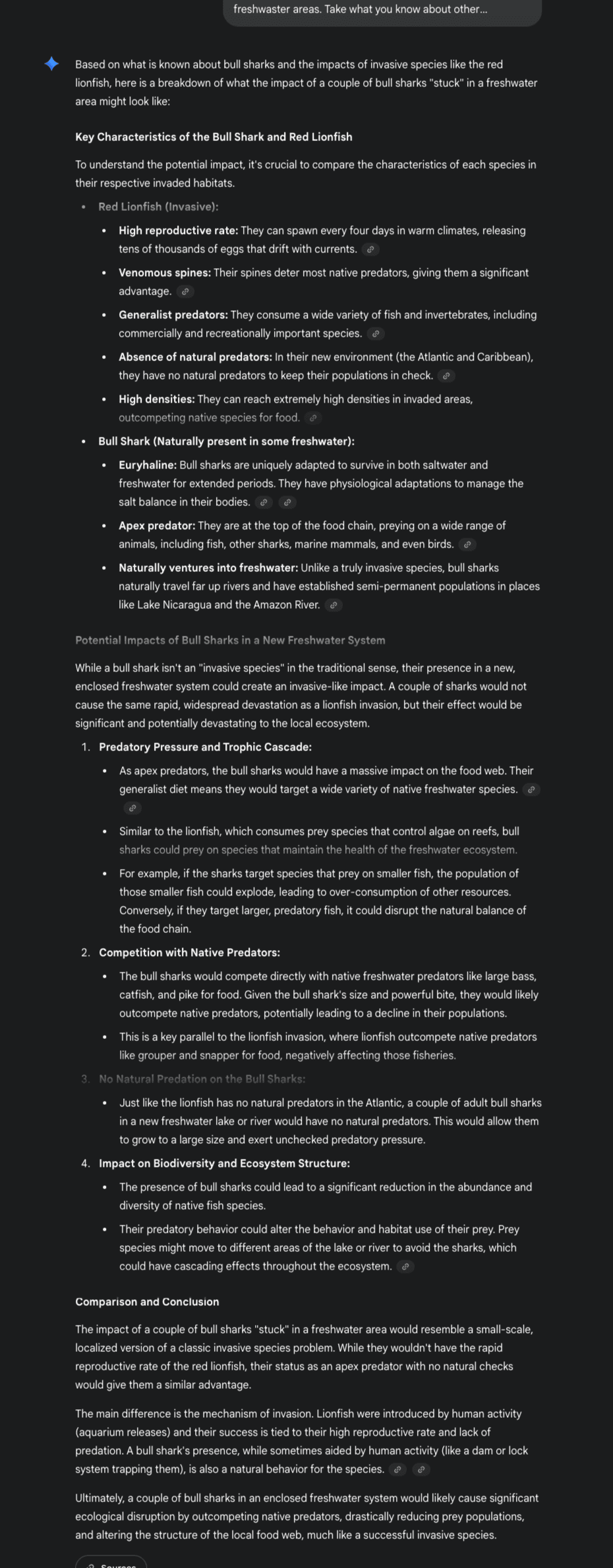
Here’s where it gets interesting: because AI functions like a well-read librarian with access to vast amounts of information, it’s particularly good at making connections and comparisons. Try asking it to help you think through a hypothetical scenario.
For example, you might say: “I know bull sharks aren’t invasive species, but they can survive in freshwater, which could make them act like invasive species in certain situations. Take what you know about actual invasive species like red lion fish and help me understand what the impact might look like if a couple of bull sharks got stuck in a freshwater system.”
This kind of thinking exercise helps kids understand how to use AI’s pattern-matching abilities productively while developing their own analytical skills.
Compare the results. Talk about:
- Which response was more interesting? More useful?
- What did you learn from thinking through your questions first?
- How did the quality of your questions affect the quality of the answers?
- What would you still want to research or verify?
This kind of side-by-side comparison helps kids understand the tool’s capabilities and limitations while developing their own critical thinking skills.
Deepfakes, Voice Replication, and Digital Literacy
We also need to prepare our kids for a world where AI can create incredibly realistic fake videos and replicate voices with stunning accuracy. This isn’t science fiction. It’s happening now.
When videos online look like real people saying or doing things they never actually said or did, what are the implications? When someone’s voice can be replicated to make it sound like they said something they didn’t, how does that affect:
- Personal safety (What if someone uses your voice to authorize transactions or fool family members?)
- Evidence in legal situations (How do we prove what’s real in court?)
- Political discourse (How do we trust what we see and hear from public figures?)
- Relationships (How do we maintain trust when technology can so perfectly impersonate someone?)
These aren’t distant concerns. They’re current realities our kids need to navigate.
We need to teach our children to:
- Question what they see and hear online, even when it looks completely authentic
- Understand that seeing or hearing something isn’t the same as it being true
- Develop habits of verification and cross-referencing
- Think critically about the source and context of digital content
Proofreading, Critical Thinking, and “Showing Your Work”
Remember when teachers insisted we show our work in math, even when we could get the right answer with a calculator? We probably all heard adults say, “You won’t always have a calculator in your pocket,” which turned out to be hilariously wrong.
But the principle behind “showing your work” was never really about the calculator. It was about understanding the process, being able to identify errors, and developing logical thinking skills.
The same principle applies to AI. Our kids will have these powerful tools available to them throughout their lives. The question isn’t whether they’ll use them, but whether they’ll use them wisely.
We need to teach our children to:
Proofread and verify AI outputs. Just because it sounds confident doesn’t mean it’s correct. LLMs can confidently state things that are completely false.
Cross-reference information. Use AI as one source among many, not as the final authority on any topic.
Maintain their own critical thinking skills. Can they evaluate whether an AI’s reasoning makes sense? Can they identify gaps in logic or missing information?
Understand the process, not just the output. If AI writes an essay outline for them, do they understand why those points were chosen? Could they create a different, equally valid outline?
Develop original ideas. Can they generate their own creative solutions, or have they become dependent on AI for all ideation?
Time for Control+Alt+Parenting: A Complete Reboot
You know how I’ve always advocated for raising kids who are technologically literate but not dependent? Well, AI is the ultimate test of that principle. Because AI can do so much for our kids: write their essays, solve their math problems, even create their art projects.
The question isn’t whether they’ll use it (they already are).
The question is whether they’ll use it wisely.
Raising Thinkers, Not Just Users
We’re not just raising digital natives anymore. We’re raising the first generation of AI natives. Kids who will grow up assuming artificial intelligence can solve any problem for them.
But what happens when the AI gets it wrong? What happens when they need to think critically about the answer they’ve been given? What happens when they need to create something original, not just prompt something artificial?
This is where those 11 discussion questions I shared about technology dangers become absolutely crucial, but we need to apply them specifically to AI.
Questions like:
- “What would I do without it and how would my life be different?”
- “What could I learn to do if this tech wasn’t available?”
- “How will this benefit or hinder me in the long term?”
- “Would I want everyone to know this if it got out?” (especially relevant for AI that learns from our interactions)
- “Does this technology change who I am and am I ok with that?”
These aren’t just academic exercises anymore. These are essential life skills for the AI generation.
The Conversation Your Family Needs (Even With Young Kids)
Here’s what I’ve learned from having this conversation with my children across different ages and stages:
This isn’t just a conversation for older kids.
Even young children are encountering AI in ways we might not immediately recognize: from voice assistants to educational apps that adapt to their learning.
AI is already part of their world, whether we’ve acknowledged it or not.
The families who will thrive in this new reality aren’t the ones who ban AI or ignore it. They’re the ones who teach their kids to:
- Recognize when AI is helpful vs. when it’s harmful
- Understand what they’re giving up when they let AI do the work
- Develop the critical thinking skills to evaluate AI-generated content
- Maintain their own creativity, problem-solving abilities, and learning skills
- Think first, then prompt
- Always verify and cross-reference
- Understand the difference between powerful processing and actual intelligence
Learning From Our Calculator Moment
The adults who told us “you won’t always have a calculator in your pocket” were wrong about the technology, but they were right about something important: we needed to understand the underlying concepts, not just rely on the tools.
We don’t want to make the same mistake with AI that we made with calculators. We don’t want to dismiss the technology or pretend it won’t be part of our kids’ lives. But we also don’t want to let it replace the fundamental thinking skills our children need to develop.
The goal isn’t to keep AI out of our children’s hands. It’s to put wisdom into their minds and hearts before they encounter these powerful tools.
Your Next Step
I’m not asking you to become an AI expert overnight. (Trust me, I’m learning right alongside you!) …But I am asking you to start the conversation.
Tonight, at dinner, ask your kids: “What do you know about artificial intelligence?” You might be surprised by their answers.
Then, grab those 11 discussion questions about technology that have helped thousands of families navigate tech decisions thoughtfully. Start applying them to the AI tools your kids are already encountering.
Try that side-by-side exercise I mentioned—prompt AI with a basic question, then do it again after thinking through what you actually want to know.
Because here’s the truth: the families who are having these conversations now (before AI becomes even more embedded in our daily lives) are the ones who’ll raise kids equipped to thrive in whatever comes next.
The future belongs to the thinkers, not just the users. Let’s make sure our kids are ready.
What questions do you have about navigating AI with your children? What concerns you most about this technology? Share in the comments—I’d love to continue this conversation with you.