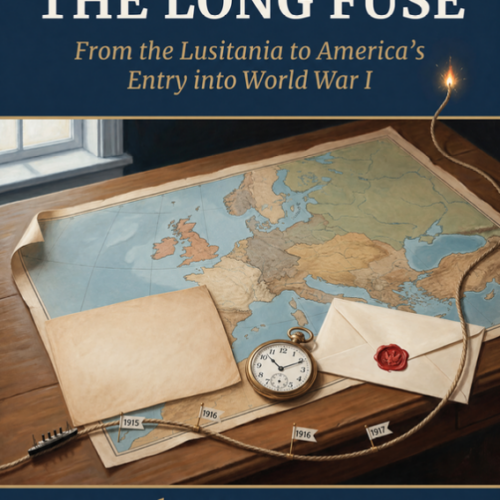
Twelve real historical documents, from a German embassy warning to a decoded telegram, trace the path from the sinking of the Lusitania to America’s declaration of war, in the actual words of the people who lived it. Students source each document, weigh what it says against what it leaves out, and build toward a full synthesis essay arguing whether the sinking was a cause, a catalyst, or both. Part of a larger World War I curriculum line, and built to work completely as a standalone unit on its own. Built for grades 9-12, with a documented way to flex down for strong grade 6-8 students.
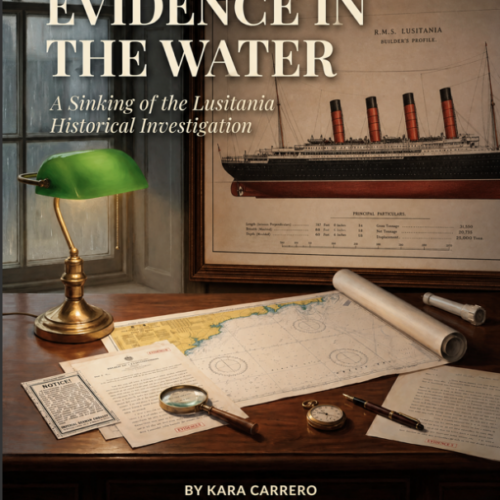
Step into a real 1915 inquiry as a junior investigator building the file the official report couldn’t. Five sealed evidence envelopes guide students through decoding a real wireless transmission, reconstructing a damaged cargo record, and auditing an official document for what it quietly leaves out. No locks required, just careful reading and cross-referencing. Includes a full facilitator guide, answer key, self-check card for solo play, and three differentiation tiers for grades 3 to 12, but geared mostly towards middle and high school. While it is an escape room, it’s built like a real inquiry, and not simply not a treasure hunt: every stage ends in a written hypothesis, judgment call, or argument.
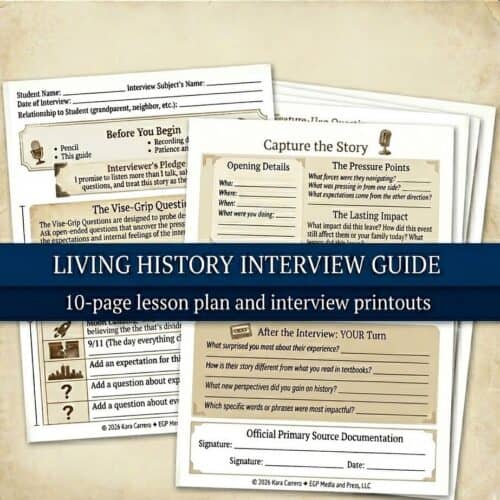
Send your student into a real conversation with history. This 10-page printable guide teaches students to ask specific questions, listen for the story beneath the story, and treat a family member’s memory as the primary source it actually is. Grab the free companion lesson plan for full differentiated assignments in grades K–12.
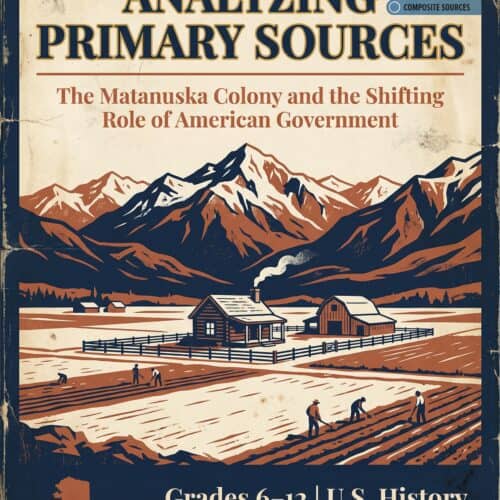
A 26-page primary source analysis unit exploring how the 1935 Matanuska Colony reflects the shifting role of American government, from Homestead-era individualism to New Deal federal intervention. Includes real, composite, and illustrative sources, each clearly labeled with full transparency notes and verified archive links. Built for grades 6–12.
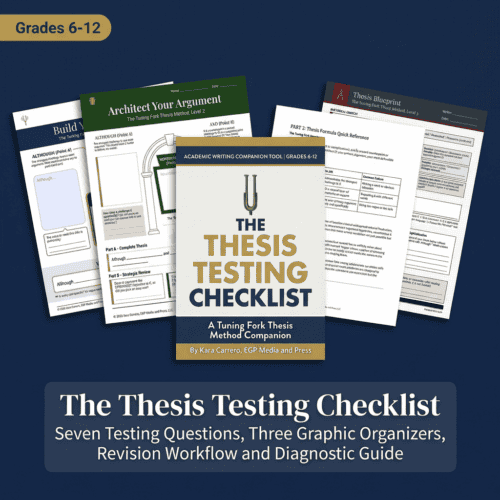
A 12-page companion tool for the Tuning Fork Thesis Method. Includes seven thesis testing questions with revision direction for each, the “Although A and B, nevertheless C” formula broken down with cross-subject examples, an announcement language guide, a step-by-step revision workflow, a quick diagnostic table, and three level-specific graphic organizers for Levels 1, 2, and 3. Works as a planning tool before drafting, a revision diagnostic, or a conferencing reference.
A 183-page, three-level essay writing curriculum built around one central idea: a strong thesis doesn’t just state a position, it creates tension, holds two competing ideas in balance, and resolves them with a clear argument within a 5 paragraph essay (and any academic paper). Students at every level learn to write with precision, authority, and purpose.
Teach sophisticated historical thinking through food historiography! This 106-page toolkit shows students grades K-12 how to analyze historical recipes as primary sources revealing economic pressure, daily realities, and the context behind historical decisions.
Includes complete theoretical framework, two ready-to-teach lesson plans (Colonial & Great Depression), grade-level adaptations K-12, student worksheets, assessment rubrics, and flexible implementation for classrooms, homeschools, and co-ops. Uses the Four Lenses framework (Economic, Technological, Social/Cultural, Policy) to develop critical thinking, primary source analysis, and evidence-based argumentation.
Your saved items live in this browser and clear eventually. Add your email to save them permanently to an account (and get notified if they go on sale).