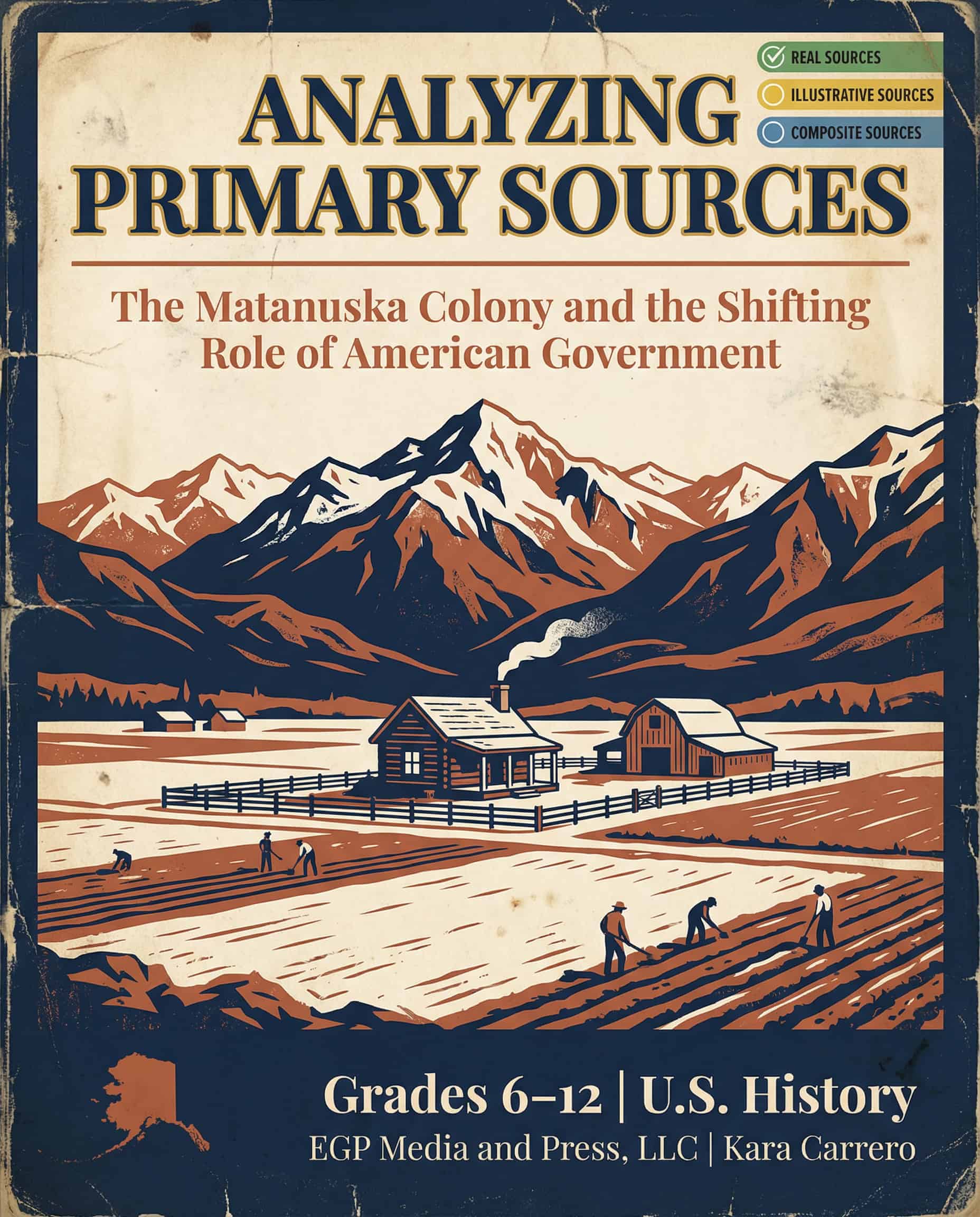
Analyzing Primary Sources: Alaska’s Matanuska Colony & U.S. Government
$5.00
A 26-page primary source analysis unit exploring how the 1935 Matanuska Colony reflects the shifting role of American government, from Homestead-era individualism to New Deal federal intervention. Includes real, composite, and illustrative sources, each clearly labeled with full transparency notes and verified archive links. Built for grades 6–12.
Description
What does it look like when the government stops stepping aside and starts stepping in?
This primary source analysis unit uses Alaska’s Matanuska Colony, one of Franklin Roosevelt’s most ambitious and controversial New Deal experiments, as the lens for examining one of the most significant shifts in U.S. history: the transformation of the federal government’s relationship with its citizens.
Students move through three source sets spanning 1862 to 1959, analyzing how the language of American settlement changed from rugged individualism to federal rehabilitation, and what that change reveals about power, identity, and who gets left out of the historical record entirely.
✦ About the Packet
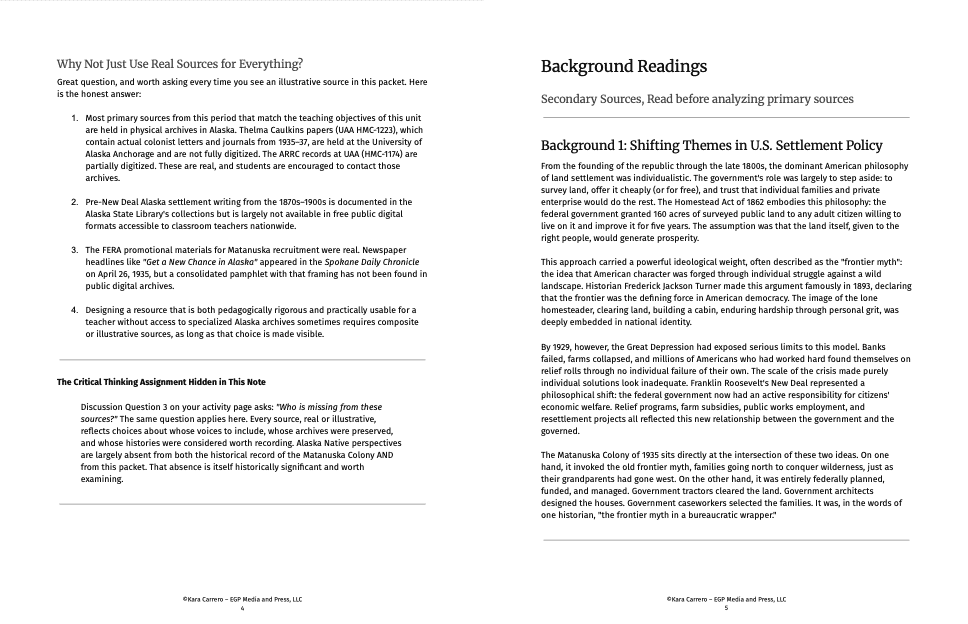
This packet uses a three-tier source framework that teaches document analysis on two levels at once: students analyze the historical sources AND evaluate the sources in the packet itself.
Every source is clearly labeled:
 Real Sources: Fully verified, publicly archived documents with direct links to the National Archives, Chronicling America, the Eisenhower Presidential Library, and Alaska’s Digital Archives.
 Illustrative Sources: Carefully constructed teaching documents modeled on verified historical evidence, used where the ideal primary source exists in a physical archive but is not publicly digitized. Each includes a full transparency note explaining what real evidence it draws from and where comparable authentic materials can be found.
 Composite Sources: Real historical language presented in a new format, with original citations included.
✦ What Is Included (26 pages)
Transparency Note (2 pages) Explains all three source types and the pedagogical reasoning behind each. Functions as a critical thinking exercise on its own.
Background Readings (2 pages)
-
Shifting Themes in U.S. Settlement Policy
-
A Brief History of the Matanuska Colony
Source Set A: Pre-New Deal Alaska Settlement
-
Source A-1: Illustrative 1877 prospector letter from Sitka
-
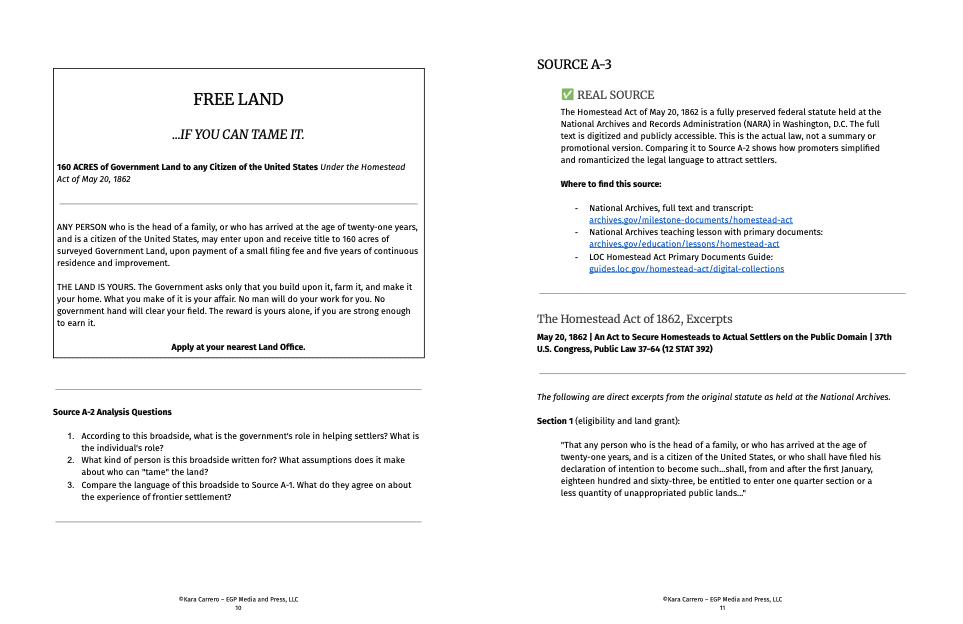
Source A-2: Composite Homestead Act promotional broadside
-
Source A-3: Real excerpts from the Homestead Act of 1862 (National Archives)
Source Set B: The Matanuska Colony, 1935–1938
-
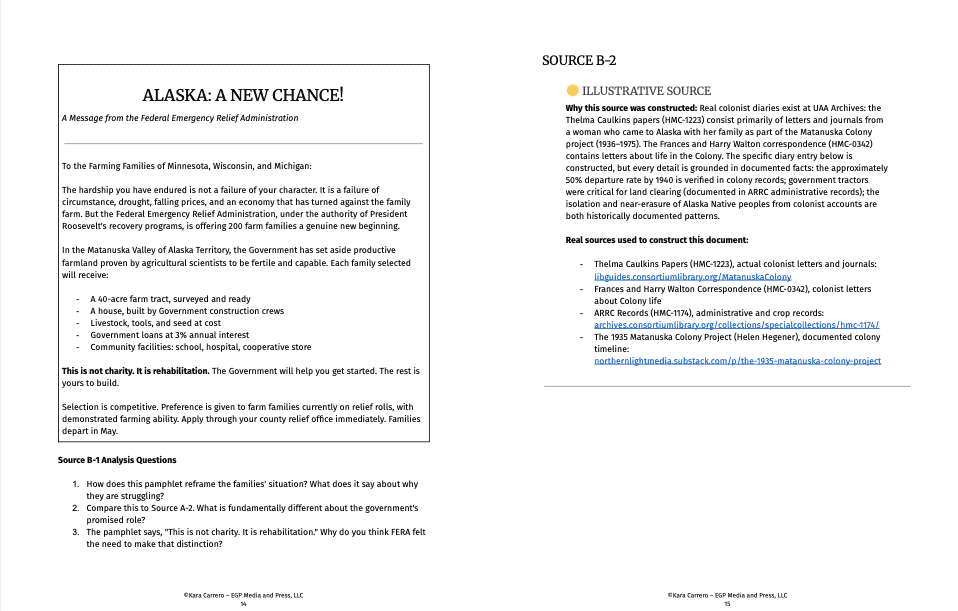
Source B-1: Composite FERA recruitment pamphlet built from verified contract language
-
Source B-2: Illustrative colonist diary entry grounded in documented colony records
-
Source B-3: Real photographic source from the Palmer Museum and Alaska’s Digital Archives
Source Set C: Legacy and Criticism, 1940–1959
-
Source C-1: Illustrative 1940 editorial representing documented critical press coverage
-
Source C-2: Real documents from the Alaska statehood debate, including a verified letter from President Eisenhower to Senator Henry Jackson
Student Activities
-
3 analysis questions per source
-
Comparative T-chart with source evidence log
-
3 discussion questions, including a structured prompt on Alaska Native erasure from the historical record
-
CER writing scaffold (Claim, Evidence, Reasoning)
-
3 creative synthesis options: 1935 FERA recruitment poster, protest poster from a Dena’ina Athabascan perspective, or a 1960 newspaper editorial
Archive Directory Live links to every real archive referenced, organized by topic.
✦ Key Themes
-
Individualism vs. collective action
-
Laissez-faire policy vs. federal intervention
-
The frontier myth and its limits
-
New Deal ideology and resettlement programs
-
Cold War strategic priorities
-
Source credibility and document analysis
-
Historical erasure and missing voices
✦ Best Used For
-
U.S. History survey courses, grades 6–12
-
AP U.S. History document analysis practice
-
Government and civics courses examining the changing role of federal power
-
Any New Deal unit as a supplemental primary source set
-
Paired with Sweet Home Alaska by Carole Estby Dagg for a literature and history crossover unit
✦ A Note on the Matanuska Colony
The colony is a genuinely under-taught moment in American history, specific enough to be fresh for students but rich enough to carry major thematic weight. It connects the frontier myth, the New Deal, World War II strategic planning, and Alaska statehood, making it unusually productive for discussion!
For members and supporters
Get access to the Download Dashboard
Printable PDFs in course format for history, literature, and cross-curricular studies. Download what fits your students, print it, and start teaching.
- Course-style PDFs. Structured, ready-to-print studies that guide students from the first page to the last.
- Grab what you need. Choose the studies that fit your students and download them from one dashboard.
- New downloads as it grows. More are added over time, so there is always something new to print.
Get access to the Download Dashboard
$5 a month
See what is inside Already a member? Open your dashboardPrefer to start free? Many challenges also arrive as simple emails when you subscribe.
Additional information
| Activity Type | Artifact/Museum Exploration, Discussion Questions, Primary Source Analysis, Writing Prompts |
|---|---|
| Cultural Focus | |
| Setting - General | |
| Grade Range | |
| Historic US Time Period | |
| Time Period | |
| Unit Integration | |
| Subject | |
| Setting - US State | |
| Setting - Continent | |
| Setting - US Region |


Reviews
There are no reviews yet.