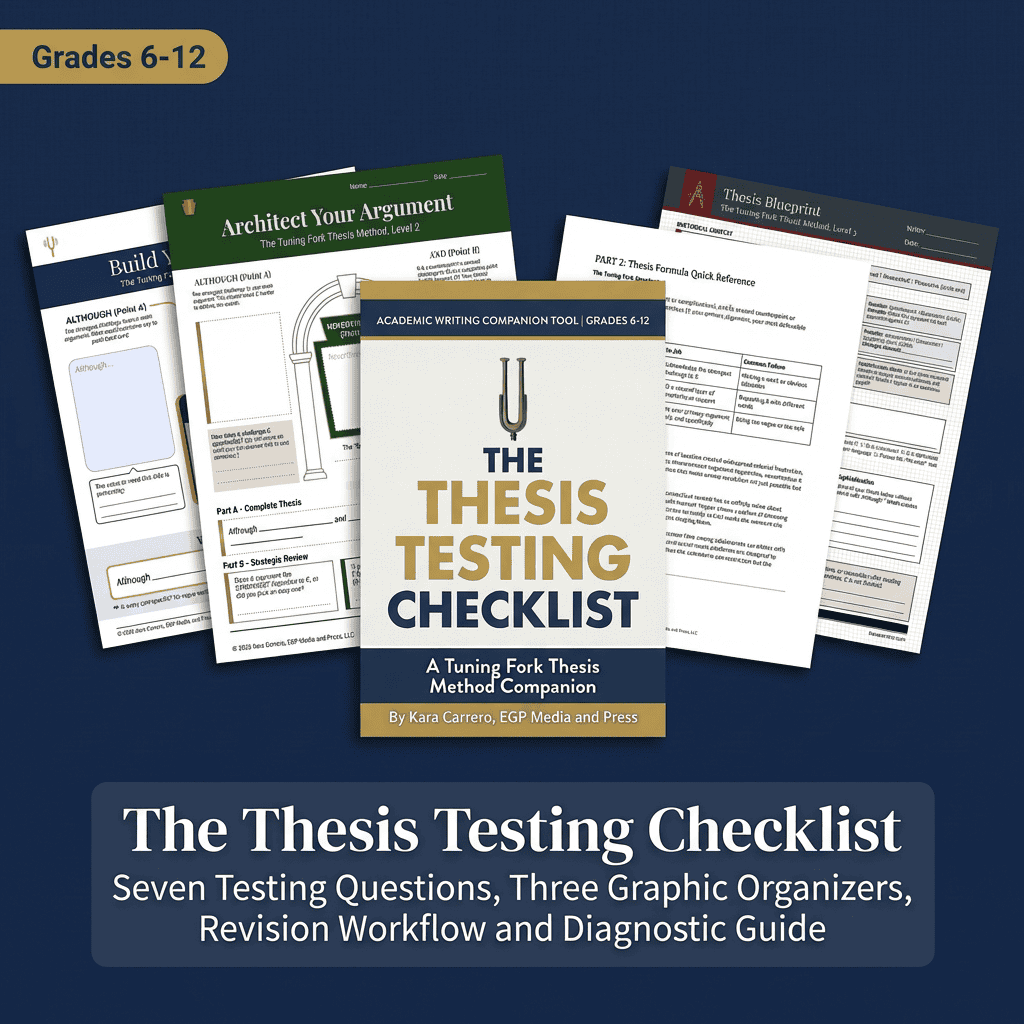
The Thesis Testing Checklist: A Tuning Fork Thesis Method Companion with Graphic Organizers
$7.00
A 12-page companion tool for the Tuning Fork Thesis Method. Includes seven thesis testing questions with revision direction for each, the “Although A and B, nevertheless C” formula broken down with cross-subject examples, an announcement language guide, a step-by-step revision workflow, a quick diagnostic table, and three level-specific graphic organizers for Levels 1, 2, and 3. Works as a planning tool before drafting, a revision diagnostic, or a conferencing reference.
Description
Most essay writing instruction teaches students what an essay looks like. The Tuning Fork Thesis Method teaches students what an argument does. And this checklist exists because knowing the formula and executing it well are two different things.
Before a student writes a single body paragraph, every part of the thesis needs to be tested. This tool makes that process concrete, repeatable, and teachable.
What’s Inside the 12 Pages
➔ Seven testing questions, each with a failing example and a specific revision direction so students know exactly what to fix, not just that something is wrong
➔ The “Although A and B, nevertheless C” formula broken down in a quick-reference table with complete thesis examples across history, literature, and science/current events
➔ Announcement language to eliminate at both the thesis level and the body paragraph level, with a replacement strategy
➔ A five-step revision workflow for when a thesis fails a testing question
➔ A quick diagnostic table: match the symptom to the problem to the exact question or section to address it
➔ Three level-specific graphic organizers (Level 1: Build Your Thesis, Level 2: Architect Your Argument, Level 3: Thesis Blueprint) designed to scaffold the thesis-building process from first introduction through advanced academic writing
Find Your Starting Point
This tool is written for homeschool educators, co-op writing teachers, and classroom teachers working with students in grades 6 through 12. It is also well-suited for students preparing for dual enrollment, standardized testing, or any writing-intensive academic context.
Because the Tuning Fork Thesis Method uses experience-based levels rather than grade-based levels, the graphic organizers in this checklist work the same way. Match the organizer to your student’s current level, not their age.
Meet Your Student Where They Are
➔ Ages 10 to 12 (grades 5 to 6): Begin with the Level 1 organizer. Expect to move through it slowly and revisit the first three testing questions more than once before the thesis feels solid.
➔ Ages 12 to 14 (grades 7 to 8): The most common entry point. Students this age can work through the seven testing questions independently with moderate guidance and are ready for the Level 1 organizer with some support.
➔ Ages 14 to 16 (grades 9 to 10): Students new to this method use the checklist alongside Level 1 work and move into Level 2 within the same school year. The diagnostic table is especially useful at this stage for narrowing down what is actually wrong with a draft thesis.
➔ Ages 16 to 18 (grades 11 to 12): The Level 3 organizer (Thesis Blueprint) and the sophisticated moves section of the checklist are designed for this range. Students writing college application essays, preparing for AP exams, or entering dual enrollment will find the rhetorical context and concession strategy sections directly applicable.
Right Level, Right Student
➔ Students who can follow an essay outline but cannot explain why their thesis matters
➔ Students whose writing sounds flat or formulaic even when it follows the rules
➔ Students preparing for timed writing, standardized testing, or college-level work
➔ Co-ops running a writing class across mixed grade levels where the level system makes differentiation practical
➔ Any educator who wants a concrete, consistent framework for thesis conferencing
This is not the right fit if your student is still working on paragraph-level writing or sentence construction. The Tuning Fork Method assumes students can write a coherent paragraph before they begin. If that foundation is still developing, build it first and return to this tool when they are ready.
Using This Alongside the Full Curriculum
This checklist is drawn directly from the Tuning Fork Thesis Method, a 183-page, three-level essay writing curriculum covering scope and sequence, pacing guides, student worksheets, evidence frameworks, and academic voice training. If your student needs more structured instruction than this companion provides, the full curriculum is available separately at karacarrero.com.
For members and supporters
Get access to the Download Dashboard
Printable PDFs in course format for history, literature, and cross-curricular studies. Download what fits your students, print it, and start teaching.
- Course-style PDFs. Structured, ready-to-print studies that guide students from the first page to the last.
- Grab what you need. Choose the studies that fit your students and download them from one dashboard.
- New downloads as it grows. More are added over time, so there is always something new to print.
$5 a month
See what is inside Already a member? Open your dashboardPrefer to start free? Many challenges also arrive as simple emails when you subscribe.
Additional information
| Activity Type | |
|---|---|
| Grade Range | |
| Subject |


Reviews
There are no reviews yet.