What Is a Fortress? A Hands-On Way to Teach It (Free K-5 Lesson)
Ask a seven-year-old what a fortress is and you’ll probably hear, “A castle?” Ask a ten-year-old and you might get, “A really big wall.” Both answers are close, but neither encapsulate the whole story.
I taught high school history and English before I started homeschooling, and one thing has held true in both places: kids remember what they have to decide, not what they’re told. Fortresses are a perfect example. They look simple until you ask a child to build one and explain why the gate goes there.
A definition to teach
Here’s the version I like to start with: a fortress is a place built to protect people from danger.
The Britannica Dictionary defines a fortress as a fortified place, one that has been strengthened with defenses so it is protected against attack. Notice the word people. A fortress isn’t only about walls. It’s about keeping someone safe, along with the things they need to live. That one idea turns a pile of stones into a story, and a story is where a unit study begins.
Why I’d rather they build it than draw it
Most fortress activities hand kids a labeled diagram and ask them to copy it. Copying is fine, but it doesn’t ask much of the brain.
Building does. When a child has to choose where the gate goes, how tall to make the wall, and what the keep needs to be, they are analyzing. Give an older child only forty pieces and suddenly they’re weighing trade-offs. Ask them to give you a tour of their fortress and they’re explaining their reasoning out loud. That’s the kind of thinking I want from my students, whether they’re six or sixteen, and it happens on the living room floor with a bin of toys.
Fortresses have anatomy
I like to tell kids that a fortress works like a body. Every part has a job, and the parts work as a team. A few to get you started:
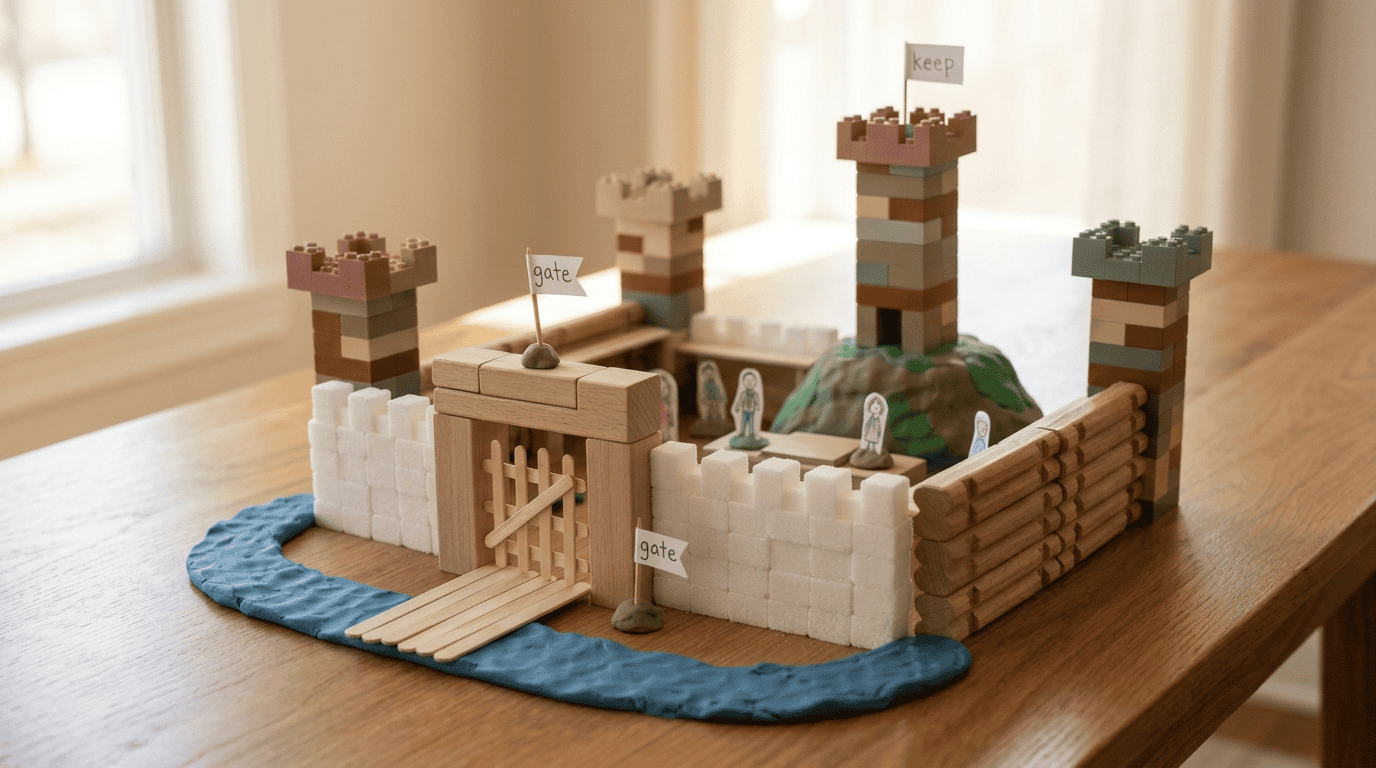
- Curtain wall: the tall outer wall that circles the fortress
- Towers: high points that give guards a place to watch from
- Gatehouse: the protected entrance
- Moat: a ditch around the walls, with or without water
- Bailey: the open courtyard inside the walls
- Keep: the strongest, safest part at the center
Here’s a detail kids love: according to TimeRef, most castles had a wall high enough to be hard to climb and usually just one main entrance, which meant defenders only had one door to guard. And location mattered too. English Heritage’s teaching materials point students toward natural advantages like high ground, steep slopes, and rivers. Suddenly “why did they build it on a hill?” becomes a real question with a real answer.
How one lesson becomes a unit study
A unit study doesn’t have to be a giant binder. It can start with one good question and grow from there. Here’s how a single fortress lesson can stretch across a few days:
- Learn it. Introduce the definition and the parts of a fortress.
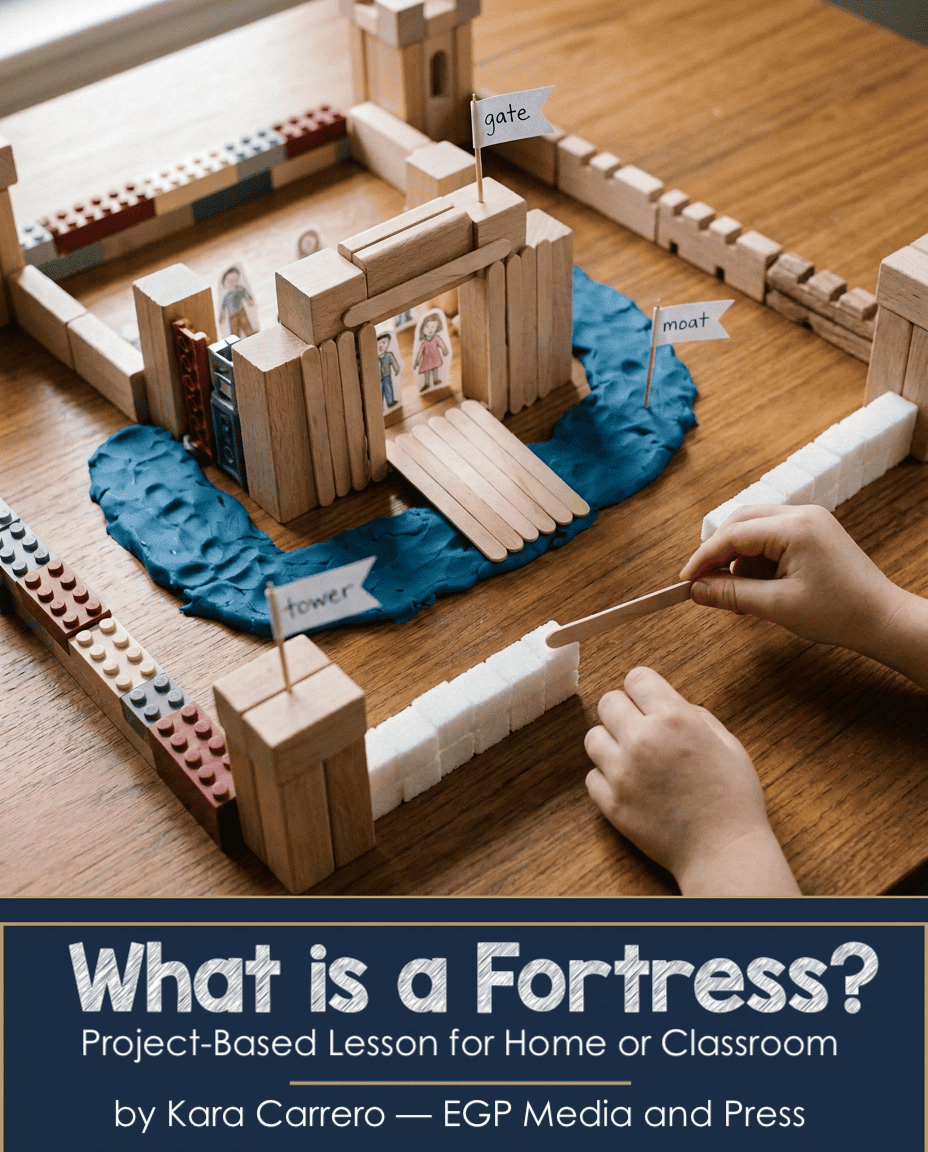
- Build it. Pull out whatever you have: Legos, Lincoln Logs, wooden blocks, craft sticks, sugar cubes, even Play-Doh for a moat or a hill.
- Explain it. Let your builder give you a guided tour. “This is my tower, and its job is to…”
- Watch it. Choose a documentary and have kids spot the parts they built. What matched? What surprised them?
- Talk or write about it. What was the one part the fortress couldn’t do without, and why?
Notice what’s missing: a stack of worksheets. Every step asks kids to think, and the learning sticks because they made something real.
Grab the free lesson
I put this lesson together so you can use it tomorrow with whatever is in your toy bin. It’s built for kindergarten through fifth grade, in three tiers (K-1, 2-3, and 4-5), so siblings can build side by side at their own level.
Inside you’ll find:
- A fortress anatomy chart paired with ideas for building each part
- A separate building challenge for each grade pairing
- Sentence starters for the guided tour
- A simple checklist so you can see what your kids understand, with no grading and no tests
Download the free Build a Fortress lesson below and give it a try this week.
Where this leads
Once kids understand how a fortress works, the questions start rolling. Who built them? Why did designs change? Some early castles, for example, were built on a raised mound called a motte, next to a walled courtyard called a bailey, according to historian Mark Cartwright. Why a mound? Why a courtyard? One good build leads to a dozen good questions.
If your kids catch the fortress bug, Arms and Strongholds is the unit study I created to follow that curiosity further. It’s for families who want their kids to explain why things happened, not just memorize what happened.
For now, start with the free lesson, clear a spot on the floor, and see what your builders come up with. I’d love to hear how it goes.
Sources
Cartwright, Mark. “Motte and Bailey Castle.” World History Encyclopedia, World History Publishing, www.worldhistory.org/Motte_and_Bailey_Castle/. Accessed 23 Oct. 2026.
English Heritage. Warkworth Castle: Teachers’ Activity Ideas, KS1-KS4. English Heritage, www.english-heritage.org.uk/siteassets/home/visit/places-to-visit/warkworth-castle/school-visits/warkworth-castle_teachers-activity-ideas_ks1-ks4.pdf. Accessed 23 Oct. 2026.
“Fortress.” The Britannica Dictionary, Encyclopaedia Britannica, www.britannica.com/dictionary/Fortress. Accessed 23 Oct. 2026.
“Gatehouses.” TimeRef, www.timeref.com/castles/gatehouses.htm. Accessed 23 Oct. 2026.
For members and supporters
Get access to the Download Dashboard
Printable PDFs in course format for history, literature, and cross-curricular studies. Download what fits your students, print it, and start teaching.
- Course-style PDFs. Structured, ready-to-print studies that guide students from the first page to the last.
- Grab what you need. Choose the studies that fit your students and download them from one dashboard.
- New downloads as it grows. More are added over time, so there is always something new to print.
$5 a month
See what is inside Already a member? Open your dashboardPrefer to start free? Many challenges also arrive as simple emails when you subscribe.