Nobody Won: Teaching Concession and Compromise in History
Why the Most Important Moments in History Are Defined by Friction, Not Victory, and How to Teach Students to See It
The night my daughter didn’t go to her extracurricular meeting and when we dropped off some of her siblings, she cried a little.
In that moment she grieved something that was real and mattered, but as she said she knew “it was likely the right decision.” She had held a leadership role in that organization and had invested in it, grown in it, earned her place in it at some cost. Leaving wasn’t clean or an easy decision.
But the next night, she walked through the door after her first speech and debate meeting; something had shifted. She was lit up in a way I hadn’t seen before, the kind of alive that isn’t performance or excitement but recognition, like a person who has found the place where their particular wiring actually fits. She made friends easily. She found her footing immediately. And as she’s invested into this new endeavor, she has even placed in the top ten at two national tournaments in her first year, competing against students older and more experienced than she is.
And she was the one who named what the transition felt like. She called it bittersweet. One night of grief, one night of arrival, forty-eight hours that held both things at once and refused to resolve neatly into one.
I have thought about that word, bittersweet, more than she probably intended me to.
Because here is what she was actually doing when she said it: she was refusing to declare a winner. She was holding two true and competing things simultaneously, the real value of what she left and the real rightness of where she landed, and she was insisting that both deserved to be named.
That is, in fact, one of the most sophisticated cognitive moves a person can make… It is also, almost exactly, what history requires.
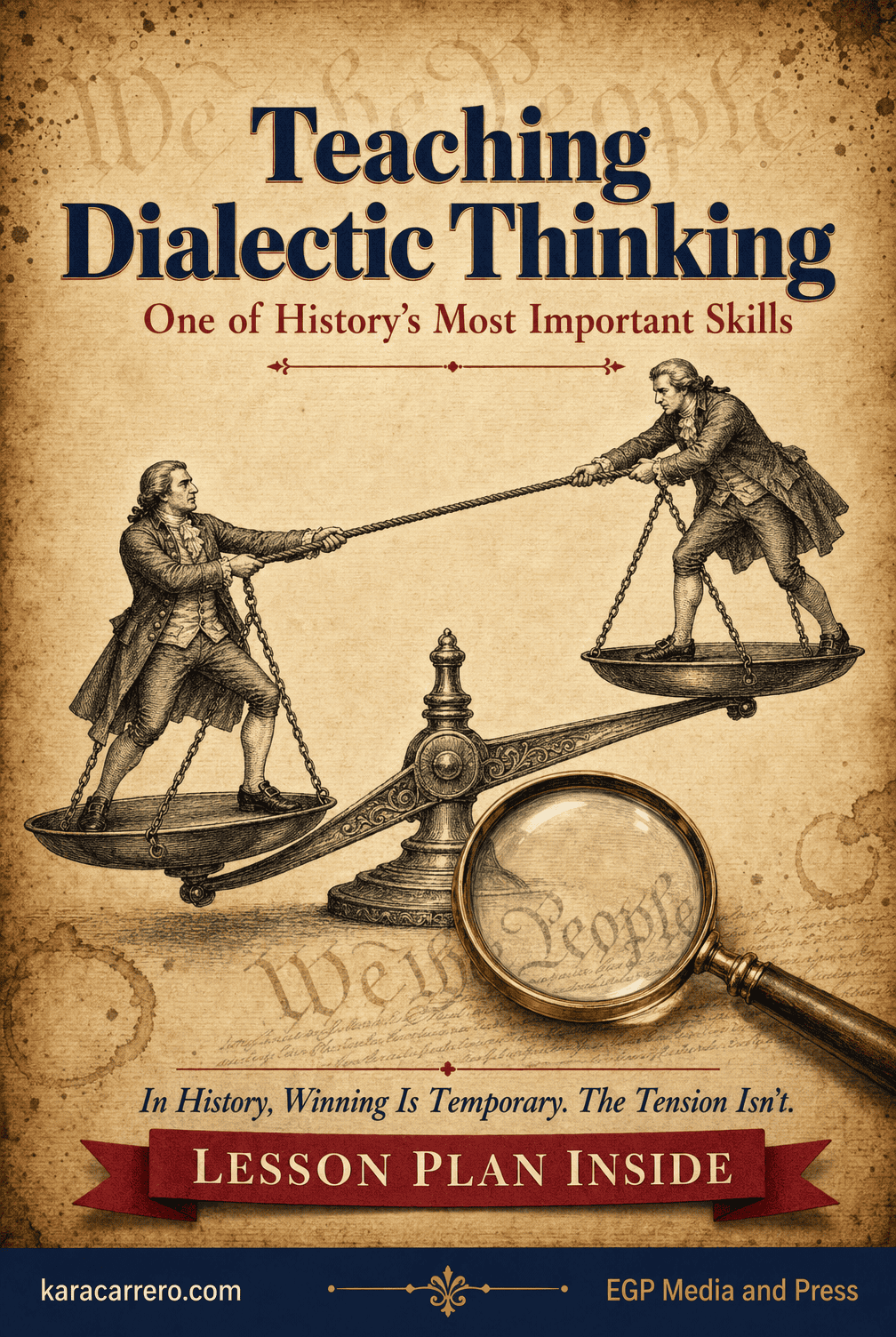
Your Students Already Know How to Apply Dialectic Thinking
Here is something that does not get said enough in conversations about historical thinking skills: children are not bad at holding competing truths in tension. They are actually quite good at it, in the right conditions.
- Watch a child negotiate a conflict with a sibling over something they both want.
- Watch a teenager work through why a friendship that was meaningful has also become genuinely harmful.
- Watch a student in a debate round argue a position they were assigned rather than one they chose, and do it well, because they have genuinely found the logic inside the argument even when they disagree with the conclusion.
What you are watching in all of those moments is dialectic thinking, the ability to identify two valid, competing ideas, understand the internal logic of each, and sit in the tension between them long enough to actually learn something rather than just picking a side and defending it.
Children do this naturally. They are doing it at the dinner table and in the car and on the playground, in the language of fairness and loyalty and competing loyalties and what it means when two things you care about point in different directions.
Then they come to history class. And history class, more often than not, asks them to stop.
Pick a side. Write a thesis. Defend your position. Tell me who was right. Tell me who won.
The entire architecture of traditional history instruction is built around the finish line. We teach history as a sequence of events with outcomes, and the outcomes are the point. The South lost the Civil War. The Allies won World War II. The colonists won independence. These are true things, and they matter. But when we teach history only through the lens of who won, we accidentally teach students that the friction that produced those outcomes was just noise on the way to an inevitable conclusion. We flatten the tension that was actually doing all the historical work.
We take their most sophisticated instinct and train it out of them.
Related: The Psychology of Folklore: Investigating Historical Myths with America’s Original Tall Tales
History Is Not a Timeline. It Is a Tug-of-War.
The dominant metaphor in history education is the race.
… Events lead to outcomes, outcomes lead to consequences, consequences become context for the next set of events. The textbook has a start and a finish and a clear direction of travel. Progress is the assumption baked into the structure.
But that is not actually what history looks like from the inside.
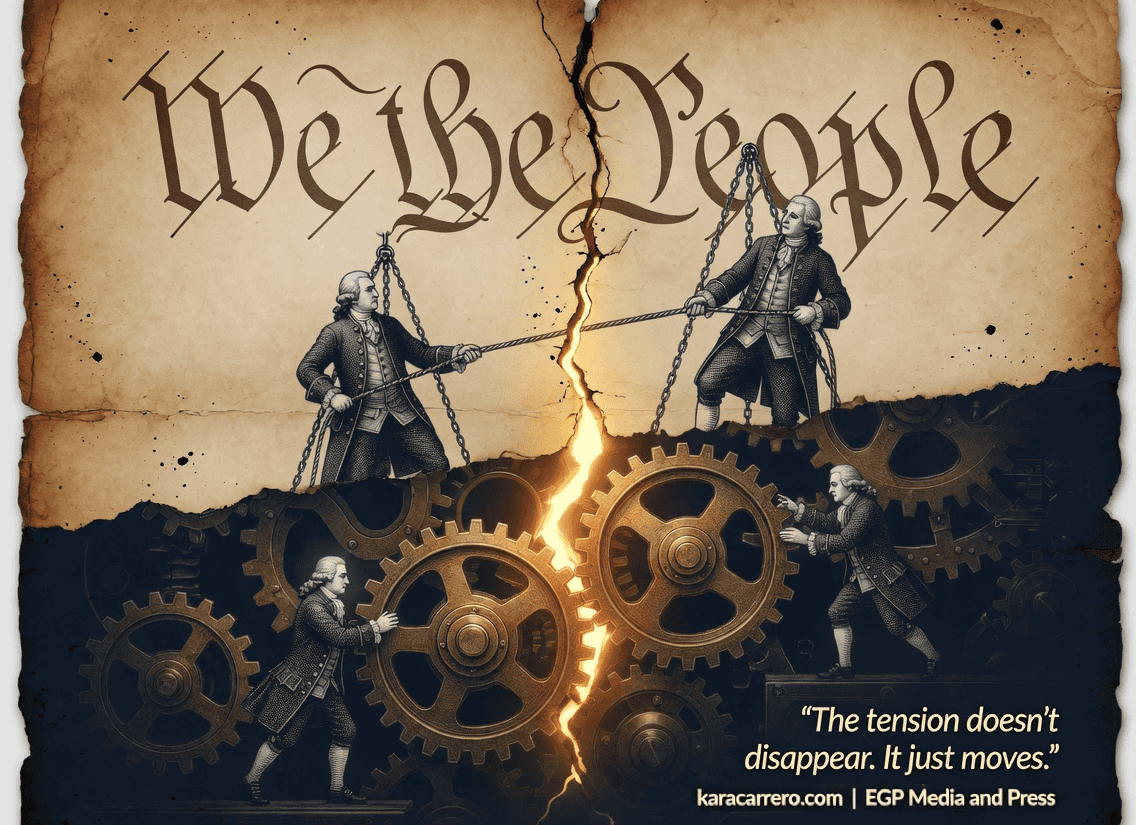
From the inside, history looks like a tug-of-war between two ideas that are both trying to survive. And here is the thing about a tug-of-war that the finish-line metaphor misses entirely: the rope does not disappear when one side lets go. The tension does not resolve, it just changes location.
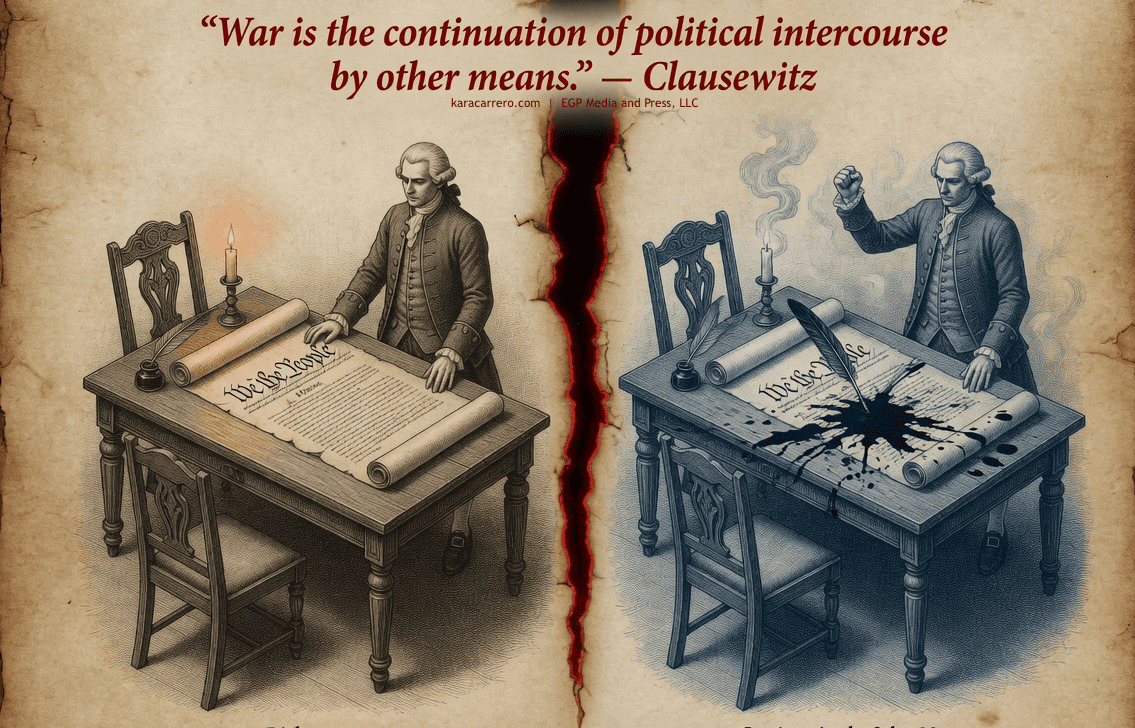
The Prussian military theorist Carl von Clausewitz captured this in a line that has outlasted almost everything else written about war in his era:
“War is not merely a political act, but also a real political instrument, a continuation of political intercourse, a carrying out of the same by other means.”
The argument he was making was not that war is simply a more intense version of talking. It was that war does not end the underlying conflict. It shifts the form the conflict takes. The negotiating table becomes the battlefield and the battlefield eventually becomes the negotiating table again, and the underlying friction point has never stopped existing. It has only changed the tools it is using.
When we look at history through that lens, the moments that seemed like decisive victories start to look different. They start to look like friction points, places where two competing values pushed against each other hard enough to generate heat and produce something new, something that neither side fully wanted and that did not actually end the tension that created it.
The Constitutional Convention Did Not End the Argument
In the summer of 1787, fifty-five delegates gathered in Philadelphia to design a government for a nation that had just fought a war to escape one kind of centralized authority, and they needed to build another kind, carefully, without recreating the thing they had just rejected.
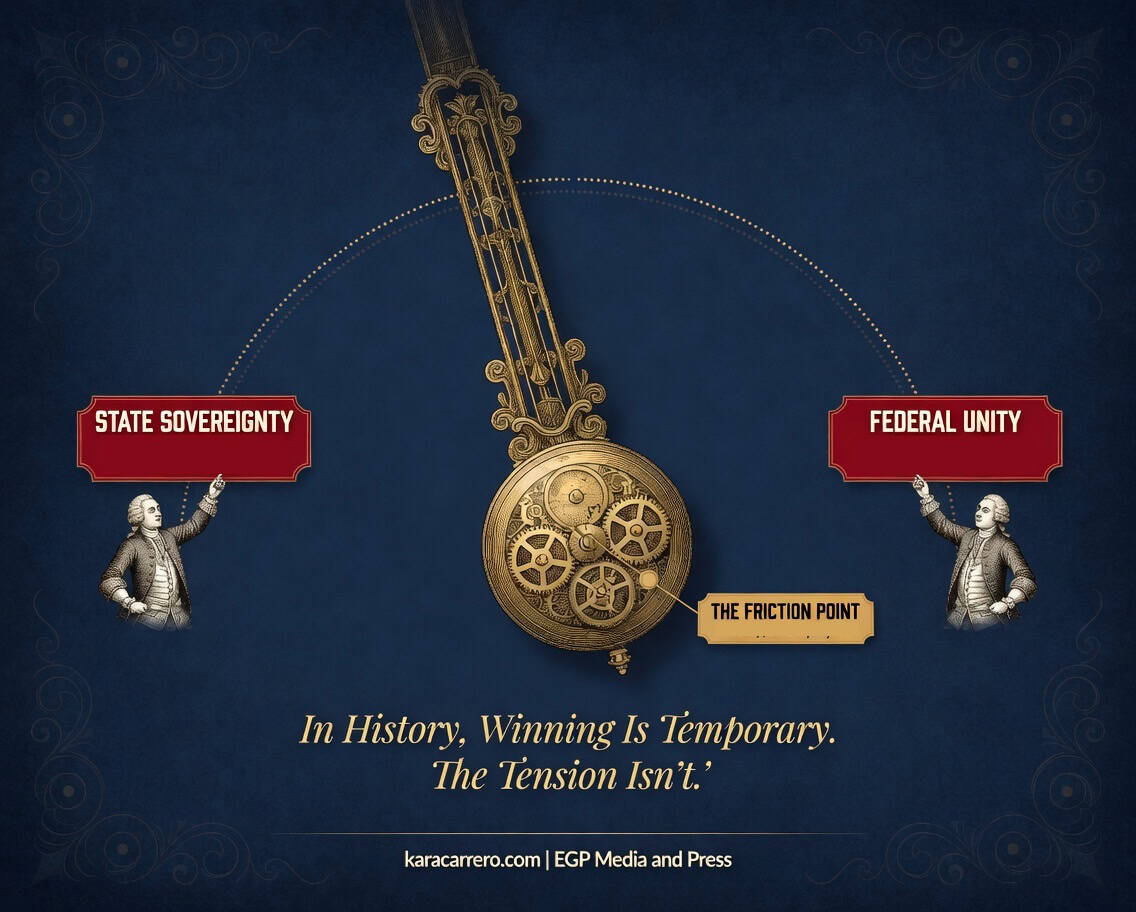
The visible debates were about representation and the structure of the legislature and the question of slavery. But the underlying dialectic, the friction that was generating all that heat, was between two values that were both legitimate and both necessary: state sovereignty and federal unity.
The delegates who argued most passionately for state sovereignty were not obstructionists. They were protecting something real. They had watched a distant central power govern without accountability and they were not going to build another one. The memory of Parliamentary overreach was not abstract for them. It was recent and visceral and they had paid for it.
The delegates who argued most passionately for federal unity were also protecting something real. They had watched the Articles of Confederation produce a government that could not field an army, could not pay its debts, could not stop individual states from undercutting each other economically, and could not hold the union together under the weight of its own competing interests. A loose collection of sovereign states was not a country. It was a slow-motion dissolution.
Both sides were right. And the Constitution they produced was not a victory for either position. It was a friction point, a place where two valid and competing ideas pushed against each other and generated enough heat to produce something new, something that neither side fully wanted and both sides could reluctantly accept.
And then the argument continued.
The tension between federal power and state sovereignty did not end in Philadelphia. It produced the Bill of Rights, because Anti-Federalists demanded protection from the central government they had just agreed to. It produced nullification crises and states’ rights arguments and the Civil War and Reconstruction and a hundred subsequent legal and political battles that are still being fought in courtrooms and legislative chambers today.
Nobody won in Philadelphia. The friction point just moved.
Related: The Off-Camera Perspective: Teaching Students to See Forgotten Historic POV
FDR’s Neighbor and the Firehose
In the fall of 1940, Franklin Roosevelt faced a version of the same tug-of-war on a global scale.
Britain was being bombed into attrition. Churchill was asking for destroyers, planes, ammunition, and money.
- On one side of the American debate stood those who believed the United States had both a strategic and moral stake in the outcome of the war in Europe and that failing to act was its own kind of choice.
- On the other side stood a powerful and sincere isolationist movement shaped by two decades of deliberate distance from European conflict.
The isolationists were not a fringe. They represented a genuine and seriously held position rooted in real historical experience. The memory of the First World War and a conflict that had not produced the lasting peace it promised, had left a deep mark. Many of the people who argued against intervention had buried sons in that war or knew people who had. Their position was not indifference to what was happening in Europe, rather it was a conviction that the cost of involvement had to be weighed honestly against the outcome it could realistically produce.
Both anchors in this dialectic were protecting something real. The interventionists were protecting democratic solidarity and arguing that threats do not stay contained by geography.
Roosevelt could not simply override that position. He had to work within the tension.
So he gave a press conference and described a hypothetical. If your neighbor’s house is on fire, he said, you do not haggle over the price of the garden hose before you hand it over. You lend the hose. You deal with the details later. You help, because the fire that burns your neighbor’s house down will not stay on your neighbor’s property.
That metaphor became the Lend-Lease Act. It was a legislative friction point, a place where the competing values of American non-intervention and democratic solidarity generated enough pressure to produce something new, something that was neither full neutrality nor full entry into the war, but a third thing that held both values in a creative and unstable tension.
The underlying dialectic, intervention versus sovereignty, did not resolve with Lend-Lease. It was not really a victory for either side and kept generating heat through the rest of 1941, through debates in Congress and newspapers and living rooms across the country. And it was not persuasion or policy or the force of any argument that finally ended the debate.
It was Pearl Harbor, on December 7, 1941.
An external shock, not a better argument, was what finally forced the question off the table. And even then, what ended was simply the debate. The values underneath it like the question of when a government is obligated to act beyond its borders and at what cost, did not disappear. They resurfaced in Korea and Vietnam and every foreign policy crisis that followed, because that is what friction points do. They do not resolve, they simply move.
Related: “Whose Pen Is This? Teaching Students to Question Who Writes History”
The Skill We Keep *Almost* Teaching
Most history instruction gets close to this without quite arriving.
We do teach students to consider multiple perspectives. We do ask them to think about causes and effects. We sometimes even ask them to argue both sides of a historical debate before writing a thesis.
The problem is that we almost always resolve the dialectic too quickly.
… We get students to the friction point and then ask them to escape it rather than inhabit it.
We treat the tension as a problem to be solved rather than as the actual historical substance worth understanding.
A student who can argue both sides of the Constitutional Convention debate and then write a clean thesis declaring a winner has learned something. But a student who can identify the two anchors, name the specific pressure each side was applying, locate the exact point where they generated heat, and then explain why neither side’s victory would have been stable, that student has learned history.
And that student, almost certainly, already had the instinct for it. They used it the last time they were caught between two things they cared about and could not find a clean way through. And in the case of my daughter, it’s called something like bittersweet and kept moving.
We just have to give them the structure to apply it to the past.
Introducing the Tension Lines Graphic Organizer
Tension Lines: The Mechanics of History graphic organizer is built around the idea that the most important historical moments are not defined by who won but by the friction between two competing values that were both legitimate, both necessary, and both trying to survive. It gives students a formal structure for the kind of thinking they already do naturally, and it introduces them to the scholarly term for it: dialectic.
The word sounds academic. The skill is not because your student already uses it. This organizer just names it, formalizes it, and puts it to work on the past.
Here is how it works.
Anchor 1 and Anchor 2 ask students to identify the specific value or need each side of a historical debate was protecting. Not “the North” and “the South.” Not “federalists” and “anti-federalists.” The underlying value: What did they believe was worth fighting for? What would have been lost if they had simply conceded?
The Friction Point is the place where those two values meet and generate heat. This is not the event. This is the structural tension that the event is an expression of. Students who can locate the friction point can see why the same argument keeps recurring across decades, because the friction does not disappear just because one event resolves.
The Bridge Builder Challenge is where the organizer does its most important work. Before a student is allowed to declare a winner or take a position, they are required to demonstrate that they genuinely understand both sides, not just the side they agree with. They have to name the strongest possible argument for the position they find least convincing. They have to find what both sides wanted, the shared goal underneath the competing strategies.
And then, only then, they get to argue.
That sequence matters. Concession is not weakness in this framework. It is the prerequisite for a credible argument. A student who can say “the strongest case for the other side is this, and here is why it is not sufficient” is building something structurally different from a student who simply ignores the opposing position. They are building an argument that can survive contact with a real counterargument.
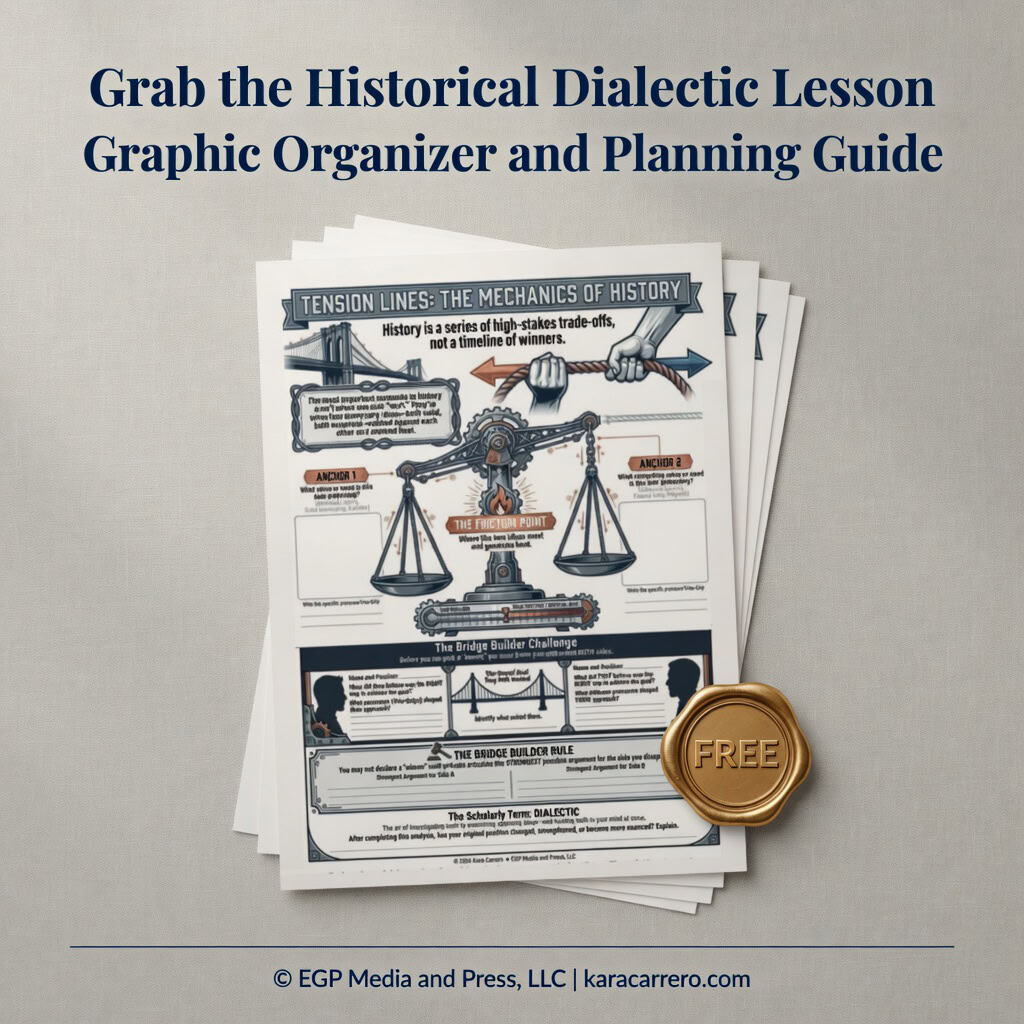
Download the Tension Lines Graphic Organizer
The Tension Lines graphic organizer is available as a free download, along with a short companion lesson plan that walks you through using it with any historical debate, from the Constitutional Convention to Lend-Lease to whatever your students are studying right now.
It works across grade levels. It does not require you to be teaching a specific unit or following a specific curriculum. If you have a historical debate in your lesson plan, this organizer fits.
What Happens After the Friction Point
Once students have worked through this framework a few times, something shifts in how they approach historical arguments because they stop simply looking for the winner.
They have learned that the most interesting and defensible position is usually not the one that ignores the other anchor, it is the one that has genuinely reckoned with it.
There is a significant difference between saying “both sides have a point so we cannot know anything” and saying “both sides have a point, and here is why this argument is stronger despite that.” The first is an excuse to stop thinking. The second is what a real historical argument looks like.
When your students are ready to take that dialectic and build it into a fully developed argument, one that holds the tension rather than collapsing it and uses concession as a structural strength rather than an admission of weakness, the Tuning Fork Thesis Method is the natural next step. It is designed to teach students exactly what to do with the friction point once they have found it.
…Because the friction, almost always, is still generating heat.
Explore more resources for teaching historical thinking, argumentation, and primary source analysis in the EGP Media and Press lesson library.

