“Whose Pen Is This? Teaching Students to Question Who Writes History”
A free mini-lesson that helps K-12 students understand that history isn’t just WHAT happened, but WHO got to tell the story
Here’s a question that should make us uncomfortable: When we teach the American Revolution, whose version of events are we teaching?
Think about it. After the Revolution, who wrote the textbooks? Who compiled the archives? Who decided which documents were “historically significant” and which could be ignored?
It wasn’t the British, who lost. It wasn’t the Loyalists, who fled or were silenced. It wasn’t the enslaved people who heard white slaveholders talk about “liberty.” It wasn’t the women who managed households and farms while men went to war. It wasn’t the poor soldiers whose motivations were more complex than simple patriotic fervor.
For generations, American students learned a version of the Revolution written almost exclusively by the victors. By those who had power. By those who could read and write. By those whose perspectives were considered “official” and “important.”
And here’s the thing: This isn’t ancient history. This is how history has always worked.
Those with power get to shape the narrative. Those who win wars write the textbooks. Those with access to literacy and publishing get their voices preserved while others are forgotten or filtered through someone else’s interpretation.
If we want our students to be critical thinkers and not just passive receivers of information, we need to teach them to ask one crucial question whenever they encounter a historical source:
“Whose pen is this?”
Why This Question Matters
When students learn to ask “Whose pen is this?” they develop skills that go far beyond memorizing dates and facts. They learn to:
Recognize bias and perspective in every source. There’s no such thing as an “objective” historical account. Every source reflects someone’s viewpoint, shaped by their experiences, loyalties, and circumstances.
Question power structures. Understanding that history is written by those with power helps students recognize how political, economic, racial, and gendered power shapes whose stories get told and whose get erased.
Seek out marginalized voices. When students realize that “official” history often centers the powerful, they start asking: Whose voices are missing? What perspectives have been silenced or lost?
Avoid both oversimplification AND paralysis. Students learn that recognizing bias doesn’t mean all sources are equally unreliable or that we can never know anything about the past. Instead, it means we need multiple perspectives to understand complex events.
Connect past to present. Students start noticing how the same dynamics play out today. Who controls media narratives? Whose experiences are centered in news coverage? Whose stories are dismissed or ignored?
RELATED: How to teach Historical Contextualization
The Problem with “Just the Facts”
Many history curricula present events as settled facts: “The Boston Tea Party happened on December 16, 1773. Colonists destroyed tea to protest British taxation.”
But here’s what we often don’t teach:
- Who named it the “Boston Tea Party”? Not the British, who called it the “Destruction of the Tea.” The playful name came from patriots who wanted it to sound justified and exciting.
- Whose account of the event became “official history”? The Sons of Liberty, who won the Revolution and later shaped American education. British accounts were dismissed as enemy propaganda. Loyalist perspectives were erased. Neutral observers who saw complexity rather than heroism were ignored.
- Whose voices are completely missing? Women who watched from their homes. Enslaved people who lived in Boston. Indigenous people whose land this was. Poor laborers who didn’t leave written records.
When we teach “just the facts,” we’re actually teaching one group’s interpretation of events while pretending it’s objective truth.
Introducing “Whose Pen Is This?” – A Free Mini-Lesson
I created this free resource because I kept seeing students accept historical sources at face value without questioning who created them or why their version of events was preserved while others weren’t.
“Whose Pen Is This?” is a differentiated mini-lesson (grades K-12) that uses Revolutionary War events to teach students to analyze historical perspective and understand how power shapes historical narratives.
Here’s what makes this lesson different:
It’s not about “both sides.” This isn’t a false equivalency exercise. The goal isn’t to say “everyone has a valid point” but to help students understand how power determines whose point gets heard and preserved.
It teaches the relationship between power and narrative. Students analyze not just WHAT different people said about an event, but WHY some accounts were preserved, legitimized, and taught while others were marginalized, dismissed, or lost.
It explicitly addresses whose voices are missing. For every perspective students analyze, they’re asked: Whose voices are completely absent from ALL of these accounts? Why?
It connects to modern media literacy. Once students understand that “winners write history,” they start recognizing how the same dynamics operate in current events coverage, social media, and news narratives.
It’s differentiated for all grades. The core concept adapts from kindergarten (“different people see the same thing differently”) through high school (“analyze how political, economic, racial, and gendered power structures determine whose perspectives are recorded and legitimized”).
What’s Included in This Free Resource
The complete lesson includes:
Teacher Guide with background on why this matters, how to teach it, and connections to critical thinking skills
Three Revolutionary War Event Options:
- The Boston Tea Party
- The Boston Massacre
- The Battles of Lexington and Concord
Each event includes the basic facts PLUS three distinct perspectives representing different power positions and stakes in the outcome.
Grade-Banded Mini-Lessons:
Grades K-2: “Who’s Telling the Story?”
- Simple introduction to perspective using relatable scenarios
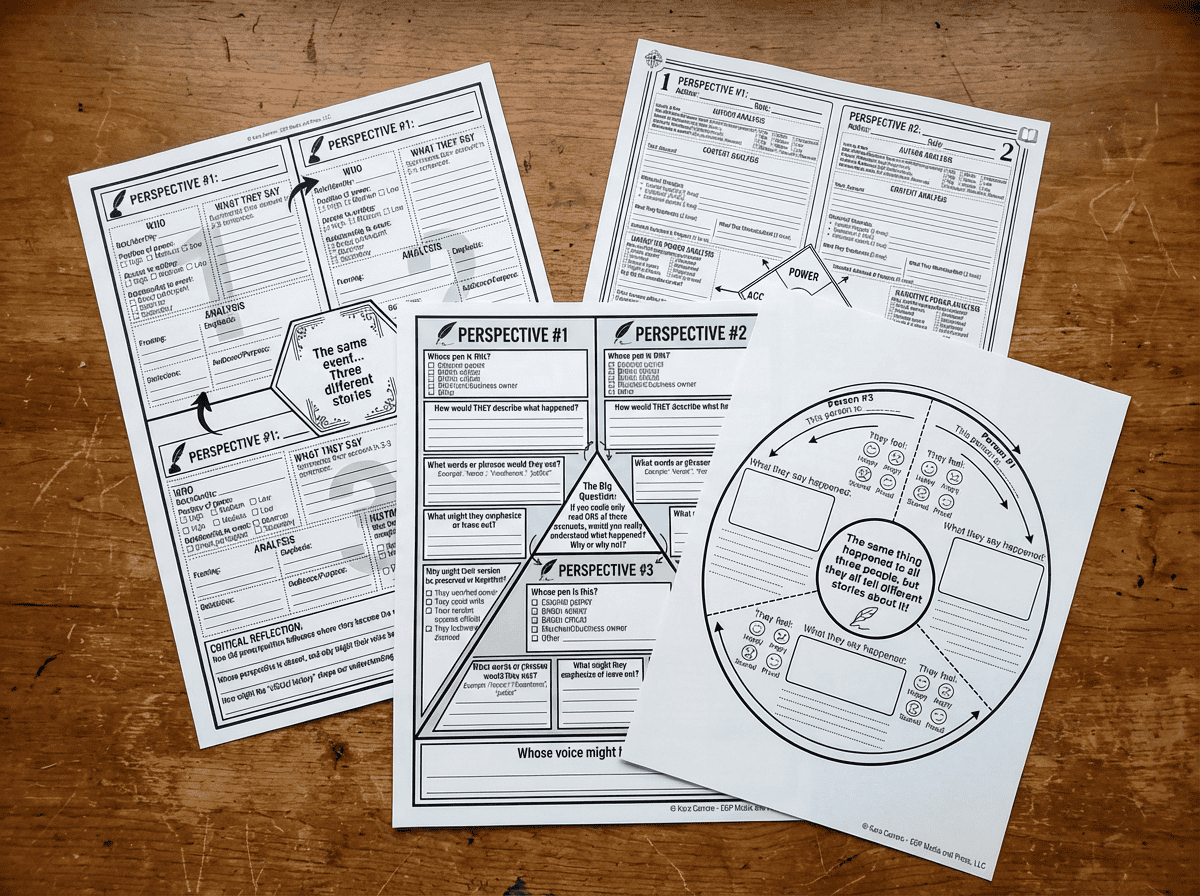
- Visual “wheel” graphic organizer students rotate to see different viewpoints
- Focus: Same event, different stories, need multiple voices
Grades 3-5: “Whose Pen Is This?”
- Introduction to power and access in historical narrative
- Analysis of whose version became “official” and why
- Focus: Understanding that those who win, can write, and have power shape history
Grades 6-8: “Who Writes History?”
- Deeper analysis of how power, literacy, and access affect whose accounts survive
- Explicit examination of missing voices and structural silencing
- Focus: Critical source analysis and recognizing marginalization
Grades 9-12: “Who Controls the Narrative?”
- Sophisticated analysis of power structures and narrative construction
- Historiographical thinking (how interpretations change over time)
- Focus: Relationship between power and historical truth, ethical obligations of historians
Graphic Organizers designed so students literally see how the same event looks different depending on whose perspective they’re viewing
How to Use This Freebie
This lesson works beautifully as:
A standalone critical thinking activity. Use it any time you want students to practice analyzing perspective and bias.
An introduction to primary source analysis. Before diving into Declaration of Independence grievances or founding documents, teach students that every source has an author with a perspective.
A companion to literature or novel studies. Pair with historical fiction to discuss how authors choose whose story to tell.
A current events connection. After completing the historical analysis, ask students to apply the same questions to a current news story: Whose perspective is centered? Whose is missing?
A gateway to deeper Revolutionary War study. This lesson pairs perfectly with
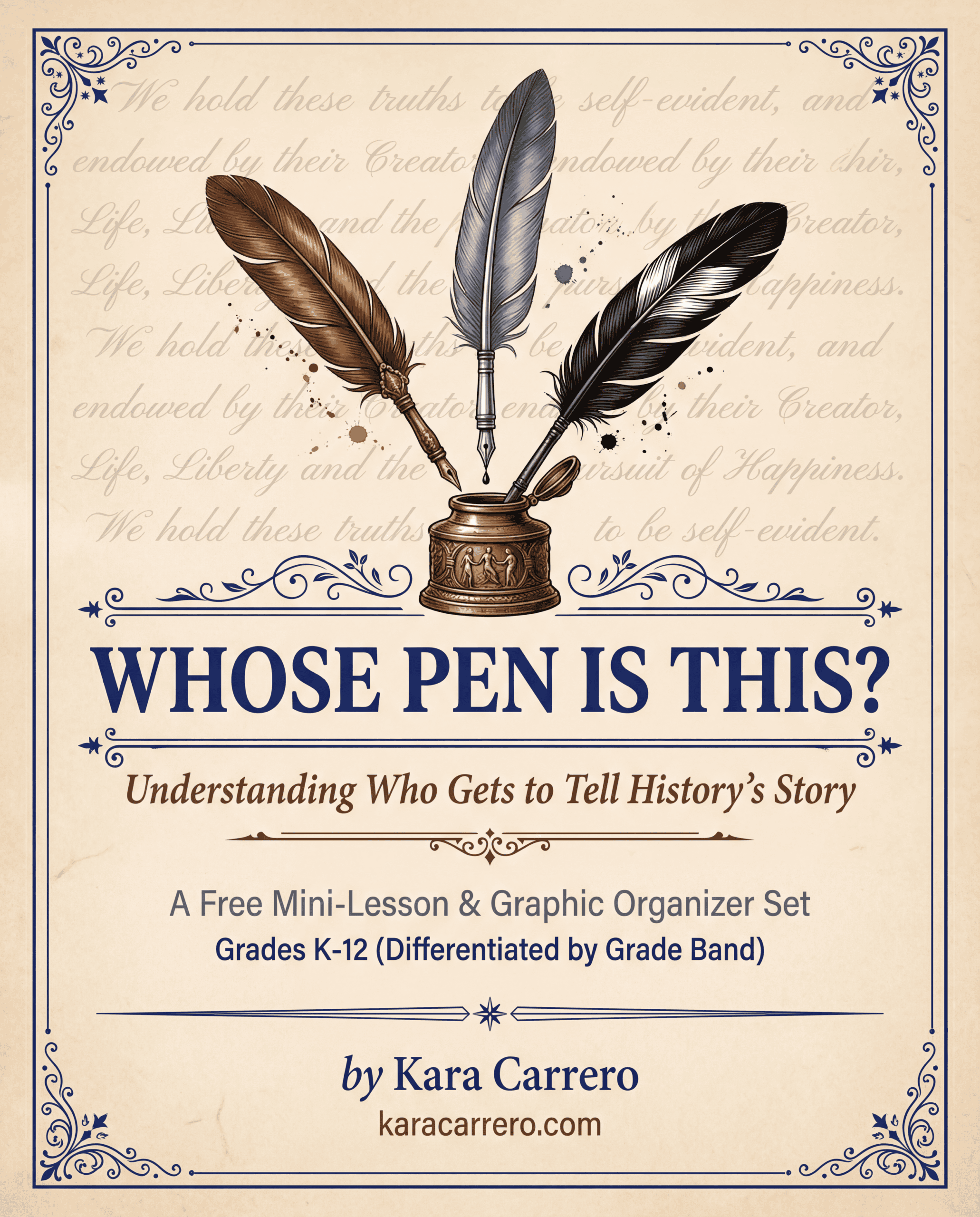
Download Your Free 45-Page “Whose Pen Is This?” Lesson
Ready to teach your students to question who writes history?
This complete 45 page lesson includes:
- Teacher guide with background and teaching tips
- Differentiated lessons for grades K-2, 3-5, 6-8, and 9-12
- Three Revolutionary War event options to analyze
- Graphic organizers for all grade levels
- Sample student responses
- Extension activities
- Answer keys/Sample Answers