Teaching Pointillism Across Ages: From Toddler Dot Markers to Teen Masterpieces
How one art technique can engage every child in your homeschool, from preschoolers to high schoolers
Recently, I watched my 10-year-old daughter place a bright yellow perler bead next to a purple one, then gasp as she noticed how much more vibrant the yellow appeared. “Mom, it’s perfect!” she exclaimed, unknowingly discovering the same color theory principles that Georges Seurat spent years perfecting in the 1880s.
This is the beauty of teaching Pointillism in a multi-age homeschool. Whether your child is 3 or 17, the fundamental concept remains wonderfully accessible: tiny dots of color placed side by side create something entirely new when viewed from a distance. But the ways we can explore this concept? That’s where the real and profound educational moments happen.

What Exactly is Pointillism?
Before diving into our family’s adventures with dots, let me give you the foundation. Pointillism is an art technique developed by French painter Georges Seurat in the 1880s. Seurat actually preferred the term “Neo-Impressionism” or “Divisionism,” but “Pointillism” stuck because, well, it’s much easier to say!
The technique involves applying small, distinct dots of pure color in patterns to form an image. Instead of mixing colors on a palette, artists let the viewer’s eye do the mixing. When you stand close to a Pointillist painting, you see individual dots. Step back, and those dots blend into a cohesive, often luminous image.
Seurat based his technique on scientific color theories of the time, particularly the work of Michel Eugène Chevreul and Ogden Rood. He discovered that placing complementary colors (like red and green, or blue and orange) next to each other made both colors appear more vibrant. This is exactly what my daughter experienced with her perler beads!
Why Pointillism Works So Well for Multi-Age Learning
I’ve taught my children about many art movements, but Pointillism has a unique advantage: it’s simultaneously simple and sophisticated. A toddler can make dots with a bingo dauber and create something beautiful, while a teenager can study color theory and optical mixing at a college level. The core technique remains the same; only the complexity and materials change.
And because of modern technology, the concept can even be applied to modern concepts like video game creation and pixel art.
Our Family’s Pointillism Journey: Age by Age
Ages 2-6: Dot Markers and Stickers Galore
For our youngest learners, I start with the most basic concept: dots make pictures. Dot markers (bingo daubers) are perfect for this age group. I give them simple outlines – a tree, a fish, a flower – and let them fill in the shapes with dots. The key is keeping it pressure-free and focused on the joy of making marks.
What worked:
- Large-format coloring pages with thick black outlines
- Washable dot markers in primary colors
- Sticker activities where they place circular stickers to “paint” a picture
- Pointing out that they need to step back to see the whole image
The lesson: Dots can make pictures, and art looks different up close versus far away.

Ages 4-8: Q-tip Painting Adventures
This is where things get messy but exciting. Q-tip painting bridges the gap between the simplicity of dot markers and the precision required for true Pointillism. I set up washable tempera paints in small cups, give each child a handful of Q-tips, and watch them discover color mixing through experimentation of what color dots are placed next to one another.
Materials we use:
- Washable tempera paint in primary colors plus white
- Q-tips (lots of them!)
- Heavy paper or canvas boards
- Paper plates for palettes
- Wet wipes for cleanup
The breakthrough moment: When they realize they can make orange by placing red and yellow dots next to each other, or that adding white dots makes colors look lighter.
Ages 6-12: Perler Bead Perfection
This has been our most successful Pointillism activity across all my children ages 6-12+. Perler beads are essentially ready-made “dots” that eliminate the mess while allowing for incredible precision and complexity.
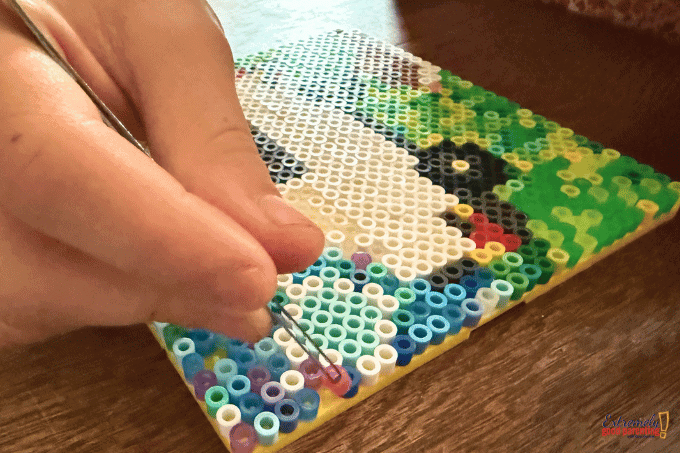
Why perler beads work so well:
- Each bead is uniform in size (perfect “dots”)
- Wide range of colors available
- Mistakes are easily corrected
- Finished pieces can be ironed and kept as keepsakes
- Works for simple designs (younger kids) and complex artwork (older kids)
My youngest can create simple patterns or copy basic designs, while my 12-year-old has recreated sections of famous Pointillist paintings. The tactile nature appeals to kinesthetic learners, and the grid system on perler bead boards helps visual learners understand how individual elements build into a whole.
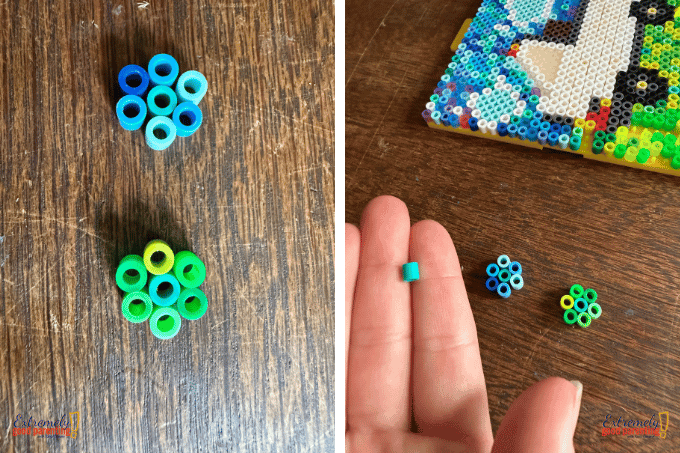
The color theory lesson: This is where we had our biggest “aha moment.” I showed my daughter how the same green bead looks completely different when surrounded by red beads versus blue beads. She spent an entire afternoon testing different color combinations, unconsciously learning the same principles Seurat used in his masterpieces. And she showed how the same color could be places in the “sky” of her creation and the “grass” but look completely different.
Ages 8-18: Digital Pointillism and Pixel Art
For my older children, we’ve expanded into digital realm with pixel art programs. This connects Pointillism to modern technology while maintaining the core concept of building images from individual colored units.
Tools we use:
- Free pixel art apps and websites
- Minecraft for 3D “pointillism”
- Graph paper for planning designs
- Sharpie markers for color theory exercises
The precision required for pixel art appeals to detail-oriented kids, while the connection to video game graphics keeps them engaged.
Ages 8-16: Markers and Sharpies for Color Theory Mastery
Once my children had grasped the basic concept through perler beads, I wanted to introduce them to more traditional art materials while maintaining the controlled aspect that makes Pointillism so educational. This is where fine-tip markers and Sharpies became our go-to tools.
Why markers work brilliantly for Pointillism:
- Consistent dot size when used with a dabbing motion
- Wide range of colors available
- No drying time or mess
- Easy to control pressure and placement
- Perfect for studying color relationships
Our marker progression:
- Ages 8-10: Crayola fine-tip markers on heavyweight paper
- Ages 11-14: Prismacolor fine-tip markers for more color options
- Ages 15+: Sharpie fine-tips and brush tips for varied effects
The color theory breakthrough: This is where my children really began to understand complementary colors, warm vs. cool relationships, and optical mixing. I’d have them create simple color wheels using only dots, then experiment with placing different color combinations next to each other.

Favorite marker activities:
- Color mixing charts: Creating gradients using only pure colors placed closer or farther apart
- Complementary color studies: Red dots next to green dots, blue next to orange, watching how each color appears more vibrant
- Value studies: Using only one color family (like blues) but varying the dot density to create light and shadow
- Texture experiments: Varying dot size and spacing to suggest different surfaces
The patience lesson: Working with markers taught my kids the meditative aspect of Pointillism that Seurat himself described. My 12-year-old spent three hours creating a 6×6 inch sunset using only orange, yellow, red, and purple markers. The concentration required was incredible, and the final result was something she was genuinely proud of.
Pro tip: I learned to have them work on smaller compositions (4×6 inches maximum) to prevent frustration. The detail work required for larger pieces was overwhelming for most ages.
Ages 10-18: Traditional Pointillism Techniques
My oldest children have progressed to actual paint and brushes, creating their own Pointillist-inspired artwork. We start with simple subjects – a piece of fruit, a flower – and gradually work toward more complex compositions.
Materials for serious Pointillism:
- Acrylic paints in pure colors
- Small round brushes (sizes 0-2)
- Canvas boards or heavy watercolor paper
- Color wheels for reference
- Magnifying glass for studying technique in art books
Preparing for Success: Our Video Resources
Before starting any Pointillism project, I always show my children videos that explain the technique and show it in action. Here are our family favorites that I’ll link below:
These videos help them understand the “why” behind the technique before they start creating. My visual learners especially benefit from seeing the transformation from individual dots to complete image.
Cross-Curricular Connections: Making it a Full Unit Study
What I love about Pointillism is how naturally it connects to other subjects. Here’s how we’ve expanded our dot-making into a full unit study:
Science: Color theory, optics, how the eye perceives color, light wavelengths Math: Patterns, geometry, ratios (especially in perler bead designs) History: Late 19th-century France, the Industrial Revolution’s impact on artGeography: Paris, the Seine River, locations of famous Pointillist paintings Literature: Reading about Seurat’s life, the art world of the 1880s
The Reality: What Actually Works (and What Doesn’t)
Let me be honest about what I’ve learned through trial and error:
What works:
- Sketching outlines first
- Having older students do one element of a picture at a time so they can have a completed artwork even if they decide to leave out elements
- Starting simple and building complexity gradually
- Having ALL materials ready before beginning
- Emphasizing the process over the product for younger children
- Taking frequent “step back and look” breaks
- Connecting to famous artworks they can see online or in books
- Utilizing AI to take a photo and turn it into pointillist art for the more complex pictures to help them visualize what they need to do
What doesn’t work:
- Starting with too many color choices (overwhelming)
- Expecting perfection from any age
- Doing complex or detailed work when kids are tired or hungry
- Forgetting to protect surfaces (seriously, dots get everywhere)

Age-Appropriate Expectations
Ages 2-5: Focus on the joy of making dots and the magic of stepping back to see the image Ages 6-9: Introduce basic color mixing concepts and pattern recognition
Ages 10-13: Explore color theory, optical mixing, and historical context
Ages 14+: Study the scientific basis of the technique and create complex original works
Building Art Appreciation Through Hands-On Learning
One unexpected benefit of our Pointillism adventures has been how it’s transformed my children’s art appreciation. When we visit museums or look at art books, they now actively seek out brushstrokes and color choices. They understand the patience and planning required for Seurat’s massive compositions because they’ve experienced the meditative rhythm of placing individual dots.
Some of my kids have found it to be the style they didn’t know existed that was tedious yet rewarding while other hated every second.
Resources for Extending the Learning
After experimenting with different approaches and materials, I’ve created two resources that support families wanting to dive deeper into Pointillism education:
For families wanting to add copywork and art history: I developed a Pointillism Copywork guide that includes sentences about the technique and famous artists, differentiated for four different skill levels. It’s perfect for adding handwriting practice to your art study, and at $3.50, it’s an easy way to add educational value to your projects.
For families ready for a comprehensive art study: My Foundation of Modern Art curriculum places Pointillism in the broader context of art history, showing how it connects to Impressionism and influenced later movements. It includes project ideas, cross-curricular connections, and resources for grades 3-12. This has been a game-changer for families wanting to understand not just individual techniques, but how art movements build on each other.
Both resources grew directly out of my own family’s learning journey and the realization that hands-on art creation becomes so much richer when combined with historical understanding and skill-building activities.
Making Memories Through Dots
As I write this, I can see my 6-year-old at the kitchen table, carefully placing blue perler beads next to yellow ones and watching them “turn green” in his peripheral vision. Nearby, my 12-year-old is sketching plans for a pixel art version of van Gogh’s “Starry Night” (not technically Pointillism, but the dot connection is there!).
These aren’t just art projects – they’re science experiments, history lessons, and patience-building exercises all rolled into one. More importantly, they’re creating shared experiences and vocabulary that will last long after the dots are cleaned up.
Pointillism has taught my children that complex, beautiful things can be built from simple elements when you have patience and vision. Whether they’re 6 or 16, that’s a lesson worth learning.

Pointillism Neo-Impressionist Art Copywork Pack
Explore Pointillism and Neo-Impressionism with this five-day copywork pack for ages 5+. Includes leveled handwriting sentences on art history, step-by-step instructions for two differentiated art projects (flower garden and sunny landscape), four dot-coloring pages, and a blank art frame. Ideal for homeschool or classroom use to build fine motor skills, color theory knowledge, and creativity.
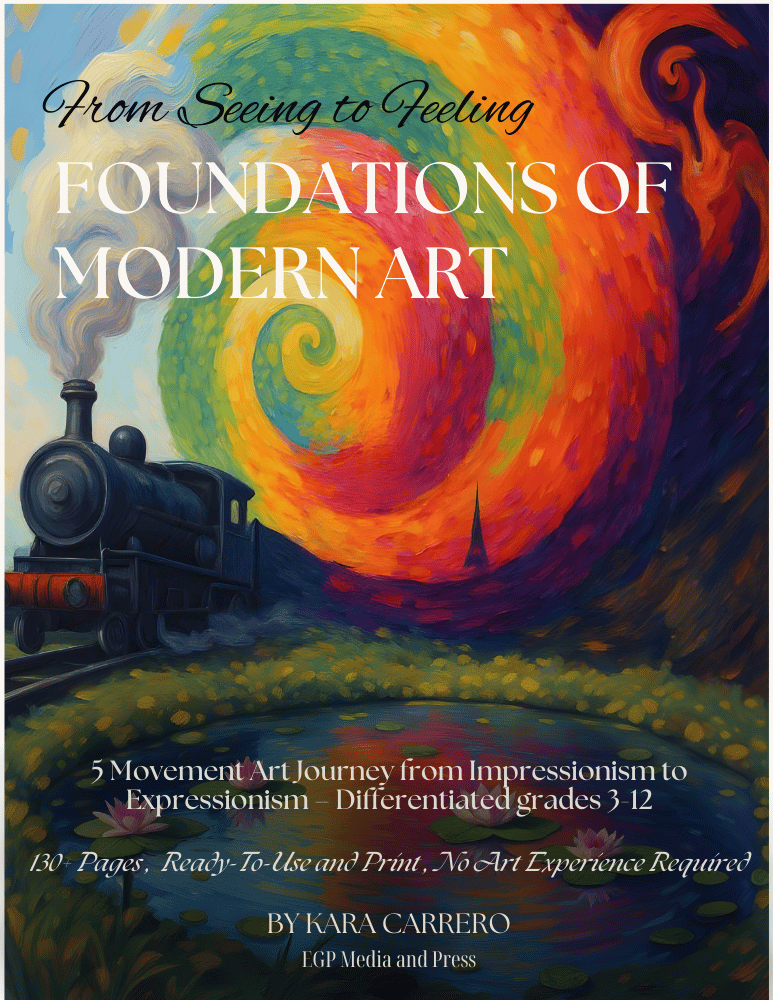
Foundations of Modern Art: From Seeing to Feeling Art History Unit Study
Complete art history curriculum and unit study covering the birth of modern art (1860s-1910s). Includes 5-movement progression from Impressionism to Expressionism with differentiated materials for grades 3-12. Features hands-on projects, historical context, assessment tools, and flexible 5-day to 3-week implementation. Perfect for homeschool, classroom, or family learning. 130+ pages of ready-to-use content.