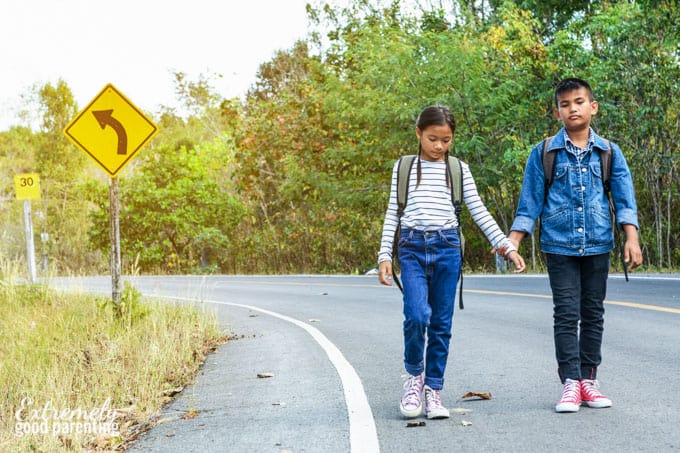
How to empower a student after their teacher uses fear as discipline
As I walked to the dismissal line at school, Jenn quickly walked right past me with a sour face. She trotted to the car without a word and melted immediately upon entering the van. “What’s wrong? What happened?” I asked.
“Ms. Kinsington told us if we weren’t better, she wouldn’t be our teacher anymore!” she sobbed. “So many other kids were talking and so tomorrow we all have to sit out at recess.”
Disappointed by her teacher’s use of class punishment and fear-based discipline, I scrambled to find the right words to ameliorate the situation. What band-aid could I use to not let it haunt her the rest of the night?

I started by asking her “What can I do to help make you feel better?” because this was obviously a runaway train on a fast track to hysterical, crazy land. Therefore, if we didn’t have some immediate relief of grief, our night was done.
“I JUST WANT UNICORNS… but they’re not even real so nothing will ever make me feel better,” she blubbered from the back seat.
“Oh dear Lord” I thought, “This is going to be a long night.”
… “Ok, let’s start with a snack. Let’s grab a bit of protein and sip some water while we talk. Sound good?”
And so we did. And I asked her three big questions to help try to heal the fear and frustration she was feeling.
How to handle when a teacher has a different discipline style than you prefer
We have taught Jenn that even when we don’t agree, her teacher is the one in charge when she’s in school. And as a parent, we want to teach her to respect those in authority.
It is possible to quietly dissent and gently shape and guide a child at home when the instances are few and far between. (Of course, the more over-the-top responses would require some constructive and one-on-one talks with the teacher and/or principal).
I was once a teacher myself so I know that classroom management isn’t a 1-to-1 equal to discipline while parenting. And this is important for every mom and dad to recognize. It’s also important to acknowledge that not all parenting styles are the same and with 15-30 kids in an average classroom there’s a lot of variance.
But there are still lines that I believe should not be crossed because they erode the trust of children.
I don’t believed in fear-based tactics to coerce kids to behave in a certain way, but sometimes teachers still use it in moments of desperation, as a last resort, and to hopefully get their desired outcome.
And so then these young, impressionable minds come home scared, frustrated, and terrified. They melt into giant sobbing puddles of “eager to please, but afraid to disappoint” just like Jenn did.
Related: Parents who build unshakable trust with their kids have these 7 things in common.
Questions to ask your child after their teacher uses whole-class discipline.
And for kids under the age of about 8 or 9, they are still trying to figure out the world around them and understand how consequences work. Their prefrontal cortex region lacks development (In fact it isn’t completely developed until the mid twenties). However, the prefrontal cortex is what is responsible for executive functioning, determining good and bad, figuring out consequences, and knowing what expectations others have of them to behave appropriately. (1)
Therefore, if we help gently guide them at home, they can better understand consequences at school. And there are three main questions that can help lead our kids to conclusions that will help develop those skills.
Grab your free “parents’ guide to behaviors” download.
Click Here.
“How do you react when you feel frustrated? Do you think your teacher felt frustrated?”
For weeks we have been discussing that huge outbursts of anger, screaming, or stomping are not appropriate. We have talked about using our words when we’re mad, not our actions and to make sure that our words express how we feel without hurting the person we’re talking to.
So I asked her if she lashes out sometimes when she’s frustrated. And it immediately reframed the situation. Suddenly she could empathize with Ms. Kinsington because she understand she said something rash in the heat of the moment.
It was just as impulsive as Jenn’s own threats to her sister that she would never, ever play with her again.
Related: Nurturing emotional intelligence empathy
If you could do one thing differently today to get a different outcome, what would it be?”
And then we talked about the class as a whole. In this case it was about talking. And most times, the whole class gets punished for talking.
Was the class talking over her for the most part?
Could they have behaved better?
Even if Jenn wasn’t talking in the moment, did she make good choices?
And so in comes the discussion about natural consequences. If she talked over me at home, the natural consequence would probably be something along the lines of losing the privilege to speak without raising her hand. So we would discuss that and get some books to reinforce the concept.
Books to donate to child’s classroom or help your kids with talking in class
“What can you do tomorrow to do better and be an example to your classmates?”
Finally, we talked about how part of learning was that we practice. And as with any practice, progress is made.
So what could Jenn do to ensure tomorrow was better? We discussed how we cannot control anyone but ourselves, but controlling our own behavior was enough.
What other questions would you use as either a parent or teacher to help with whole-class discipline?
Check out the sneak peek of our Pocket Guide to Behavior and sign up by CLICKING THE IMAGE: