The Psychology of Folklore: Investigating Historical Myths with America’s Original Tall Tales
Here is something worth sitting with before you teach your next history lesson.
Americans pride themselves on being straight-talkers that are practical and grounded. A pull-yourself-up-by-your-bootstraps, tell-it-like-it-is kind of people. We celebrate the self-made individual, the honest laborer, the person who does not need a gilded story to feel good about themselves. We have built an entire national identity around the idea that we deal in facts, not fairy tales.
And yet.
No nation on earth has mythologized its own history more aggressively, more creatively, or more persistently than the United States.
This is not an accusation, rather it is one of the most fascinating things about American culture, and it is a tension worth putting directly in front of your students. Because the question of why a nation that prizes honesty and hard truth produces so many elaborate historical myths is not a cynical question. It is one of the most revealing questions in American History education.
America Has Always Been a Nation of Storytellers
The American tall tale did not begin with Paul Bunyan swinging his axe through a Wisconsin forest, or Pecos Bill lassoing a tornado, or John Henry driving steel against a machine. Those stories came later, built on top of a tradition of mythmaking that started at the very beginning, in the first decades of colonial settlement, and accelerated rapidly through the Revolutionary period.
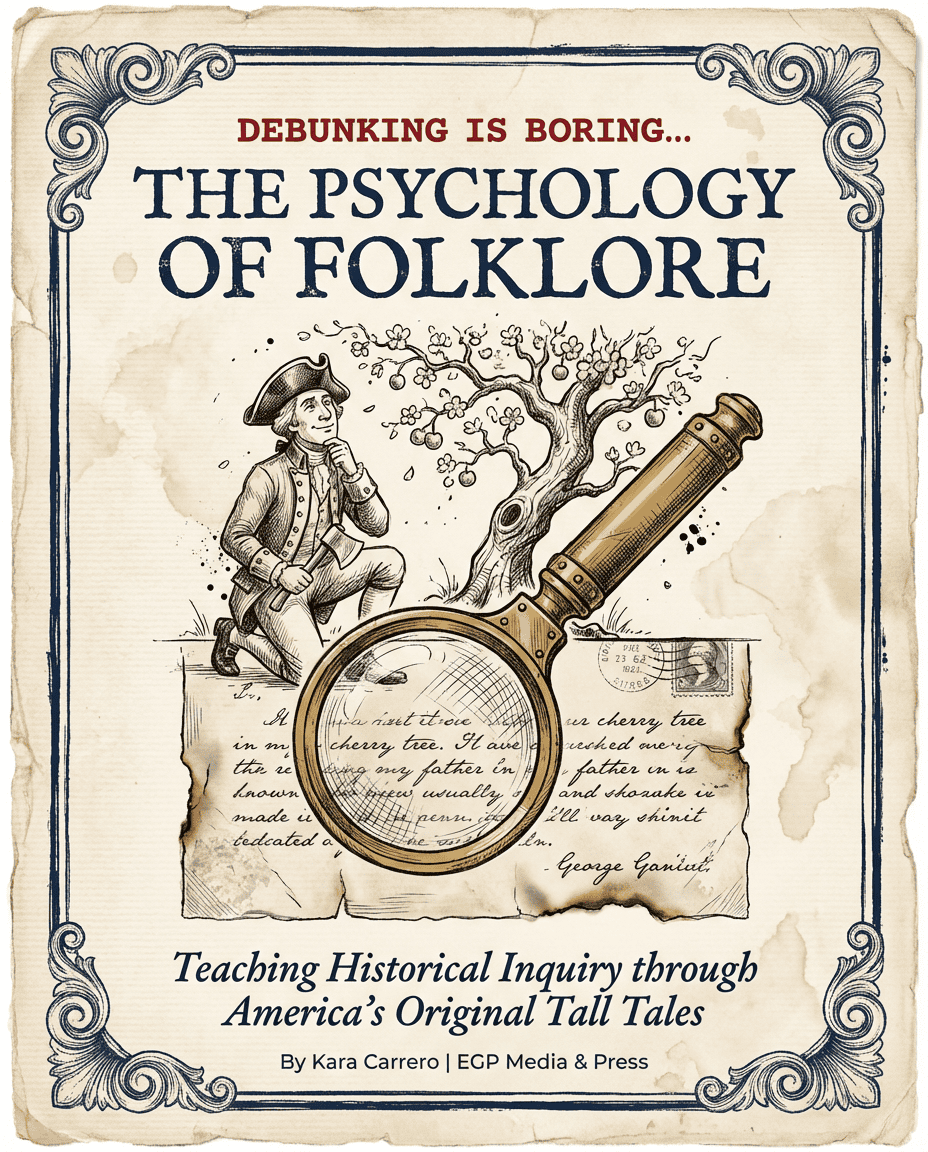
Before there was Paul Bunyan, there was George Washington.
The American Tall Tale Has a Much Longer History Than Most People Realize
When most people think of American folklore and tall tales, they think of the 19th century: the frontier, the lumberjacks, the railroad workers, the cowboy culture that produced exaggerated heroes to match an exaggerated landscape. Paul Bunyan. Davy Crockett (the legend, not the man). Mike Fink. Casey Jones.
But the pattern starts much earlier, and it starts in places we tend to think of as serious historical record rather than folklore.
Consider Plymouth Rock. If you have been there, it’s underwhelming in size and stature. The story holds that the Pilgrims stepped ashore onto a specific boulder in 1620 as the first act of settlement in the New World, making that rock the literal foundation of America… which seems like it should be large or even HUGE. It is one of the most recognizable images in the national imagination. The rock has been moved, split, nearly destroyed, and eventually enshrined under a neoclassical portico in Plymouth, Massachusetts where it receives hundreds of thousands of visitors per year.
Who knows if it was all that massive when they landed or not.
Or if the rock even existed.
The rock is not mentioned in any primary source from the period. Not in William Bradford’s detailed chronicle of the Plymouth Colony. Not in any letter, journal, or official record from 1620. The first written reference to a specific rock as a landing site appears more than a century later, in 1741, when a 94-year-old man named Thomas Faunce claimed to remember his father telling him about it. That account was then embellished, popularized, and eventually cemented as national origin mythology during the years surrounding the American Revolution, when a young nation needed a clean, symbolic creation story.
That is the pattern. And it predates Paul Bunyan by well over a century.
The George Washington cherry tree story follows the same architecture. A traveling Methodist minister and bookseller named Mason Locke Weems published it in 1806 in a biography of Washington, seven years after Washington died. Weems invented it. He said so, essentially, in his own writing, describing his intent to give readers a moral lesson suited to the national hero they needed. The story spread because it was useful, not because it was true.
The Betsy Ross story, in which Washington personally visits a seamstress in Philadelphia and asks her to sew the first American flag from a sketch he has drawn, appears nowhere in the documentary record of the Revolutionary period. The account was introduced publicly in 1870, nearly a century after the events it describes, when Ross’s grandson presented it to the Historical Society of Pennsylvania. It may contain elements of truth. It may be entirely constructed. There is no way to verify it because no contemporary source records it.
These are the central stories of the American founding, and they were largely invented or dramatically embellished by subsequent generations who needed them to be true.
The Tension at the Heart of American Historical Memory
Here is the genuinely interesting question, the one worth wrestling with before you bring it to your students: why does a nation that prides itself on practicality, self-reliance, and no-nonsense grit produce such elaborate and persistent mythology about its own past?
Part of the answer is that the mythology serves the practicality. The bootstrap ideal needs origin stories populated with people who bootstrapped.
- Washington cannot just be a wealthy Virginia planter and skilled military strategist who benefited enormously from colonial privilege. He needs to be a boy who could not tell a lie, a general who prayed in the snow at Valley Forge, a leader who was offered a crown and refused it. Whether or not those specific stories are accurate, they construct a kind of founding character that validates the values Americans want to see in themselves.
- The same logic applied from the very beginning of European settlement in America. The Pilgrims were not, for the most part, poor and desperate refugees. Many were middle-class Separatists with sufficient resources to fund an ocean voyage. The landing on Plymouth Rock, whether or not it happened, became a story about humble origins and courageous beginnings because that is the story a developing national identity required.
- The signers of the Declaration of Independence are perhaps the most dramatic example of this pattern. The viral essay that circulates every Fourth of July, claiming that all 56 signers lost everything, that they were hunted down and executed, that they died in poverty as a direct result of their decision to sign, has been shared millions of times and appears in classroom materials across the country. It is largely false. Several specific claims in it are entirely false. No signer was executed for treason. Many faced no direct military retaliation at all. Benjamin Franklin died a celebrated, wealthy man. The true stories of what signers actually experienced, including the ones that are genuinely dramatic and genuinely involve real sacrifice, are crowded out by an exaggeration so pervasive that most adults cannot distinguish the myth from the record.
The mythologized version exists because it serves a purpose. It says: the founding of this country cost everything. It says: these men gave all they had so that you could have what you have. Whether or not that claim is fully accurate, it carries enormous emotional and civic weight. Maintaining it feels, to many people, like honoring the past. Questioning it can feel like disrespect.
This is the tension that makes American historical mythology so rich to investigate with students, and so important to address honestly in the classroom and at the homeschool table.
The Problem: We Have Confused the Legend with the Honor
Here is a reframe that might change how you approach this material.
Exaggerating the myth does not honor the real people. It replaces them with cardboard figures.
When the story becomes that all signers lost everything and were executed, the signers who actually did face brutal consequences, Richard Stockton, who was imprisoned and tortured and eventually signed an oath of loyalty to the British Crown under duress, Francis Lewis, whose wife was captured and held in conditions that destroyed her health, Abraham Clark, whose sons were imprisoned on a notorious British prison ship in conditions designed to break them, those real stories get absorbed into a generic, undifferentiated legend of collective suffering that is actually less powerful than the specific truth.
Stockton recanted. That is historically documented and deeply uncomfortable. He was the only signer who signed a loyalty oath to Britain. He did so after being subjected to physical torture. What does that mean? What does it tell us about the limits of human endurance? What does it tell us about what we ask of people when we make them into symbols? That story is harder and more interesting than any tall tale version, and it respects Stockton’s actual humanity in a way the legend does not.
Caesar Rodney rode 80 miles through a night of thunderstorms while battling cancer and a disfiguring skin condition, arriving in Philadelphia to break Delaware’s tie vote for independence. He did not need any embellishment. The documented record is astonishing. But students who have only encountered the generic “signers lost everything” mythology have never heard Caesar Rodney’s name, because specific true stories require more effort than sweeping exaggerations.
Teaching the myth as myth is not cynicism about the founding era. It is the most genuine form of respect for the people who actually lived it.
Why History Often Feels Flat (And Why Myths Feel So Alive)
Every teacher and every homeschool parent who has taught American history has faced the same moment. You introduce the chronology of events leading to the Revolution. You talk about Parliamentary taxation, colonial assemblies, and the First Continental Congress. You watch the engagement drain out of the room.
Then someone mentions that Paul Revere rode alone through the night shouting “The British are coming!” and a hand goes up. Someone wants to know how fast his horse was. Someone wants to know if he was scared. Someone wants to know what happened.
The myth pulled them in… and the Myth far beyond the vocabulary of “British” vs “Redcoats”.
This is a reflection of how human cognition actually works. We process narrative differently than we process lists of events. We engage with characters under pressure in a way that purely sequential history does not trigger. The myth is doing real pedagogical work just by generating engagement.
The mistake that traditional history instruction sometimes makes is treating the myth as the enemy of learning and the dry record as the only legitimate alternative. There is a third path, and it is far more powerful than either.
Paul Revere was actually one of dozens of riders dispatched that night by the colonial warning system. He was captured by a British patrol before completing his ride and never reached Concord. A man named Samuel Prescott, who happened to be riding home from a late-night visit with his fiancee, was the one who actually got through. William Dawes also rode. The operation was a coordinated network, not a solo act.
That is a better story than the legend. It has more moving parts, more human texture, and it tells us something genuinely interesting about how colonial resistance actually functioned. But students only discover that story when they discover the gap between the legend and the record.
That gap is the doorway and we walk through it with them.
Introducing the Investigator’s Evidence Ledger (Free Download)
To help students formalize that investigator mindset, I created the Investigator’s Evidence Ledger, a hand-designed graphic organizer built around the three core questions that every American historical myth deserves to face.
You can download the ledger for free and use it with any legend, tall tale, or founding mythology you are already teaching. It is designed to work in a single class period or as part of a longer unit, and it scales from upper elementary through high school without requiring separate versions for different ages.

Download the Investigator’s Evidence Ledger here – free, printable, and usable with any American legend or historical myth.
Here is what each section of the ledger asks students to do:
Section 1 – The Tall Tale Anatomy: The Legend
Before students can investigate a myth, they need to be able to state it precisely. This first section asks students to identify the “larger than life” claim at the heart of the story. What is the extraordinary assertion being made? What would make this story feel like legend rather than biography?
Section 2 – The Evidence Lab: The Record
This is where the investigation begins. Students identify three primary source facts that either contradict or meaningfully complicate the legend they named in Section 1.
Section 3 – The Psychology Engine: The Why
This section is where the Investigator’s Evidence Ledger separates itself from a simple fact-check activity. After students have identified the legend and examined the record, they are asked to think about why the myth survived. Three engines are offered as starting points:
Hero-Making – We needed a role model. The real person was complicated, flawed, or simply too human to carry the symbolic weight the nation required, so the story was adjusted to produce the hero we wanted.
The Telephone Effect – The myth grew through repetition and retelling across decades and generations. Details shifted, exaggerations accumulated, and eventually the embellished version displaced the accurate one in public memory.
Winners Write History – The myth survived because it served a specific purpose for specific people who had a stake in controlling how the past would be remembered and what lessons it would teach.
Students select one or more of these engines and then answer the question at the bottom of the page: does the truth make the history more or less interesting? Defend your verdict.
That question has no wrong answer, and it consistently generates the most substantive historical thinking students produce. Because once a student realizes that the actual documented story is more complicated, more human, and in many cases more dramatically compelling than the sanitized version, they rarely want the simple version back.
The Moment the Investigation Changes Everything
There is a specific moment in historical myth investigation that is worth watching for. It happens when a student who has been working through the evidence in Section 2 stops, looks up, and says some version of “wait, so people just made this up?”
That productive skepticism is the goal.
After that moment, students stop accepting historical stories at face value because they have been equipped to investigate any and everything. That skill does not stay inside the history classroom, it travels with them.
History Is Not Served by a Perfect Story
There is an argument, sometimes made with genuine sincerity, that teaching students to question founding myths is somehow unpatriotic or that it produces cynicism about American history and American institutions.
The evidence from classrooms and homeschool settings consistently points the other direction.
Students who learn to investigate the myths do not come away respecting the founding era less. They come away respecting it more accurately, and accuracy produces a more resilient form of respect than mythology does.
Americans pride themselves on not needing a fairy tale. Our history education should reflect that pride.
Start the Investigation
The Investigator’s Evidence Ledger is free. Download it, use it with whatever legend or founding myth you are already planning to teach, and watch what happens when your students stop being told history and start investigating it.
When your students are ready to go deeper, the American Myth Investigators collection is ready with fully developed case files, primary source support, differentiated activities, and complete teacher and parent guides for every product.
Your students will never look at a good story the same way again.
Browse the ever-growing American Myth Investigators collection here.
For members and supporters
Get access to the Download Dashboard
Printable PDFs in course format for history, literature, and cross-curricular studies. Download what fits your students, print it, and start teaching.
- Course-style PDFs. Structured, ready-to-print studies that guide students from the first page to the last.
- Grab what you need. Choose the studies that fit your students and download them from one dashboard.
- New downloads as it grows. More are added over time, so there is always something new to print.
$5 a month
See what is inside Already a member? Open your dashboardPrefer to start free? Many challenges also arrive as simple emails when you subscribe.



This is all so very interesting!! I will share this with my children, as soon as I get home!
Interesting! Sharing w/ some friends and family.
What a fascinating read. Definitely something I’ll be sharing about in my classroom!