You Don’t Have to Cook to Teach with Historical Recipes (But You Can)
Someone once told me they loved the idea of educational cookbooks but were intimidated by actually using them. The cooking felt overwhelming.
I get it completely.
Not every learning environment has a kitchen. Even if you homeschool with a full kitchen available, you might not want flour on every surface on a Tuesday morning. And for classroom teachers, the idea of adding cooking to an already packed school day can feel like one more thing that sounds great in theory and falls apart in practice.
Here is what I want you to understand: historical recipes work just as well on paper as they do at the stove.
In fact, some of the most powerful learning that happens around historical recipes has nothing to do with cooking at all. It happens when a student looks at an ingredient list and starts asking questions.
This post is for every educator who has ever been drawn to the idea of teaching history through food but has not been sure how to make it work in their actual learning environment. Whether you are a classroom teacher without kitchen access, a homeschool parent who wants a no-mess Tuesday morning option, or someone who absolutely wants to cook and just needs to know where to start, this is for you.
A Recipe Is a Primary Source First, a Cooking Instruction Second
Before anything else, it helps to reframe what a historical recipe actually is.
A recipe is a document. Like a letter, a diary entry, or a newspaper article, it was created by a real person in a specific time and place, and it carries evidence about that world embedded in every line.
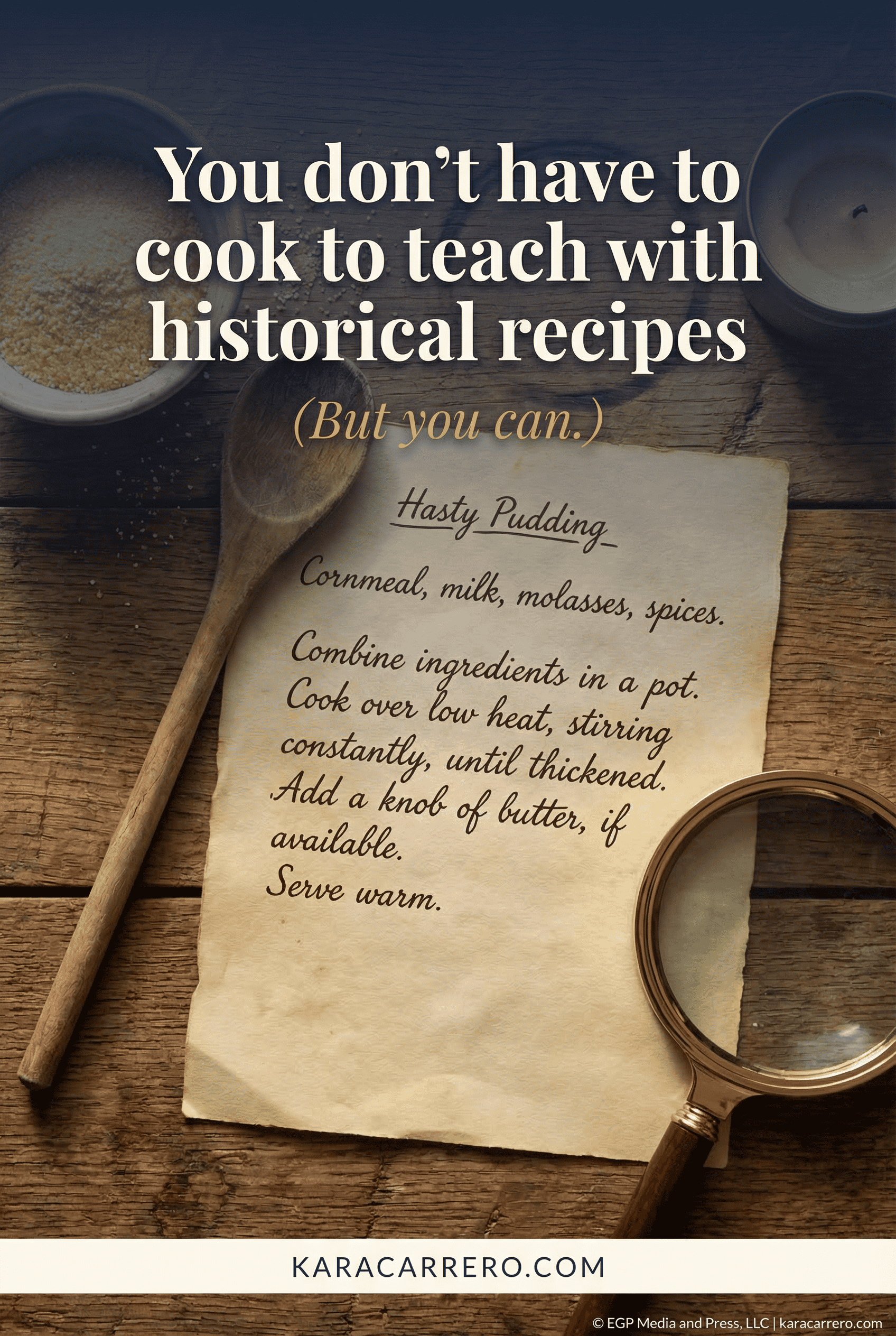
When a Colonial housewife wrote down a recipe for hasty pudding, she was documenting what was available, what was affordable, how much labor a meal required, and what her family’s daily reality looked like. She was not thinking about curriculum. She was recording survival.
That makes the recipe a primary source, and primary sources can be read, analyzed, discussed, and written about without anyone lighting a burner.
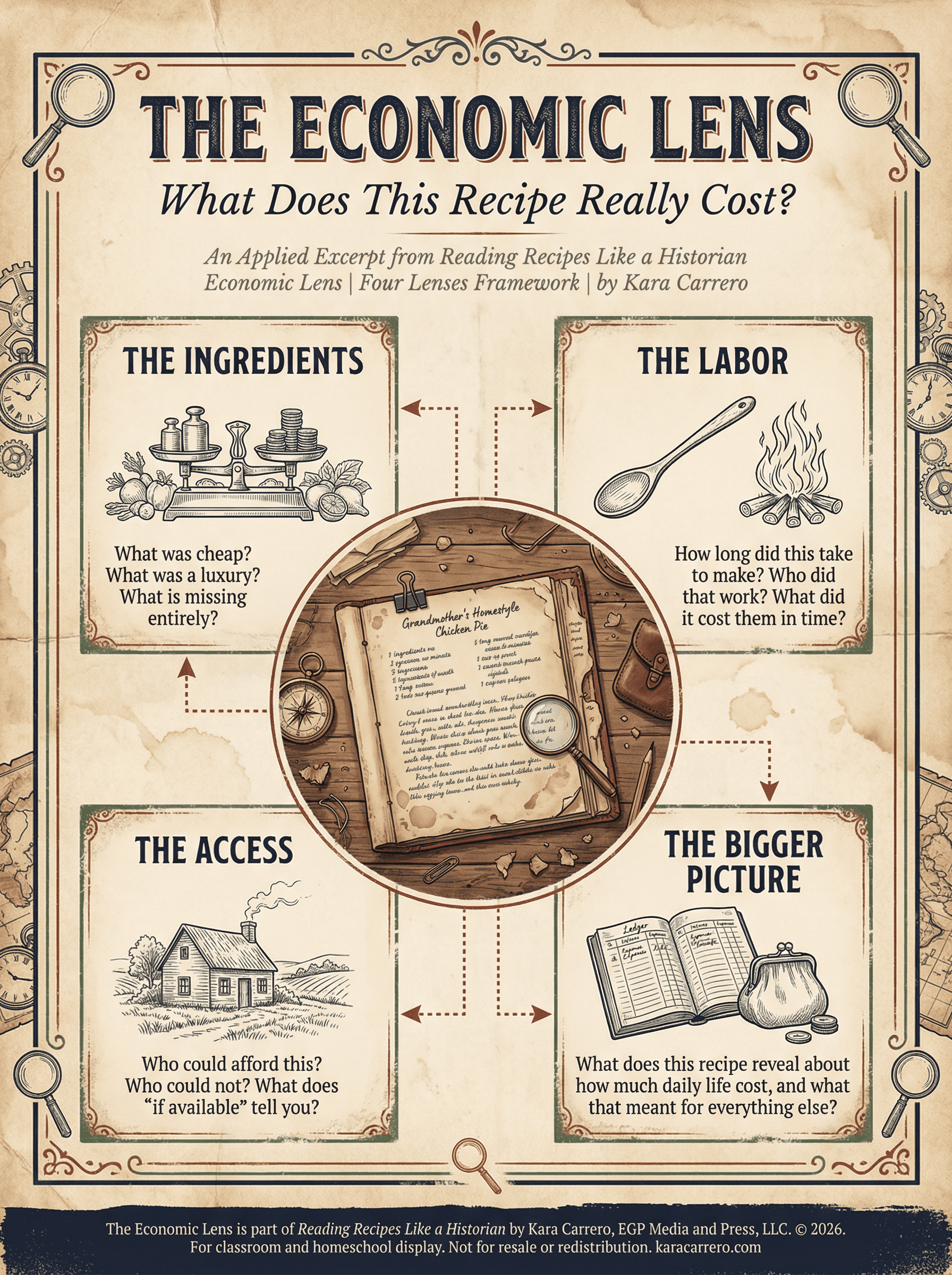
A student who spends forty-five minutes investigating a 1700s cornmeal recipe through an economic lens, asking what was cheap, what was a luxury, and who was doing the labor, is doing genuine historical analysis. The pot stays in the cupboard. The thinking happens on paper.
This is actually how historians work. They read recipes as evidence, not as instructions. Your students can do the same thing.
How to Use Historical Recipes Without Cooking: Six Approaches That Work
1. Discussion and Close Reading
Print the recipe. Read it aloud together. Then ask the questions that turn a recipe into a history lesson.
For any historical recipe, a few starting points that work across grade levels:
➔ What ingredients are in this recipe? Which would have been cheap and easy to find? Which would have been expensive or hard to come by?
➔ How long would this have taken to make? Who was doing that work?
➔ What does this recipe tell you about the daily life of the person who made it?
➔ What is missing from this recipe that you would expect to find in a modern version of the same dish?
➔ What does the word “if available” tell you about this household?
That last question, when applied to a Colonial recipe that lists butter or molasses as optional, opens up an entire conversation about economic class, trade policy, and daily hardship that no textbook passage achieves as quickly.
These questions work equally well as Socratic discussion in a classroom, a one-on-one conversation at the kitchen table, or written responses in a notebook. No cooking required.
2. Comparison Activities
Place a historical recipe next to a modern version of the same dish and let students examine what changed and what did not.
Take cornbread. A Colonial version calls for cornmeal, water, and salt, cooked in a cast iron skillet over an open fire. A modern version likely includes baking powder, eggs, milk, butter, and a preheated oven set to a specific temperature.
Ask students:
➔ What ingredients appear in both versions? What does that tell you about what has stayed constant?
➔ What is in the modern version that was not available to Colonial cooks? What does each addition represent in terms of technology or economics?
➔ Why does the Colonial version cook over an open fire while the modern one uses an oven? What does that shift represent in terms of daily life?
➔ Which version would you rather cook? Which version would have been harder to make? What does that difference reveal?
This kind of comparison builds historical thinking skills that transfer far beyond food. Students begin to see that everything that seems ordinary and modern was at some point an innovation, and that what we take for granted was once a luxury, or simply did not exist.
For classroom teachers, this works beautifully as a paired document analysis, the same skill tested on standardized assessments, applied to a more engaging set of texts.
3. Writing Prompts and Research Projects
Historical recipes are exceptional writing prompts because they ground abstract historical periods in concrete, sensory detail.
A few that work well across grade levels:
For younger students (grades 3 to 5):
➔ Write a story about a Colonial family making this dish. What is their day like? Who is cooking? What are they talking about?
➔ Draw and label what a meal from this era would look like. What is on the table? What is not there that would be at your table?
➔ Write a letter from a Colonial child to a friend describing what they ate for breakfast this week.
For middle schoolers (grades 6 to 8):
➔ Choose one ingredient in this recipe and research its history. Where did it come from? How did it end up in a Colonial kitchen? What did it cost?
➔ Write a comparison essay: How does this recipe reveal what Colonial families could and could not afford?
➔ Research food preservation methods from this era and explain how limited preservation technology shaped what families ate.
For high schoolers (grades 9 to 12):
➔ Write a research paper connecting the ingredients in this recipe to British trade policy in the 1760s. How did government decisions show up on Colonial dinner tables?
➔ Analyze this recipe as a primary source: what does it reveal, what does it obscure, and whose perspective is centered?
➔ Create an argument: to what extent did food scarcity drive the political decisions that led to the American Revolution?
Every one of these prompts is rooted in a recipe but requires historical research, analytical thinking, and evidence-based writing. They meet rigorous academic standards while being far more engaging than a generic essay prompt.

4. Scene and Drama Activities
Historical recipes are also surprisingly effective anchors for drama and role-play activities, particularly for kinesthetic learners who need to inhabit history rather than read about it.
Try these with a single recipe as the anchor:
➔ Act out a scene. For a Colonial recipe, stage a conversation between a mill girl eating a boarding house breakfast and her employer. What are they each thinking about the food in front of them? For a Great Depression recipe, stage a family deciding how to stretch their last pounds of flour.
➔ Host a mock debate. Using food cost data from the Colonial era, debate whether the British taxation policies that affected everyday staples were a reasonable revenue strategy or an act of economic aggression.
➔ Simulate a household. Give students a weekly “income” based on historical wages for their era and a list of ingredient prices. Ask them to plan a week’s worth of meals. What do they have to cut? What do they have to prioritize? What happens when the price of molasses goes up?
These activities work especially well in co-op settings and classrooms, where the social dynamic adds a layer of authenticity. But they also work with a single child or a small group of siblings.
5. Cross-Curricular Projects
One of the strengths of food history as a subject is that it connects to almost every academic discipline naturally.
A single historical recipe can anchor work in:
➔ History and social studies: What was happening in this era? What policies, events, and social structures shaped what people ate?
➔ Language arts: Read the recipe as a primary source, write about it analytically, research its history, create a creative narrative around it.
➔ Math: Calculate ingredient costs against historical wages. Convert historical measurements to modern equivalents. Determine what percentage of a family’s weekly income this meal would have cost.
➔ Science: How did people preserve food without refrigeration? What is the chemistry behind sourdough fermentation or salt preservation? Why does fat prevent bread from going stale?
➔ Geography: Where did each ingredient come from? What trade routes made it available, or unavailable, in this region?
➔ Economics: What do ingredient choices reveal about supply and demand, trade policy, and economic class?
For homeschool families especially, this cross-curricular reach is part of what makes food history so efficient. One recipe, studied well, can anchor a full week of learning across subjects without requiring a separate lesson plan for each one.
6. Student Choice and Independent Research
One of the most underused approaches is simply letting students choose.
Present a list of historical recipes from the era you are studying. Ask each student to pick one that sounds interesting and investigate it independently.
Give them a set of guiding questions. What do the ingredients tell you about this time period? What surprised you about this recipe? What questions did it raise that you did not know how to answer? What would you need to research to understand this recipe fully?
Student-chosen investigation tends to go deeper than assigned investigation, because students are invested in understanding something they personally selected. For homeschool families, this can be a week-long independent project. For classroom teachers, it works well as a station activity or an individual research assignment.
When You Want to Cook: Making the Most of It
Everything above works beautifully without cooking. But if you do want to cook, even occasionally, the experience adds a dimension that is genuinely hard to replicate on paper.
There is something about the physical reality of standing over a pot and stirring cornmeal for twenty-five minutes that lands differently than reading about it. My children understood Colonial labor in a new way the morning we made hasty pudding together, not because I explained it, but because their arms got tired.
Related: What recipes reveal about history that textbooks never show
For homeschool families, historical cooking can be as simple or as involved as you want it to be.
On the simple end: make one recipe from the era you are studying. Keep it low-stakes. The point is not a perfect historical recreation. The point is the conversation that happens while you cook.
On the more involved end: if you want to go deep, you can try milling your own grain the way Colonial families did. Before I had a grain mill, I used a blender. For a truly hands-on approach with children, a mortar and pestle works for small amounts and gives kids a visceral sense of how labor-intensive this process was.
For classroom teachers, a single cooking session with one simple recipe, done as a demonstration or a shared class activity, can anchor an entire unit. It does not have to be elaborate. Even making trail mix together while discussing Westward Expansion food carries more weight than most worksheets.
One Teacher who used the Historical Kitchen cookbooks with her students, put it well: “The recipes were great. My students and I actually made quite a few of them. The extra information, the nutrition information, the substitution charts, was interesting and added to the lesson.”
The cooking enhanced the learning. But notice what she said first: the extra information added to the lesson. The historical notes did the work. The cooking deepened it.
The Historical Notes Are the Real Curriculum
This is worth saying directly: every cookbook in the Historical Kitchen series is built around historical notes woven into the recipes themselves.
The Colonial Kitchen includes colony-specific recipes, teaches students what anachronisms are, and has activities where students hunt for historical inaccuracies in Colonial cooking scenes. The Great Depression cookbook includes substitution charts showing how families stretched ingredients during hard times, which are themselves primary source documents that reveal the economic collapse of the era better than any statistic.
Those notes are the curriculum. The recipes are the anchor. Whether or not you ever cook a single thing, you have a rich, historically grounded set of primary sources to work with.
Start Here: A Free Lesson Packet
If you want to try this approach with a ready-made resource, I put together a free 13-page Economic Lens lesson packet built around a Colonial hasty pudding recipe.
It is designed for use with or without cooking, in classrooms, homeschools, and co-ops, and it scales from elementary through high school. It includes guided investigation questions, a reflection prompt, a drawing activity, and a reusable graphic organizer that works with any historical recipe from any era, in both color and black-and-white versions.
Print it, use it in your next lesson, and see what your students notice when they stop reading history and start investigating it.
History Does Not Require a Kitchen. It Requires Curiosity.
The moment a student looks at a Colonial ingredient list and asks “why didn’t they just use wheat flour?” is the moment they start thinking historically. The stove is optional. The question is not.
Whether you cook together, analyze on paper, write about it, debate it, or act it out, a historical recipe gives students something a textbook rarely does: evidence they can actually hold, examine, and question.
That is worth forty-five minutes on any Tuesday morning, flour or no flour.