Three free resources that teach critical thinking, historical perspective, and nuanced analysis of the American Revolution
Move beyond memorization. These three free resources help students question sources, understand context, and analyze the Declaration of Independence with depth and sophistication.
Complete lessons for K-12, ready to use tomorrow
Your Students Can Memorize Dates. But Can They Think Historically?
Most students can tell you when the Boston Tea Party happened or list a few grievances from the Declaration of Independence.
But ask them deeper questions and you'll often get silence:
These aren't "bonus" questions for advanced students. These are the foundational skills that separate students who memorize history from students who think historically.
The problem is, most curricula don't teach these skills explicitly. They assume students will just "pick them up" somewhere along the way.
They don't.
But you can change that, starting today.
Three Free Resources That Build Real Historical Thinking
Each resource teaches a different critical skill. Together, they create students who don't just know history - they know how to analyze it.
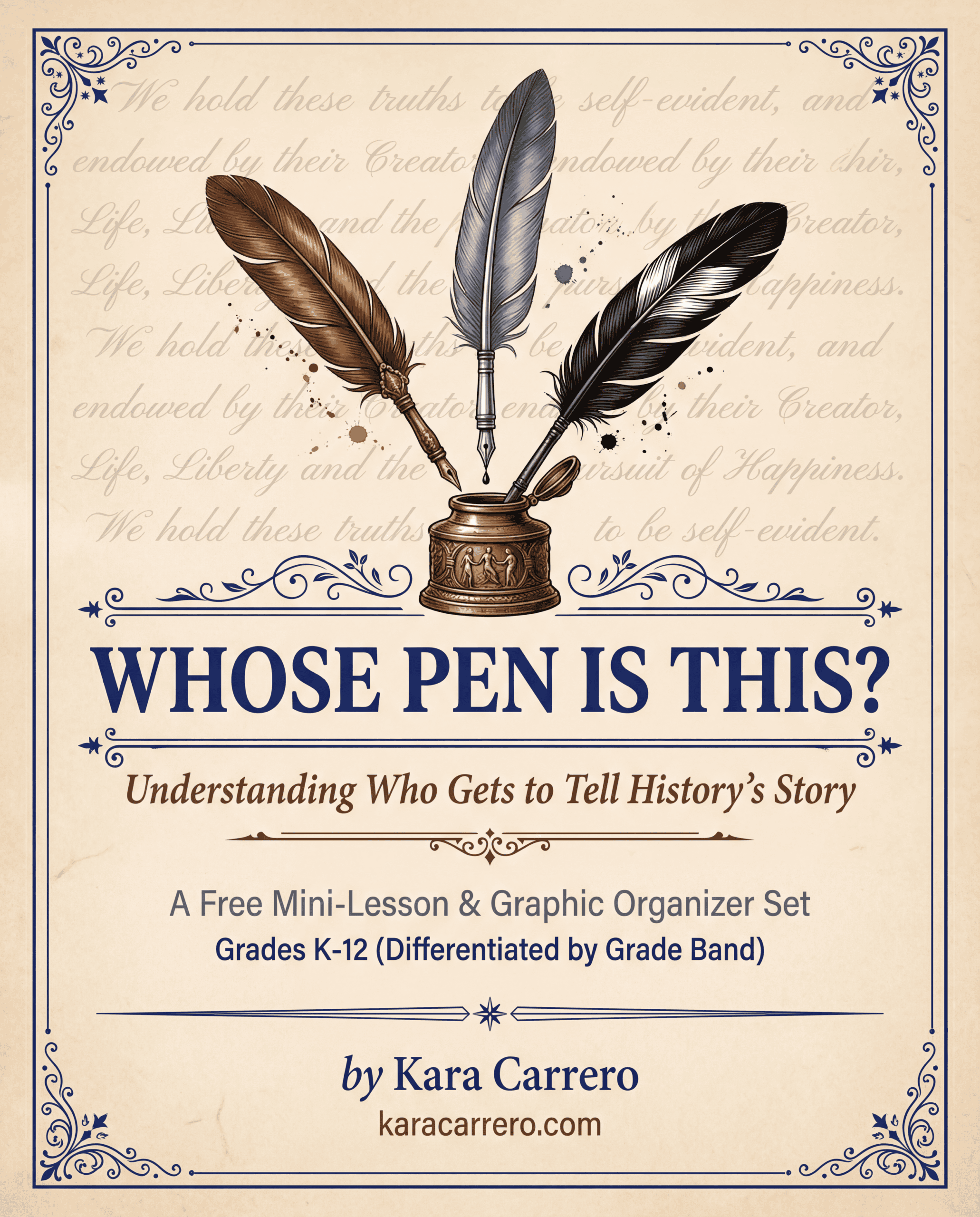
Whose Pen Is This?
The Problem It Solves: Students accept historical accounts at face value without asking who wrote them, why, or whose voices are missing.
What Students Learn:
- Every historical account reflects someone's perspective
- History is written by those with power, literacy, and access
- Many voices are missing from historical records entirely
- Understanding who writes history is as important as what they write
How It Works: Students analyze the same Revolutionary War event from three different perspectives, then grapple with whose voices are completely absent.
What's Included:
- Differentiated lessons for K-2, 3-5, 6-8, and 9-12
- Engaging graphic organizers
- Three event options with complete background
- Sample responses and extension activities
Perfect For: Teaching source analysis, media literacy, critical thinking, understanding bias

The Time Machine Rule
The Problem It Solves: Students either dismiss historical figures as "all bad" by modern standards, or accept harmful beliefs with "that's just how things were."
What Students Learn:
- How to distinguish between understanding why people believed something and excusing those beliefs
- The difference between historical context and moral relativism
- How to analyze the past on its own terms while still making moral judgments
- Why avoiding presentism doesn't mean avoiding moral responsibility
How It Works: A clear framework helps students navigate difficult histories like slaveholding Founders writing about liberty, or colonists claiming oppression while denying rights to others.
What's Included:
- Framework for avoiding presentism
- Strategies for difficult histories
- Age-appropriate approaches for different grades
- Revolutionary War examples
- Discussion prompts and reflection questions
Perfect For: Addressing controversial topics, developing moral reasoning alongside historical analysis, nuanced thinking

The Five Pillars Framework
The Problem It Solves: Students read the Declaration once, memorize "life, liberty, and the pursuit of happiness," and think they're done.
The Five Pillars:
- The Grievances - Were colonial complaints justified?
- The Philosophers - How did Enlightenment thinkers shape revolutionary ideas?
- The Road to Rebellion - What events led to revolution?
- The Creation Process - How was the Declaration drafted and debated?
- The Signers - Who were these 56 men and what did they risk?
What Students Learn: The Declaration must be understood from multiple angles. Historical documents don't exist in isolation. Ideas have intellectual ancestry. Creation processes involve debate and compromise. Individual human stories matter.
What's Included:
- Complete framework overview
- How each pillar builds historical thinking
- Grade-level suggestions
- Teaching strategies for each pillar
- Planning for 250th anniversary (2026)
Perfect For: Comprehensive Declaration units, interdisciplinary studies, project-based learning
Stronger Together: How These Three Resources Connect
While each resource is valuable on its own, they're even more powerful when used together. Here's how they build on each other:
Start with "Whose Pen Is This?"
Students learn to question every source: Who wrote this? What was their perspective? Whose voices are missing?
Add "The Time Machine Rule"
Students learn to understand historical context while still making moral judgments about the past.
Apply Both to "The Five Pillars Framework"
Students analyze the Declaration with sophisticated critical thinking, questioning sources (whose grievances?), understanding context (Enlightenment ideas in their time), and examining the document from multiple angles.
The Result
Students who don't just memorize the Declaration. They analyze it critically, understand it contextually, and recognize it as a complex document created by real people in a specific historical moment.
See What You'll Get
Here's a sample of the graphic organizers your students will use to analyze historical perspectives:
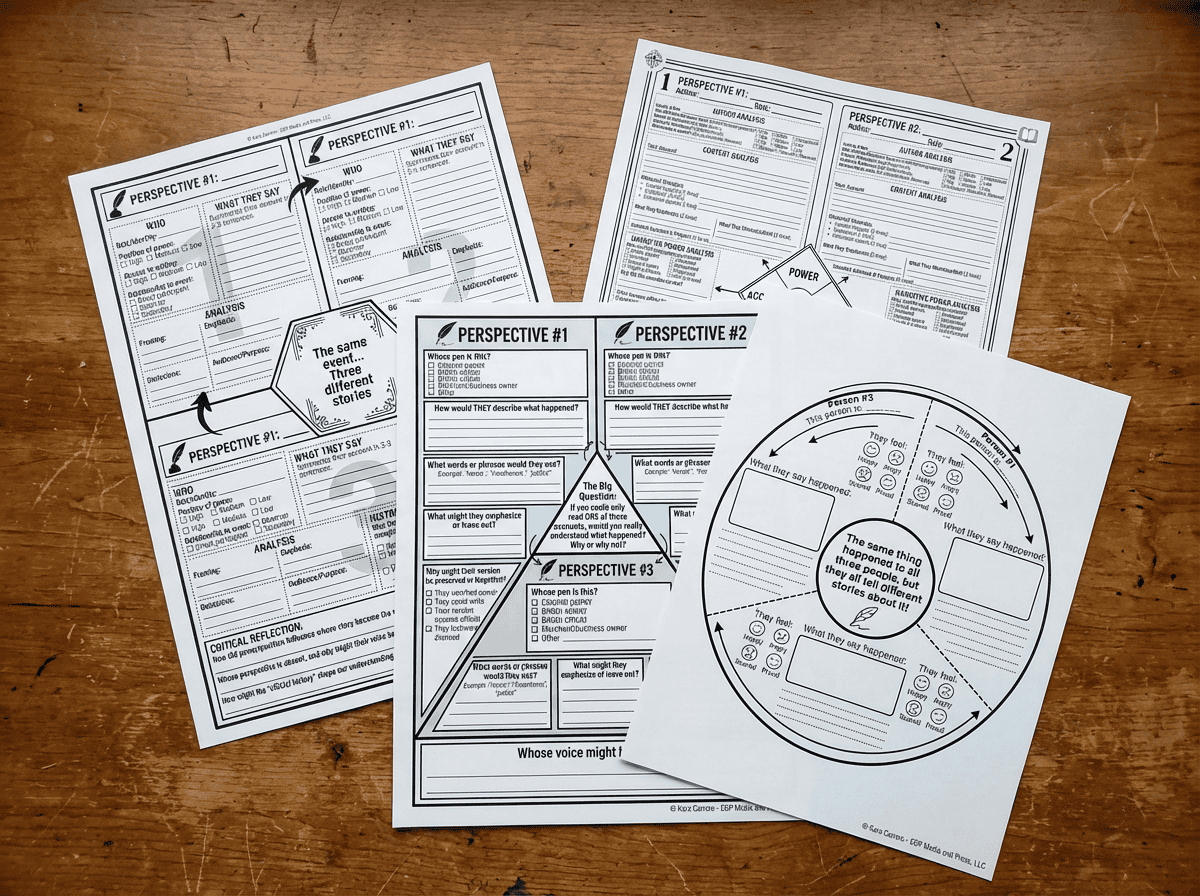
Students use graphic organizers to analyze how the same event looks different from different perspectives
One Set of Resources, Every Grade Level
Whether you teach kindergarten or AP US History, these resources adapt to your students.
K-2: Building Foundations
Students explore basic concepts: different people see things differently, people in the past thought differently than we do, big documents have lots of parts.
3-5: Developing Skills
Students begin analyzing perspective, understanding context, and exploring the Declaration's different elements.
6-8: Deepening Analysis
Students examine power structures, grapple with historical contradictions, and apply multi-dimensional analysis.
9-12: Sophisticated Thinking
Students engage with historiography, moral complexity, and comprehensive document analysis.
The Difference You'll See in Your Students
Before Using These Resources
- Accept textbook accounts without question
- Judge historical figures only by modern standards
- Read the Declaration once and think they understand it
- Struggle to analyze primary sources
- View history as simple good vs. evil stories
After Using These Resources
- Automatically ask "who wrote this and why?"
- Understand context while still making moral judgments
- Analyze the Declaration from multiple angles
- Confidently evaluate sources for bias and perspective
- Grapple with historical complexity and nuance
Questions You Might Have
You can download whichever resources fit your needs! Each works independently. But they're designed to complement each other, so using all three gives students the most complete skill set.
All three resources are differentiated for K-12. You'll get age-appropriate materials for your specific grade level.
"Whose Pen Is This?" takes 25-45 minutes. "Context Over Condemnation" is a framework you'll apply throughout the year. "Five Pillars" can be a single lesson or an entire unit depending on how deep you go.
Yes. These resources support standards around primary source analysis, critical thinking, historical reasoning, and content knowledge of the Revolutionary era.
Absolutely. "Whose Pen" and "Context Over Condemnation" teach transferable skills applicable to any historical period. Five Pillars is Declaration-specific but can be used as a standalone deep-dive.
No. Each resource includes all necessary background information.
Nope! All three resources are completely free.
Yes. These are free educational resources. Adapt them however works best for your students.
Ready to Transform Your History Teaching?
Download all three free resources now and start building students who think critically about history.
Important: After clicking download, check your email (and spam folder!) for the confirmation with your download link.
- Instant access
- Complete lessons ready to use
- No credit card required
- Unsubscribe anytime
About Kara Carrero

I'm Kara Carrero, educational content creator and curriculum developer at EGP Media and Press, specializing in American history education.
I create resources that transform complex historical concepts into engaging, interactive learning experiences while maintaining rigorous historical accuracy. My work helps teachers and homeschool families move beyond surface-level memorization to develop genuine historical thinking skills.
I believe students deserve history education that challenges them to think critically, question sources, grapple with complexity, and understand context. These three free resources reflect that commitment.
Whether you're planning for the Declaration's 250th anniversary in 2026 or simply want to teach the Revolutionary War with more depth and nuance, I'm here to help.