As a thank you, I have a special 1-time offer for you.
SAVE 25%
Take on the perspective of the Signers of the Declaration of Independence.
Walk in their shoes.
Face their choices.
Honor their sacrifice.
Interactive scenarios exploring 12 Declaration signers through critical decision-making moments. Perfect for the 250th anniversary.
Grades 3-12, but emphasis for secondary students.
This offer will expire in:
Regularly $21
Usable and Differentiated for Grades 6–12!
Experience History Through Colonial and Revolutionary Decision-Making
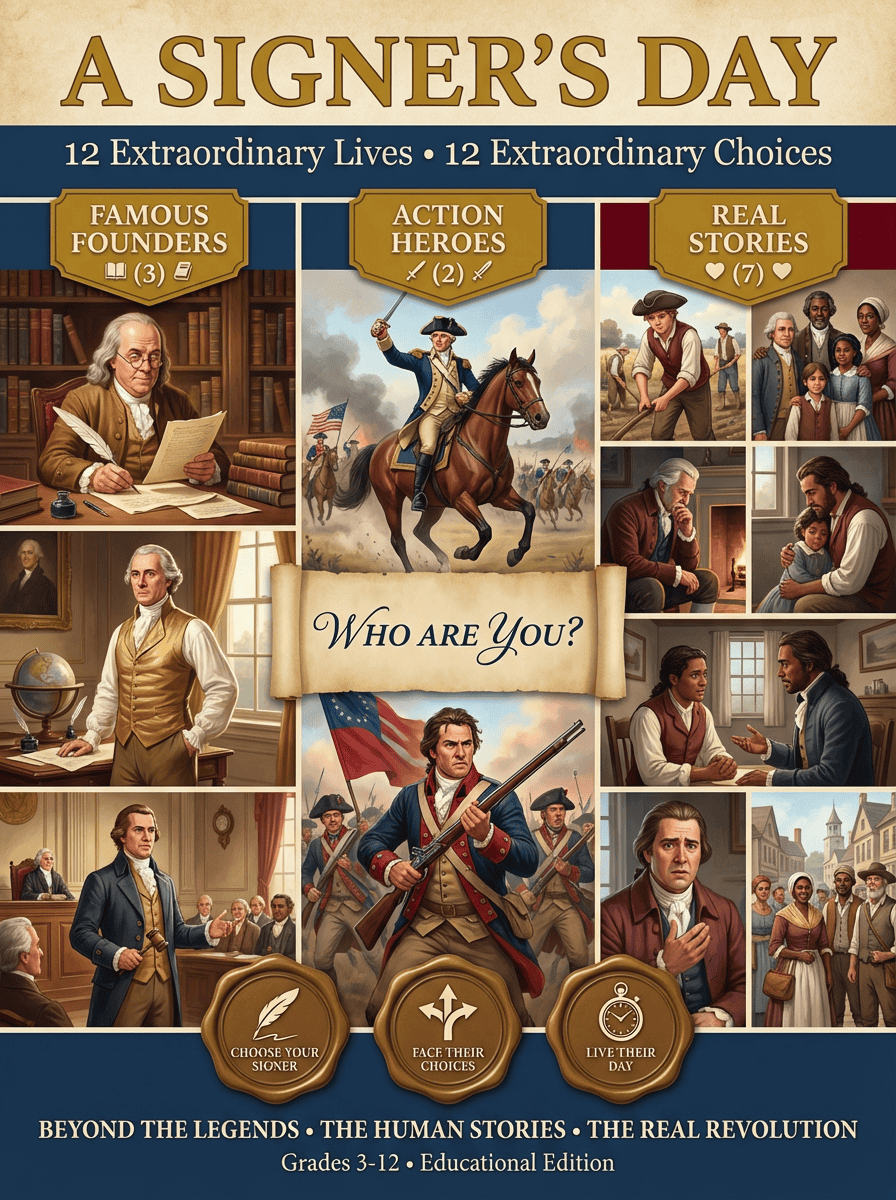
A Signer's Day: Volume 1 transforms how students learn about the Declaration of Independence. Instead of reading about what the signers did, students step into their shoes and face the actual choices these men confronted—then discover the consequences.
Should Benjamin Franklin defend himself when humiliated by Parliament, or stand in silent dignity? Should Caesar Rodney ride 80 miles through a thunderstorm despite cancer? Should Richard Stockton recant under torture to save himself? Students don't just learn history—they grapple with it.
The Recommended 12: Representative Revolutionary Stories
Of the 56 signers, we've curated 12 who represent the full spectrum of Revolutionary experience:
THE FAMOUS THREE - The household names every American should know:
Benjamin Franklin (70, oldest signer) - International diplomat who secured the French alliance
Thomas Jefferson (33) - Wrote the Declaration while owning 600+ enslaved people
John Hancock (39) - Famous bold signature, bankrupted himself funding the war
THE ACTION HEROES - Dramatic physical courage:
Caesar Rodney (47) - The midnight ride through a thunderstorm despite cancer
Thomas Nelson Jr. (37) - House struck by cannon fire at Yorktown, died bankrupt
THE COMPLEX SEVEN - The full reality of Revolutionary sacrifice:
Forgotten Heroes:
Josiah Bartlett (47) - First to vote for independence, country doctor
Button Gwinnett (42) - Died in duel 9 months after signing
Family Sacrifices:
Abraham Clark (50) - Sons captured and tortured; he refused to recant
Francis Lewis (63) - Wife imprisoned and died from brutal treatment
Principled Stands:
John Witherspoon (53) - Only active clergyman; son died in battle
Richard Stockton (45) - Only signer who recanted under torture
Young Revolutionary:
Edward Rutledge (26) - Youngest signer, initially opposed independence
Together, these 12 show students the famous and forgotten, the heroic and the broken, the principled and the compromised—the Declaration of Independence in human form.
Interactive Choose-Your-Path Format
Each signer presents 3-5 critical moments where students make choices
Students read ALL consequences (even for paths not taken) to understand alternatives
Accumulated decisions shape understanding of each signer's Revolutionary experience
Historical Accuracy Without Hero Worship
Addresses slavery, torture, moral contradictions honestly
Includes "What's Documented vs. Speculative" guide
Comprehensive MLA bibliography with verified scholarly sources
Teaching guide on avoiding presentism while maintaining moral clarity
Complete Implementation Package
3 flexible implementation options (individual choice, full rotation, family learning)
Differentiation guidance for grades 3-12
Continental Salon showcase event guide
5 types of comparison activities
Formative and summative assessment options
8 extension activities
Complete answer keys and discussion guides
Perfect for the 250th Anniversary (2026)
Timely and relevant for Declaration's 250th anniversary celebrations
Connects historical courage to modern civic engagement
"2026 and beyond" framing throughout
This product moves students from simple → dramatic → complex understanding:
Famous Three provide essential foundational knowledge
Action Heroes deliver memorable, dramatic examples of courage
Complex Seven challenge students with moral complexity and human limits
Students learn that not all heroes are perfect, not all courage succeeds, not all deaths are meaningful, and revolution was messy, human, and complicated.
What's Included?
 12 Complete Signer Profiles
Who He Was (background, path to independence, significance)
Critical Moments (3-5 decision scenarios with full consequences)
What Happened Next (fate during and after war)
Reflection Questions (personal, historical, modern connections)
Front Matter & Context
Historical Context & Presentism teaching guide
How to use (for students, teachers, parents)
Signer Selection Guide (by type, colony, question)
Understanding the 12 (ages, occupations, wealth, families, slaveholding, outcomes)
Myths vs. Reality guide
Three Groups Explained
Support Materials
Continental Salon: Student Showcase Event Guide
Historical Accuracy Guide (What's Documented vs. Speculative)
Reflection Questions by Theme
Comparison Activities
Assessment Options (Formative & Summative)
Extension Activities
Teacher/Parent Implementation Guide
Complete Answer Keys & Discussion Guides
Comprehensive MLA Bibliography
Verified scholarly sources for all 12 signers
Primary sources (letters, documents, papers)
Specialized studies (slavery, diplomacy, battles, prison conditions)
Digital archives and museum resources
Total: 200+ pages of complete, ready-to-use educational content
Target Audience
Grades 6-12 (with built-in differentiation)
Middle school: Focus on choices, courage, personal sacrifice
High school: Political philosophy, moral complexity, Enlightenment thought
Perfect for:
Classroom teachers (3-5 class periods or full unit)
Homeschool families (12-week family study)
250th anniversary commemorations
American history units
Civics and government courses
Character education programs
Three Main Implementation Options
OPTION 1: Individual Student Choice (Recommended for Classroom)
Each student selects one signer independently
Students present their signer to class
Class discusses diverse experiences
Time: 3-5 class periods
OPTION 2: Assign All 12 (Deep Dive)
Each student gets one of the 12 (or rotate through all)
Ensures all groups represented
Rich comparison discussions
Time: 3-4 week unit or year-long integration
OPTION 3: Family Learning (Homeschool)
Family experiences one signer together each week
12 weeks total
Discussion at family dinner table
Culminates in family "Continental Salon"
Learning Outcomes
Students who complete this product will be able to:
✓ Identify 12 representative signers and their significance
✓ Explain the diversity of Revolutionary experiences (age, wealth, occupation, sacrifice)
✓ Analyze moral complexity in historical figures (slavery contradiction, limits of courage)
✓ Distinguish between historical myth and verified reality
✓ Connect historical courage and sacrifice to modern civic engagement
✓ Think critically about choices and consequences
✓ Practice historical empathy while maintaining moral clarity
✓ Avoid presentism while making sound moral judgments
Addressing Difficult Topics
This curriculum tackles challenging subjects honestly and age-appropriately:
Slavery: States facts about slaveholding without excusing it. Presents the contradiction between "all men are created equal" and the reality that half these signers owned enslaved people. Provides historical context without moral relativism.
Torture: Addresses Richard Stockton's torture and recantation honestly, exploring human limits under extreme duress without graphic details.
Moral Complexity: Shows that people can do both great and terrible things. Jefferson's words inspired abolition even though he never freed most of his enslaved people. Franklin transformed from enslaver to abolitionist.
Perfect Timing for 2026
The 250th anniversary of the Declaration of Independence (July 4, 2026) makes this the ideal time to help students truly understand the men who risked everything to create America—with all their courage, contradictions, and complexity.
Frequently Asked Questions
Q: Is this appropriate for middle school? A: Yes! Grades 6-12. Differentiation guidance helps you adjust depth and discussion for different ages.
Q: Does it address slavery honestly? A: Yes. We state facts about slaveholding without excusing it and help students understand the contradiction without dismissing the Founders entirely.
Q: How long does it take to complete? A: Flexible! 3-5 class periods for one signer, or 3-4 weeks for full unit covering all 12.
Q: Can I use this for homeschool? A: Absolutely! Includes specific family learning implementation option with 12-week plan.
Q: Is there a religious perspective? A: We address John Witherspoon's role as only clergyman signer and his theological justification for revolution, but the overall curriculum is academic/historical, not devotional.
Q: What if I only want to teach a few signers, not all 12? A: Perfect! The Signer Selection Guide helps students choose based on interest, and each signer stands alone.
Q: Are primary sources included? A: MLA bibliography directs you to primary sources, and scenarios are based on documented historical events.
25% off. Regularly $21