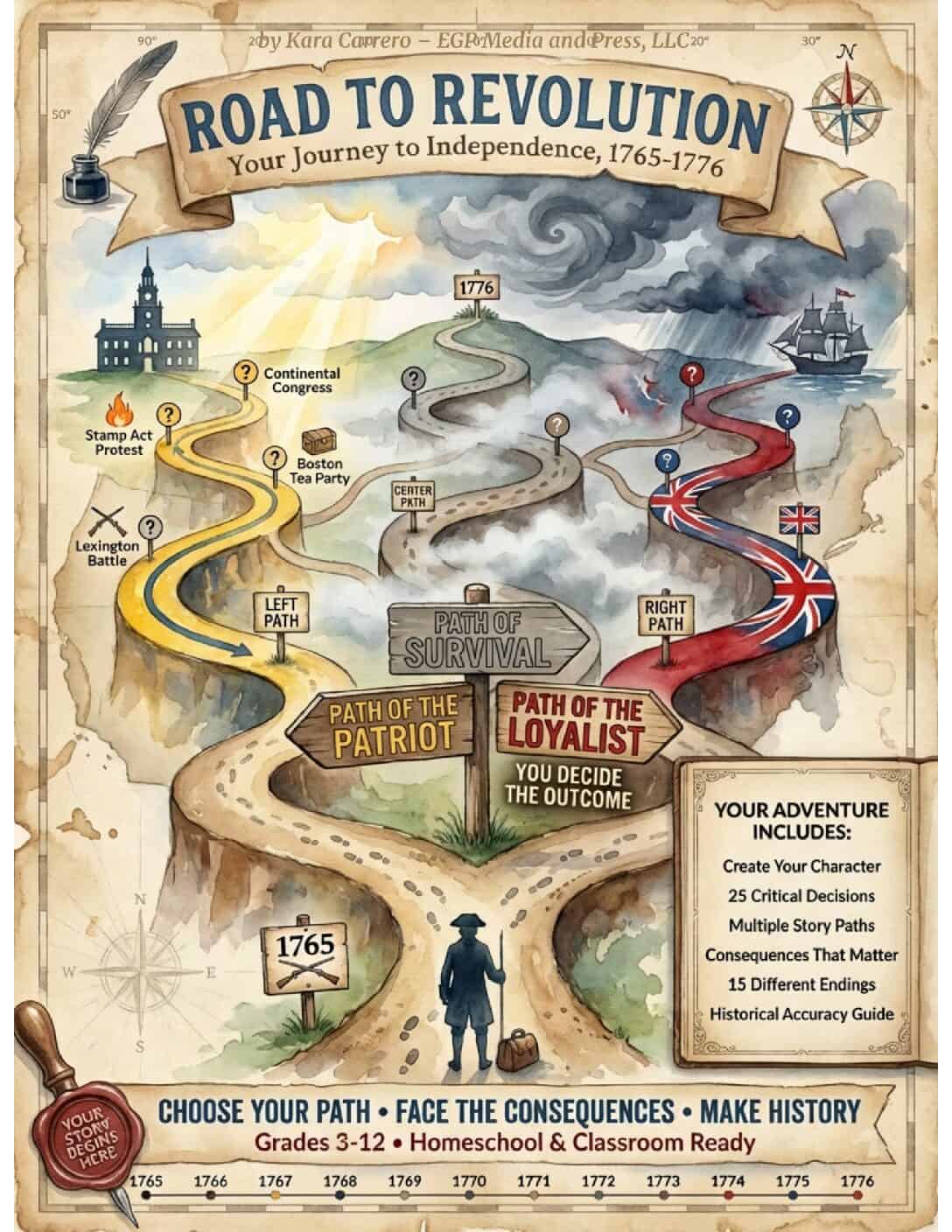
Road to Revolution: “Pick Your Own Path” Journey to Independence Game (1765–1776)
$12.00
Immersive choose-your-own-adventure Revolution simulation (1765–1776). 25 decisions, loyalty/risk tracking, 15 outcomes. For secondary teachers & homeschoolers on independence & 250th anniversary.
-
25 Historical Decision Points: From Stamp Act to Declaration, with authentic dilemmas.
-
15 Plausible Endings: Heroes, exiles, survivors—reflecting colonial diversity.
-
Accumulated Consequences: No dead ends; choices build loyalty (Patriot–Loyalist–Neutral) and risk.
-
Multiple Perspectives: Balanced view of Patriots, Loyalists, and Neutrals.
-
126 Pages: 80 student materials, 40+ teacher guide, assessments, and extensions.
-
Grades 6–12 Flexible: Differentiation for middle/high school; adaptable for younger with support.
-
Replayable & Engaging: Explore paths to grasp complexity; hooks reluctant learners.
-
Standards-Aligned: C3 Framework, Common Core ELA for historical thinking and argumentation.
-
250th Anniversary Ideal: Commemorate 2026 by living the path to independence.
-
Classroom & Homeschool Ready: Inquiry-based for teachers; family-style for unit studies.
Description
Immerse your students in the uncertainty and peril of the American Revolution where independence was anything but inevitable.
This is an immersive, decision-based, branching narrative simulation that transports students into the role of an ordinary colonist navigating the escalating tensions between Britain and the American colonies. From the Stamp Act to the Declaration of Independence, learners experience history as it unfolded: fraught with risk, moral dilemmas, and personal stakes. This isn’t about memorizing dates or simplistic “Patriots vs. Redcoats” narratives; it’s interactive learning that reveals the complexity of colonial life, where choices accumulate to shape one of 15 historically plausible outcomes.
Unlike traditional games with abrupt endings, this simulation emphasizes accumulated consequences. Students respond to the same pivotal historical events, but their decisions shift their position along a Patriot–Loyalist–Neutral spectrum and adjust their personal risk level. No path is “right” or “wrong”—each reflects rational, principled choices made by real people balancing ideals, safety, family, and survival.
Key Historical Moments and Dilemmas:
- 1765: The Stamp Act – Join protests and risk arrest, or comply and face social ostracism?
- 1770: The Boston Massacre – Witness violence and grapple with moral reckonings.
- 1773: The Boston Tea Party – Support destruction of property, or condemn it as lawlessness?
- 1774: The Intolerable Acts – Take sides as freedoms erode.
- 1775: Lexington, Concord, and Bunker Hill – Face the outbreak of war and decide whether to fight, flee, or stay neutral.
- 1776: The Declaration of Independence – Celebrate its ideals, or question its hypocrisy on issues like slavery?
Across 25 chronological decision points, students track their loyalty and risk, leading to diverse endings such as:
- Becoming a Revolutionary Hero who survives to witness independence.
- A Fallen Patriot dying for the cause at Valley Forge.
- A Loyalist in Exile, fleeing to Canada but remaining true to the Crown.
- A Conflicted Neutral, satisfying no one while trying to avoid the fray.
- A Tragic Victim caught in the crossfire of civil war.
This resource challenges oversimplified views by highlighting:
- Why many colonists remained neutral amid uncertainty.
- The rational, principled decisions of Loyalists.
- How independence emerged gradually through contested choices, not unanimously or suddenly.
- The human costs of revolution, including violence, mob actions, family divisions, and the slavery contradiction in “all men are created equal.”
Why This Excels for Secondary Teachers and Homeschool Families
- Secondary Classrooms (Grades 6–12): Perfect for inquiry-based units, simulations, small-group discussions, or full-class role-playing. Built-in reflection questions foster writing, debate, document analysis, and critical thinking. Supports formative and summative assessments, with extension activities for gifted students or AP-level depth.
- Unit Study & Family-Style Homeschoolers: Adaptable for multi-age groups, with older learners analyzing ideological shifts and consequences while younger ones engage through guided discussions and choice-making. Self-paced and flexible, it’s ideal for family read-alouds or independent exploration, promoting empathy and civic courage.
What’s Included (126 Pages):
- Student Materials (80+ Pages): Character creation (location, occupation, age), decision tracking sheets, loyalty/risk meters, 25 fully developed decision points with 4 choices each and detailed consequences, 15 distinctive endings with post-war reflections, and empathy-focused questions.
- Teacher/Parent Guide (40+ Pages): Implementation strategies for classrooms or homeschool, historical accuracy notes (common vs. rare experiences), discussion prompts for sensitive topics (slavery, violence, Loyalism), assessment options, extension activities including marginalized perspectives, standards alignment (C3 Framework, Common Core ELA), and troubleshooting tips.
- Additional Features: Replayability for exploring alternate paths, vocabulary support, and digital/print-friendly format (works with Google Classroom, Canvas, or black-and-white printing). Lifetime updates included.
Grade Levels and Differentiation: Core for grades 6–10 (flexible for 3–5 with adult support or 11–12 for advanced analysis). Middle schoolers focus on decision-making; high schoolers delve into political philosophy and moral complexity.
Educational Impact:
- Historical Empathy: Feel the fear and uncertainty colonists faced.
- Multiple Perspectives: All paths—Patriot, Loyalist, Neutral—are valid, teaching nuance.
- Cause & Effect: Accumulated choices show history as a series of decisions, not fate.
- Engagement: Hooks reluctant learners with interactive format and no dead ends.
- Critical Thinking: Defend choices with evidence, sparking debates.
- Replayable Depth: Multiple playthroughs reveal how small decisions alter outcomes.
Educational Honesty: Doesn’t sanitize history—addresses warfare’s violence, Loyalist persecution, family hardships, and the founding hypocrisy on slavery. Age-appropriate language with guidance for difficult discussions.
Standards Addressed: C3 Framework (historical thinking, multiple perspectives), Common Core ELA (reading, argumentation), and skills like causation, perspective-taking, and continuity/change.
Perfect for the 250th Anniversary: Tis simulation invites students to live the fragile, contested path to independence. It’s not a game about winning; it’s an experience about understanding history’s human side.
For members and supporters
Get access to the Download Dashboard
Printable PDFs in course format for history, literature, and cross-curricular studies. Download what fits your students, print it, and start teaching.
- Course-style PDFs. Structured, ready-to-print studies that guide students from the first page to the last.
- Grab what you need. Choose the studies that fit your students and download them from one dashboard.
- New downloads as it grows. More are added over time, so there is always something new to print.
$5 a month
See what is inside Already a member? Open your dashboardPrefer to start free? Many challenges also arrive as simple emails when you subscribe.
Additional information
| Activity Type | |
|---|---|
| Grade Range | |
| Skill Focus | Analytical Thinking, Character Analysis, Historical Analysis |
| Time Period | |
| Unit Integration | |
| Subject | |
| Historic US Time Period |
Reviews
There are no reviews yet.