ENLIGHTENMENT IDEAS & THE DECLARATION – The DNA of Liberty
$12.00
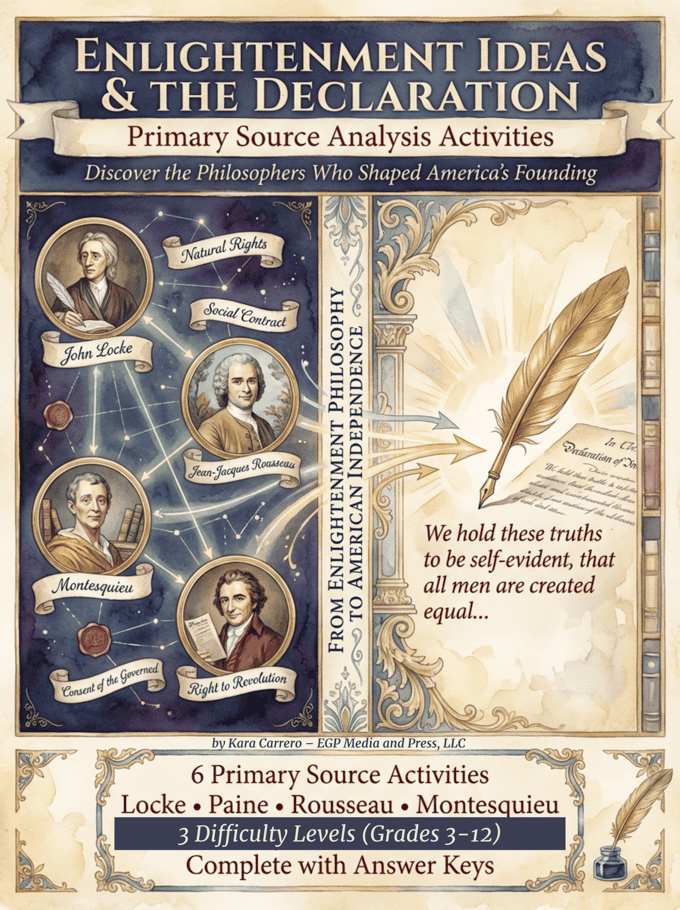
Primary source investigation into drafting the Declaration. 5 stations + editing project. Analyze process, compromises. Grades 3-12. 152 pages. Ideal for 250th anniversary.
- 5 Interactive Stations: Contextual setup, revisions, omissions, perspectives—build detective skills.
- Primary Source Focus: Excerpts, organizers, and tools for hands-on analysis.
- Track Changes Project: Students edit drafts, justify changes, reflect on process.
- Addresses Key Themes: Compromises, collaboration, founding contradictions.
- 152 Total Pages: 60 student dossier, 80+ teacher guide, appendices.
- Three-Tier Differentiation: Adaptable for grades 3-5, 6-8, 9-12.
- Comprehensive Support: Implementation plans, discussions, assessments, extensions.
- Flexible Formats: Station-based or whole-class; classroom/homeschool ready.
- Standards-Aligned: C3 Framework, Common Core ELA for historical and literacy skills.
- 250th Anniversary Ready: Deepen understanding for July 4, 2026 commemoration.
Description
Trace the intellectual DNA of the Declaration back to its Enlightenment ancestors.
Enlightenment Ideas & The Declaration: The DNA of Liberty uses an innovative scientific metaphor to transform abstract 18th-century philosophy into concrete, memorable learning. Students become Historical Geneticists conducting forensic investigations to trace which ideas in the Declaration came from which Enlightenment thinkers—and how those ideas mutated when they crossed the Atlantic.
Philosophy is notoriously difficult to teach. Students struggle with abstract concepts, dense texts, and the question “why does this matter?” This product solves all three problems by using a metaphor students already understand: genetic inheritance.
Just as children inherit DNA from their parents, the Declaration inherited “intellectual DNA” from Enlightenment philosophers. Just as genetic mutations create variations, Jefferson and Congress adapted European ideas to American circumstances. Just as genetic deletion can be harmful, removing the anti-slavery clause created a flaw in the founding document.
Students get it immediately because the metaphor is concrete, visual, and familiar.
The Investigation:
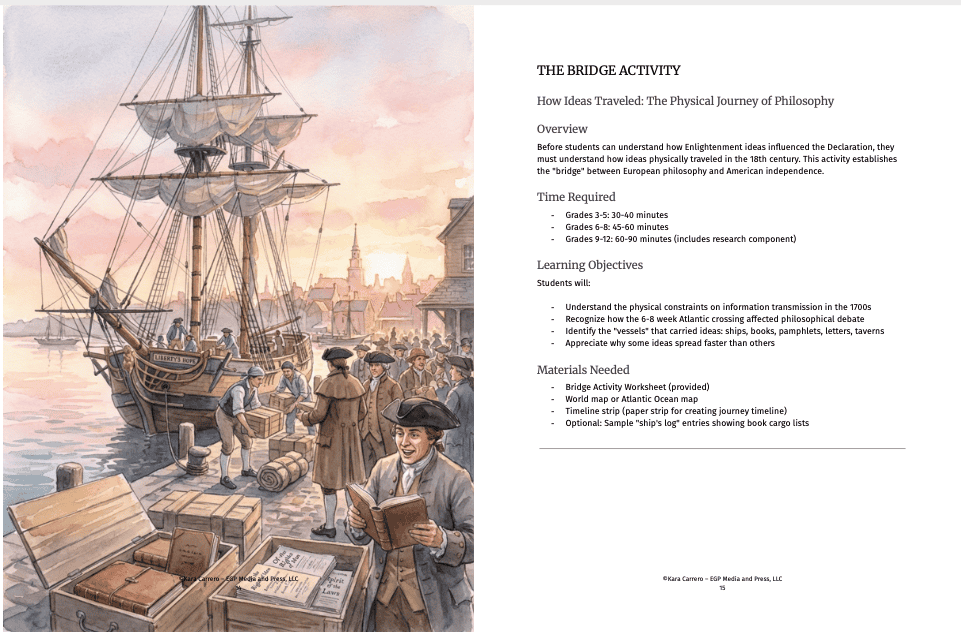
THE BRIDGE ACTIVITY (30-45 minutes) Understanding how ideas physically traveled:
- Books were expensive, pamphlets were cheap (why Common Sense mattered more than Locke’s treatises)
- The “Republic of Letters” connected colonial intellectuals
- Ships took 6-8 weeks to cross the Atlantic
- Ideas spread through taverns, churches, town meetings
- Mapping the transatlantic intellectual network
STATION 1: John Locke – The Father of Natural Rights (45-60 minutes)
- Key DNA: “Life, Liberty, and Property”
- Natural rights philosophy
- Consent of the governed
- Right to revolution
- Direct influence on Jefferson
- Primary source: Second Treatise of Government (1689)
STATION 2: Montesquieu – The Architect of Separation (45-60 minutes)
- Key DNA: Separation of powers
- Checks and balances
- Prevention of tyranny through structure
- Influence on governmental design
- Primary source: Spirit of the Laws (1748)
STATION 3: Rousseau & Voltaire – The Social Contract & Free Thought (45-60 minutes)
- Rousseau’s DNA: Popular sovereignty, social contract, general will
- Voltaire’s DNA: Freedom of speech, religious tolerance, criticism of tyranny
- How both influenced revolutionary thought
- Primary sources: The Social Contract (1762), Voltaire’s essays
STATION 4: Thomas Paine – The Catalyst (45-60 minutes)
- DNA: Direct, accessible language about independence
- Common Sense (January 1776) as game-changer
- Why 120,000 copies sold in a population of 2.5 million
- Paine’s influence on timing of independence
- Primary source: Common Sense excerpts
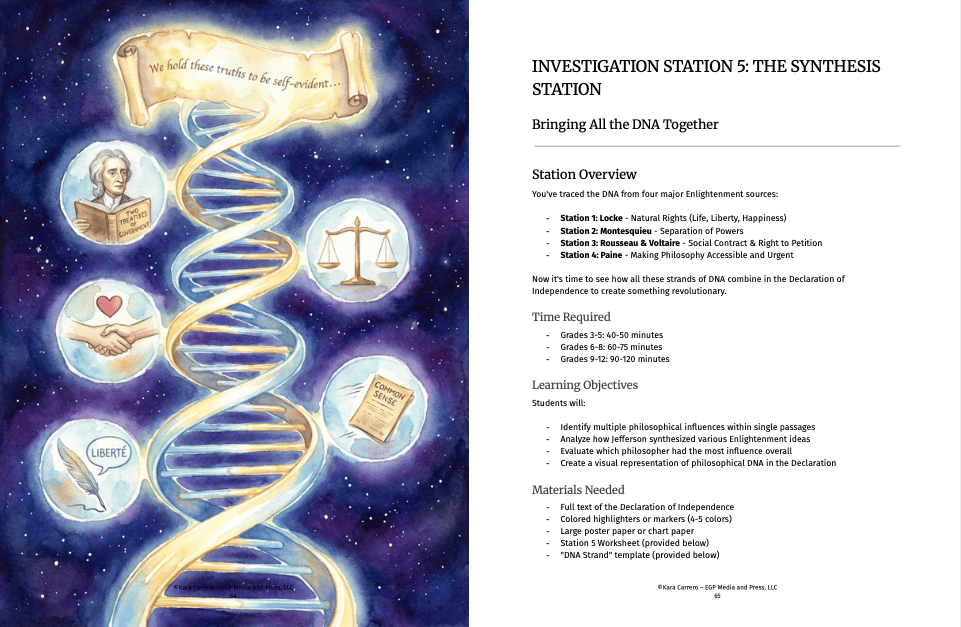
STATION 5: Synthesis – Tracing DNA Markers (45-60 minutes)
- Identify which phrases in Declaration came from which philosopher
- Create visual DNA map connecting ideas to sources
- Understand Jefferson as synthesizer, not original thinker
- Recognize unique American adaptations
THE MUTATION LAB (60-90 minutes) Analyzing how ideas changed:
- Mutation 1: Locke
- What does it reveal about American values?
- Mutation 2: Rousseau
- Mutation 3: Paine
THE LETHAL DELETION (30-45 minutes) Understanding harmful genetic deletion:
- The anti-slavery clause as vital “DNA” that was deleted
- Why this deletion created a flaw in the organism (nation)
- How this contradiction haunts America’s founding
- Connecting to ongoing work toward equality
CULMINATING PROJECT: The DNA Children’s Book
What’s Included:
STUDENT DOSSIER (70+ pages):
- The Bridge Activity materials
- All five investigation station materials
- Primary source excerpts (age-appropriate)
- Enlightenment philosopher “profiles”
- DNA tracing worksheets
- Mutation Lab analysis guides
- Visual DNA mapping templates
- Children’s Book project materials and rubric
- Reflection questions
TEACHER GUIDE (60+ pages):
- Complete historical context on each philosopher
- Implementation strategies (5 different approaches)
- Three-tier differentiation (Grades 3-5, 6-8, 9-12)
- Discussion facilitation guides
- How to teach philosophy accessibly
- Answer keys with sample responses
- Assessment options
- Extension activities
- Cross-curricular connections (Science, ELA, Art, Math)
- Complete bibliography
- Standards alignment
Total: 132 pages of comprehensive philosophy investigation
Three-Tier Differentiation:
Grades 3-5 (Young Detectives):
- Focus on 3 main philosophers (Locke, Montesquieu, Paine)
- Simplified vocabulary and concrete examples
- Hands-on manipulatives and visual aids
- Illustrated projects and oral presentations
Grades 6-8 (The Investigators):
- 4-5 philosophers with deeper analysis
- Primary source excerpts with scaffolding
- Small group analysis and comparison charts
- Written analysis and multimedia presentations
Grades 9-12 (Forensic Analysts):
- All philosophers plus historiographical debate
- Full primary source texts
- Socratic seminars and scholarly research
- Research papers and philosophical essays
Cross-Curricular Connections:
SCIENCE:
- Genetics and heredity (DNA, inheritance, mutation)
- Scientific method (hypothesis, evidence, conclusion)
- Evolution and adaptation concepts
ENGLISH LANGUAGE ARTS:
- Primary source close reading
- Persuasive rhetoric and argumentation
- Author’s purpose and bias identification
- Creative writing (Children’s Book project)
SOCIAL STUDIES:
- Enlightenment history and philosophy
- Transatlantic intellectual exchange
- Revolutionary political thought
- Comparative government systems
MATHEMATICS:
- Timeline construction and sequencing
- Data analysis (comparing philosopher influences)
- Geographic mapping (idea transmission routes)
ART:
- Book illustration and design
- Historical period visual analysis
- Political cartoon interpretation
- Visual metaphor creation
Why This Works:
✓ Makes Philosophy Concrete: DNA metaphor creates visual, tangible understanding
✓ Multiple Entry Points:Visual, verbal, kinesthetic, logical learners all engaged
✓ Memorable: Science/history combination sticks in memory
✓ Accessible: Complex philosophy becomes understandable for all levels
✓ Engaging: Forensic investigation theme hooks students
✓ Transferable: Students apply these thinking skills beyond this unit
Perfect For:
- Declaration of Independence units
- Enlightenment history instruction
- Political philosophy introduction
- Cross-curricular team teaching
- Gifted programs (sophisticated synthesis)
- Students who struggle with traditional philosophy instruction
- STEM students connecting to humanities
The “Aha!” Moment:
Students discover that:
- Jefferson didn’t invent these ideas—he synthesized them
- Revolutionary philosophy had been developing for nearly a century
- Ideas are inherited and adapted, not created from nothing
- The Declaration is the American “child” of European “parents”
- Even founding documents have an intellectual genealogy
This transforms understanding from “Jefferson wrote something amazing” to “Jefferson brilliantly synthesized a century of philosophical development and adapted it to American circumstances.”
Educational Honesty:
The product addresses:
- Not all Enlightenment thinking was progressive (Locke owned shares in slave trade company)
- Philosophers’ ideas about liberty coexisted with colonialism
- Jefferson applied Enlightenment principles selectively (slavery contradiction)
- Revolutionary philosophy was limited to property-owning men
- The work of extending these principles to all people is ongoing
What You Get:
PDF format, ready to print or use digitally:
- 132 total pages
- Station materials organized for easy printing
- High-quality philosopher portraits
- Visual DNA mapping templates
- Primary source excerpts with context
- Children’s Book project examples
- Comprehensive rubrics
- Answer keys with sample responses
- Bibliography with links to original sources
Standards Addressed:
- C3 Framework: All four dimensions (Questions, Concepts, Sources, Conclusions)
- Common Core ELA: Reading, Writing, Speaking & Listening standards
- Historical Thinking: Sourcing, contextualization, periodization
- Scientific Thinking: Observation, analysis, conclusion
Perfect for the 250th Anniversary:
Understanding the Enlightenment DNA of the Declaration helps students recognize that revolutionary ideas have a history—they didn’t appear from nowhere on July 4, 1776. This depth of understanding is exactly what the 250th anniversary should inspire.
This product transforms philosophy from abstract and boring to concrete and fascinating. Students remember the DNA metaphor for years and apply these thinking skills throughout their education.
Additional information
| Activity Type | Artifact/Museum Exploration, Choose Your Own Adventure, Game, Primary Source Analysis, Simulation |
|---|---|
| Grade Range | |
| Skill Focus | Analytical Thinking, Character Analysis, Historical Analysis |
| Time Period | |
| Unit Integration | |
| Subject | |
| Historic US Time Period |
Reviews
There are no reviews yet.