Declaration of Independence 250th Anniversary: 5 Pillars Teaching Guide & Downloadable Resources
Here’s a test: Ask any student (or adult) what the Declaration of Independence is about.
You’ll likely hear: “Freedom from England.” “Taxation without representation.” Maybe they’ll quote “all men are created equal.”
Now ask them these five questions:
- What specific evidence did the colonists use to justify independence?
- Which philosophers influenced Jefferson’s writing, and can they find the borrowed ideas?
- At what point between 1765 and 1776 did independence become inevitable?
- What did Congress remove from Jefferson’s draft, and why?
- What actually happened to the 56 men who signed—beyond the myths?
Silence.

That’s the gap between knowing about the Declaration and actually understanding it. And with the 250th anniversary approaching in July 2026, we have a once-in-a-lifetime opportunity to close that gap.
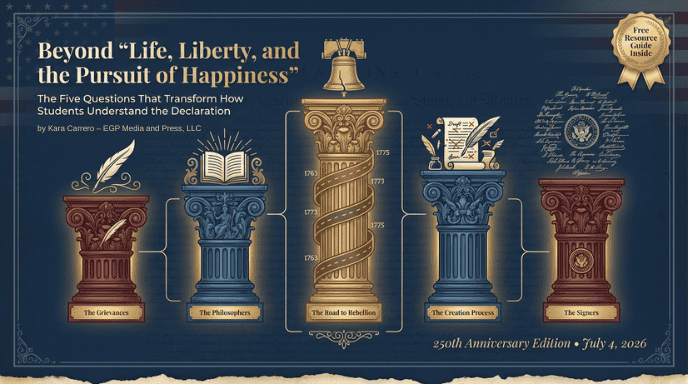
Beyond “Life, Liberty, and the Pursuit of Happiness”: The Five Questions That Transform How Students Understand the Declaration
The problem isn’t that students don’t care about history. It’s that we’ve been teaching the Declaration as a single document to “cover” rather than as the culmination of ideas, events, people, and courage that it actually is.
The solution? A framework that answers those five questions—what I call the Five Pillars of Declaration Study.
Whether you’re a homeschool parent planning your year or a teacher preparing for this historic anniversary, this framework will help you go deeper than ever before.
The Five Pillars Framework to study the Declaration of Independence
Think of the Declaration like a building. You can admire the facade (the famous preamble we all know), but to truly understand its strength, you need to examine the foundation, the supports, the architects, the builders, and what it cost to construct it.

Pillar 1: Colonial Grievances
Most people can quote the Declaration’s opening. But how many have actually read through the 27 specific grievances against King George III?
This is where the real legal case lives. The Founders weren’t just waxing philosophical—they were building a courtroom argument for treason. Each grievance connects to a specific event colonists experienced: dissolved assemblies, denied trials, quartered soldiers in their homes, taxation without representation.
When students investigate these connections, something clicks. The Declaration isn’t abstract. It’s the breaking point after years of documented injustices.
The learning shift: Instead of “they wanted freedom,” students understand “they tried everything else first, documented it all, and when nothing worked, they made their case in writing.” That’s how you build critical thinkers.
The question that changes everything: “If you were going to declare independence from something in your life, what specific grievances would you list? How would you prove your case?”
Suddenly, students understand evidence-based arguments, persuasive writing, and why the Founders spent half the Declaration listing complaints.
Pillar 2: The Influencing Philosophers
Here’s what I wish someone had told me earlier: the Declaration wasn’t new ideas. It was a revolutionary application of ideas that had been circulating for decades.
John Locke’s “natural rights.” The “social contract” between government and governed. “Consent of the governed.” These weren’t Thomas Jefferson’s inventions—he was channeling Enlightenment philosophy into political action.
When my students started reading excerpts from Locke’s Second Treatise of Government alongside the Declaration, they began finding Jefferson’s sources. They spotted the borrowed language, the refined concepts, the intellectual inheritance.
The connection students need: Show them that revolutions start in minds before they start in streets. The American Revolution was a revolution of ideas first, armies second.
The debate worth having: “Are rights natural—something you’re born with—or are they granted by governments? Can governments that don’t protect rights really be altered or abolished?”
These aren’t just historical questions. These are the foundations of how we think about government today.
Pillar 3: The Road to Rebellion
The Declaration didn’t happen overnight. It was the end of an eleven-year escalation from the Stamp Act in 1765 to Lexington and Concord in 1775 to the final break in 1776.
Each event was a step: The Boston Massacre. The Tea Act. The Intolerable Acts. The Continental Congress’s attempts at reconciliation. The king’s rejection of the Olive Branch Petition. Common Sense changing public opinion.
What students miss without this pillar: They think the colonists woke up one day and decided to rebel. They don’t understand the failed negotiations, the radicals versus the moderates, the colonies that hesitated until the last moment.
The project that makes it real: Create a timeline, but make it analytical. After each event, ask: “Did this make independence more likely or less likely? Why?” Track how attitudes shifted. Some leaders wanted independence from the start; others hoped for reconciliation until the very end.
The research question worth pursuing: “When did reconciliation become impossible? Was there a point of no return?”
Pillar 4: The Creation Process
This is where the Declaration comes alive as a process, not a product.
Thomas Jefferson didn’t lock himself in a room and emerge with perfection. He was appointed to a Committee of Five. He wrote a draft. Benjamin Franklin and John Adams edited it. Then Congress debated it, revised it, and removed entire passages—including Jefferson’s condemnation of slavery.
We have Jefferson’s rough draft. Students can see exactly what changed and imagine the debates: Why did Congress remove that? What does this edit reveal? What arguments must have happened in that room?
The writing lesson built in: Every student who’s had their work edited can relate. Jefferson’s masterpiece was collaborative, compromised, and revised. Even the Declaration of Independence went through drafts.
The critical thinking question: “Congress removed Jefferson’s passage blaming King George for the slave trade—not condemning slavery itself, but deflecting responsibility to the king. Why did Congress cut even this mild passage? What does this tell us about the contradictions present at America’s founding?”
This isn’t just history. This is examining how ideals meet political reality, how consensus requires compromise, and how documents we revere were shaped by very human debates.
Pillar 5: The Document Signers
Fifty-six men signed the Declaration of Independence.
Here’s what I didn’t know when I started teaching: most of the dramatic stories we tell about them are myths. The viral emails, the inspirational speeches, the chain letters about their fates—much of it is exaggerated or false.
Here’s what’s true: Signing was an act of treason punishable by death. These men knew it. They signed anyway. Some did face consequences—property damage, imprisonment, loss. But many didn’t. And none were executed for signing.
The honest teaching moment: We need to tell true stories, not inflated ones. The truth is compelling enough. Caesar Rodney really did ride 80 miles through the night despite cancer to cast his vote. Richard Stockton really was imprisoned and mistreated. John Witherspoon really lost his son in battle.
The project that matters: “Adopt a signer.” Research one deeply. Not just what they did before signing, but what happened after. What was their legacy? What did they sacrifice? What myths exist about them?
And here’s the harder question: “Which signers owned enslaved people? How did they justify declaring ‘all men are created equal’ while denying freedom to others?”
This is where we teach students that history is complex, that heroes were human, and that America’s founding contained both soaring ideals and profound contradictions.
Bringing the Revolutionary Declaration Pillars Together
The beauty of this framework is how interconnected everything becomes.
The grievances make sense only in the context of the road to rebellion. The philosophers explain why colonists thought they had the right to list grievances in the first place. The creation process shows how ideas become documents. The signers put their names—and lives—behind those ideas.
When you teach through these five pillars, you’re not just teaching a document. You’re teaching:
- How ideas become action
- How philosophy becomes politics
- How evidence builds arguments
- How collaboration and compromise work
- How individual courage creates historical change
- How to examine sources critically
- How to recognize myths versus facts
Making It Work in Your Homeschool or Classroom
You don’t need to tackle all five pillars equally. Depending on your students’ ages and your time, you might:
- Spend three weeks going deep on all five
- Choose two pillars to emphasize based on your students’ interests
- Use one pillar as your anchor and make connections to the others
- Return to different pillars throughout the year as they connect to other topics
The key is moving beyond surface-level coverage. Better to go deep on the grievances and really understand cause and effect than to skim all five pillars without understanding any.
For hands-on learners: This framework is perfect for project-based learning. Each pillar offers rich opportunities for research, primary source analysis, creative projects, debates, timelines, and presentations.
For different ages:
- Elementary (3rd-5th): Focus on Pillars 1, 3, and 5—events, timeline, and people are most concrete
- Middle School (6th-8th): Add Pillar 4 for understanding process, begin introducing Pillar 2’s philosophical concepts
- High School (9th-12th): Go deep on Pillar 2, tackle the contradictions in Pillar 5, analyze primary sources across all pillars
Why This Matters for the 250th Anniversary
We have a once-in-a-lifetime opportunity approaching. Most of us will never see another major Declaration anniversary in our lifetimes.
This isn’t just about teaching history. It’s about helping the next generation understand the ideas that shaped our nation, the courage it took to act on those ideas, the compromises required to make them real, and the ongoing work of living up to them.
The Five Pillars framework gives you a roadmap. It ensures you’re not just skimming the surface or repeating myths. It helps you create an experience your students will remember—not just in 2026, but for the rest of their lives.
Because here’s what I learned in the classroom: students don’t remember the textbook pages. They remember the primary sources they analyzed. The debates they had. The “aha moments” when they connected past to present. The times they felt like detectives uncovering truth, not just memorizing facts.
That’s the kind of history education that sticks.
And that’s what our students deserve as we mark 250 years since 56 men gathered in Philadelphia and changed the world.
Ready to Dive Deeper?
I’ve created a FREE Declaration 250th Anniversary Resource Bundle to help you bring this framework to life with your students.
Inside this 33-page comprehensive guide, you’ll find:

33-Page FREE Download
✅ Complete Five Pillars Reference Guide with essential questions, recommended primary sources (all linked for easy access), study activities, and high school extensions for each pillar
✅ Curated Book List organized by age level—from picture books through high school texts to adult books for teachers and parents—including selections on often-overlooked figures like Sybil Ludington and female patriots
✅ Virtual Field Trip Directory with direct links to free online tours of Independence Hall, the National Archives, Colonial Williamsburg, Boston’s Freedom Trail, and more—plus educational websites, interactive games, and primary source databases
✅ 250th Anniversary Celebration Guide including major events in Philadelphia, Washington D.C., Boston, and other key cities, plus ideas for how to participate from home and explore local history
✅ Practical Implementation Tips tailored specifically for both homeschool families AND teachers, with cross-curricular connections, differentiation strategies, and discussion questions for deeper thinking
✅ Bonus: Available Curriculum Resources – Information about Revolutionary Courage: Voicing Independence from 1776 to 2026 and Beyond (our comprehensive project-based unit study) and the complete Five Pillars interactive game line for hands-on learning
Everything you need to make 2026 an unforgettable learning experience.
Grab your free Declaration of Independence & 250th Anniversary teaching guide

P.S. – As you explore the Five Pillars framework, you might find yourself wanting ready-made activities, primary source analysis tools, or hands-on projects. I’ve developed a complete line of Declaration resources organized by pillar—each designed to make implementation easy while keeping historical accuracy and deep learning at the center. You’ll find details about Revolutionary Courage (our comprehensive unit study) and the Five Pillars interactive game collection inside the free guide. For now, start with the framework and see how your students’ understanding of the Declaration transforms.


This is amazing! What an incredible opportunity parents have to teach the history of the U.S. during the year of it’s 250th anniversary.
Wow, this is incredible! What an amazing resource. Just got the pack for our family.
This is awesome. I’m saving this for homeschool lessons. We will use this to prepare for our trip to Williamsburg this year.