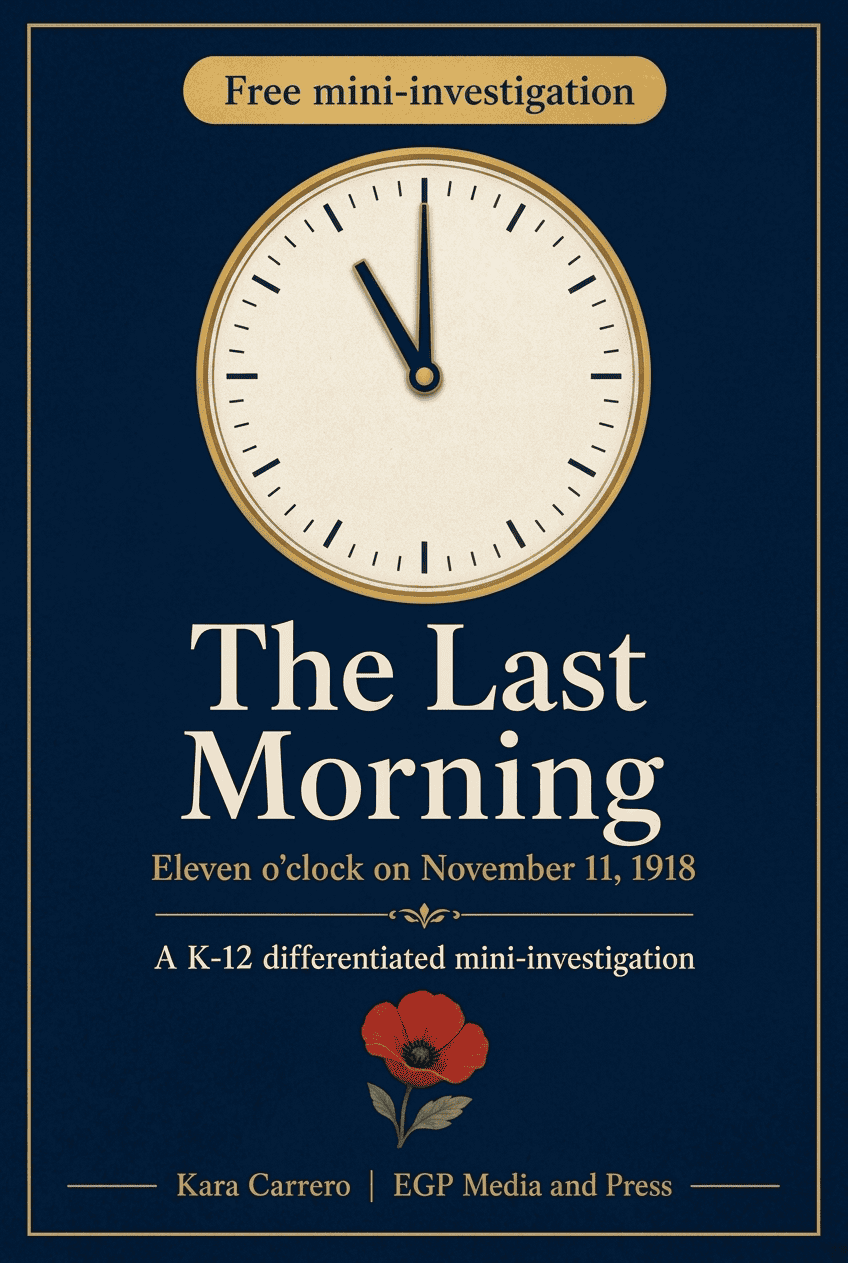
The Last Morning: A Free Armistice Day Mini-Investigation for Grades K-12
$0.00
The armistice was signed around 5 a.m., but the ceasefire didn’t begin until 11. So what happened in those six hours, and why does it still matter? This free, 15-page mini-investigation sends learners in grades K-12 into the last morning of World War I. Pick a level, work through the sources, and finish with something of their own. 20 to 40 minutes, no prep.
Description
The fighting didn’t stop when the paper was signed.
Most of us learned that World War I ended on the eleventh hour of the eleventh day of the eleventh month. Fewer of us learned that the agreement was signed hours earlier, and that people kept fighting until the clock struck eleven.
In The Last Morning, your learners become morning-of investigators. They look at the final hours of the war, notice what doesn’t add up, and do what historians do: they ask why.
The big question: If the armistice was signed around 5 a.m. (Paris time), what happened in those six hours, and why does it still matter?
What’s inside
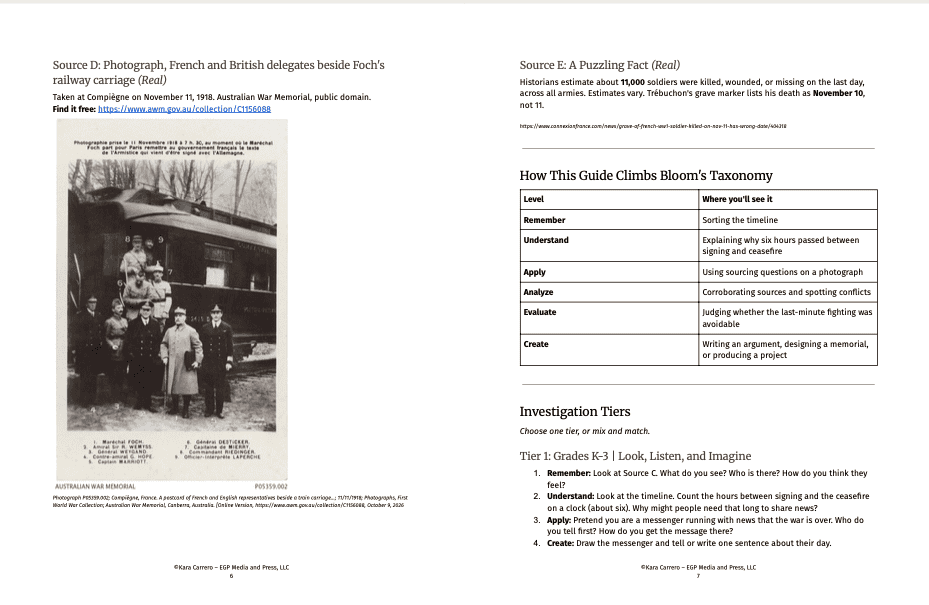
- A five-source evidence set. Real documents and photographs, each labeled Real, Illustrative, or Composite, with free links so you can find the originals yourself.
- Three investigation levels. Look, Listen, and Imagine (K-3). Source It and Sort It (4-8). Argue It (9-12). Pick the level that fits your learner, or let a family work through all three together.
- A quick teacher answer guide. So you can lead the conversation without prepping first.
- Project extensions. Two or three ideas for every grade band, plus a family or co-op capstone you can hold on November 11.
- “In Flanders Fields” copywork. A level for each grade band, with a thinking task to go with it.
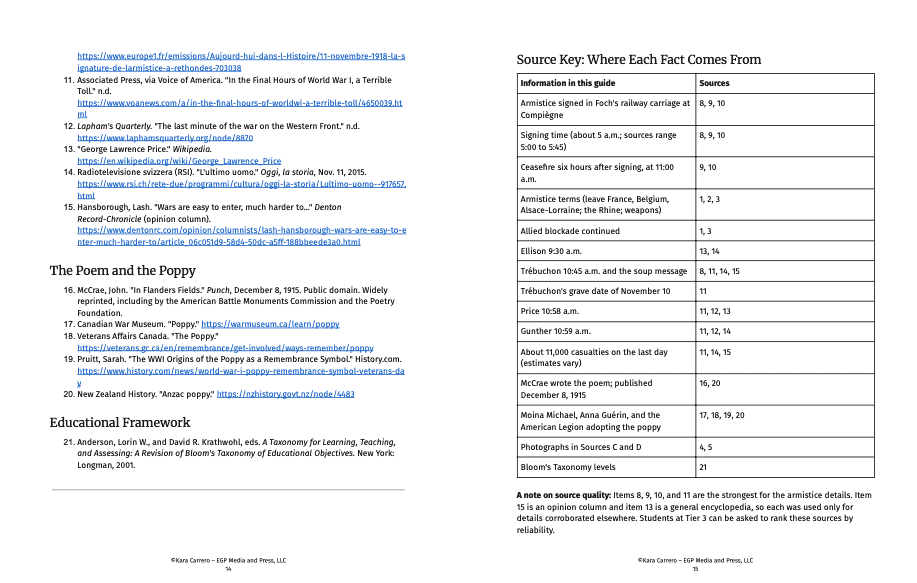
- A bibliography and source key.
Every level ends with a thinking task, not a worksheet.
The guide climbs Bloom’s Taxonomy from Remember to Create. Younger learners study a photograph, count hours on a clock, and imagine a messenger’s day. Middle grades sort what they know from what they still wonder and write from a soldier’s point of view. Older students corroborate sources, debate a hard question, and write an argument that cites their evidence by name.
How families and classrooms use it
- Work through one level together at the kitchen table, or let every age take its own level.
- Use it as a low-prep lesson for the week of Armistice Day and Veterans Day.
- Run it in a co-op or club with mixed ages and one shared question.
- Finish with a Remembrance Table on November 11, where each learner displays one project and the group observes a minute of silence at 11:00.
A note on tone
This guide deals honestly with real people who died. For younger learners, the focus stays on the messengers, the clocks, and the celebrations. For older learners, the full evidence is there.
Best for
- Grades: K-12 (differentiated into three levels)
- Subjects: History, with a writing and copywork connection
- Time: 20 to 40 minutes, plus an optional project
- Prep: None. Print it, or read it aloud.
- Format: 15-page printable PDF
Where to go next
Every ending has a beginning. When your learners finish, they’ll want to know how the war started. These two investigations go back to the start:
- Evidence in the Water: A Sinking of the Lusitania Escape Room (grades 3-12). Build the file the official report couldn’t.
- The Long Fuse: A World War I Primary Source DBQ (grades 9-12, flexes to strong 6-8). Twelve documents, from the Lusitania to America’s declaration of war.
For members and supporters
Get access to the Download Dashboard
Printable PDFs in course format for history, literature, and cross-curricular studies. Download what fits your students, print it, and start teaching.
- Course-style PDFs. Structured, ready-to-print studies that guide students from the first page to the last.
- Grab what you need. Choose the studies that fit your students and download them from one dashboard.
- New downloads as it grows. More are added over time, so there is always something new to print.
$5 a month
See what is inside Already a member? Open your dashboardPrefer to start free? Many challenges also arrive as simple emails when you subscribe.
Additional information
| Cultural Focus | |
|---|---|
| Historic US Time Period | |
| Unit Integration | |
| Time Period | |
| Activity Type | |
| Grade Range | |
| Setting - Continent | |
| Seasonal | |
| Skill Focus | |
| Subject |
Related products
-

-
-
-
Sale!
Lyddie & Industrial Revolution Bundle — Novel Study + Lowell Field Trip Guide
Original price was: $20.00.$18.00Current price is: $18.00.


Reviews
There are no reviews yet.