Teaching History Through Food: What Recipes Reveal That Textbooks Never Show
We grew a small patch of wheat for the first time in 2022. Everyone was a part of planting and watching it grow. My oldest two used a scythe to cut it. The rest of us worked through threshing together, brainstorming as we went because our first attempts were far more labor-intensive than we expected.
When we got to the winnowing, we took it outside and used a fan to separate the grain from the chaff. My kids were convinced that high speed would send the grain flying. It didn’t. We watched the chaff drift away and the grain fall right into the pan.
Every one of my children had their hands in it at some point, from planting the seed to the final winnowing. We got a few cups of flour from the whole 16×16 patch.
We made pancakes the next morning.
That experience is something we come back to again and again when we talk about historical labor. Not because it was a hardship, but because it gave us a reference point that no textbook can replicate. When a Colonial recipe calls for cornmeal ground by hand and cooked over an open fire for thirty minutes of constant stirring, my kids are not imagining an abstract past. They are remembering a morning in our own yard, a pan of grain, and how long it actually takes to make something from nothing.
That is what food history does. And whether you are teaching a classroom of twenty-five or sitting around a kitchen table with your own children, this post will show you exactly how to bring it into your learning environment, starting with one recipe and a simple framework that works at every grade level.
(And no, you don’t have to cook a thing to make this work. More on that in a minute.)
Why Food Is the Missing Primary Source in Most History Curricula
Most history curricula do a reasonable job covering events: dates, battles, political decisions, key figures. What almost none of them address is what daily life actually required.
Food was the organizing principle of daily existence for most of human history. Before refrigerators, grocery stores, and electric stoves, feeding a family was not a thirty-minute task. It was a multi-hour commitment that structured every day. It determined how much of the household budget went to basic survival, who bore the labor, what trade agreements meant at the kitchen level, and how government policies showed up not in newspapers but in what a family could or could not put on the table.
A recipe preserves all of that in a few lines.
When a Colonial cook wrote down a recipe, she was not writing for a food blogger. She was documenting survival. Every ingredient choice, every method, every shortcut tells you something about her world: what was cheap, what was scarce, what required hours of physical labor, and what was a luxury.
Historians have understood this for decades. The formal discipline is called food historiography, and it treats recipes as primary sources, examining them for evidence about economic conditions, social structures, technological limitations, and policy impacts. It is sophisticated academic work that has rarely made it into K-12 classrooms or homeschool curricula.
That gap is worth closing. And it is more accessible than it sounds.
Food Did Not Just Feed History. It Drove It.
Before getting to the how, it is worth pausing on something that tends to stop both teachers and homeschool parents in their tracks: food is not a backdrop to major historical events. In many cases, it is the catalyst.
The Boston Tea Party
Most curricula frame the Boston Tea Party as a protest against taxation without representation. That is accurate, but it misses something that hits differently through a food lens.
Tea was not a luxury for wealthy colonists. It was a daily staple, woven into the social fabric of Colonial life. The British East India Company’s monopoly, combined with the Townshend duties, meant families were paying artificially inflated prices for something they consumed every day. Add the taxation on molasses and sugar under the Sugar Act of 1764, and you have government policy showing up at every meal, every morning, in ways that were impossible to ignore.
When we read Colonial recipes that substitute locally-grown herbs for imported tea, or that quietly omit molasses from dishes that would have traditionally included it, we are reading acts of economic resistance. The Boston Tea Party was dramatic. But the anger fueling it had been building over years of breakfast tables.
The French Revolution
The French Revolution is taught as a political upheaval about liberty, equality, and the abuses of the monarchy. What is less often taught is that a significant driver of popular unrest was the price of bread.
Bread was not one food among many in 18th-century France. For urban working families, it consumed as much as 80 to 90 percent of household income in hard years. When a series of harvest failures in the late 1780s caused prices to spike, families were not facing inconvenience. They were facing starvation.
The women’s march on Versailles in October 1789, one of the most significant early events of the Revolution, began as a protest over bread prices at a Paris market. The political theory mattered. The hunger made it urgent. A student who understands what bread cost as a proportion of working-class income in 1789 understands the Revolution in a way that no political summary can replicate.
The Columbian Exchange and the Reshaping of Europe
When Columbus sailed in 1492, he initiated one of the most consequential food exchanges in human history, and its effects reshaped entire cultures in ways still visible today.
Before the Columbian Exchange, European cuisine had no tomatoes, no potatoes, no corn, no peppers, no chocolate, no vanilla, and no squash. These were all New World crops that crossed the Atlantic after 1492 and became so thoroughly embedded in European cooking that most people today cannot imagine those cuisines without them.
Tomatoes, which arrived in Europe in the 16th century from Central and South America, transformed Italian cooking so completely that it is now impossible to picture Italian food without them. Yet for generations after their arrival, tomatoes were viewed with deep suspicion across much of Europe, sometimes considered poisonous, and used largely as ornamental plants. How tomatoes went from feared novelty to the foundation of one of the world’s most beloved cuisines is a story about trade, cultural resistance, and adaptation.
The potato’s arrival in Ireland tells a different and ultimately devastating story. Introduced to Europe in the late 1500s, the potato was adopted widely by Irish peasant farmers because it produced more calories per acre than any other crop and sustained families on smaller plots of poor soil. By the early 19th century, the Irish rural poor had become almost entirely dependent on a single variety.
When the blight hit in 1845, it did not just cause a crop failure. It revealed how completely British colonial land policy had created a population with no margin for disaster. The Great Famine killed approximately one million people and drove another million to emigrate, fundamentally reshaping the Irish population for generations.
The Columbian Exchange looks, from a distance, like a story about exploration and trade. Read through a food lens, it is a story about power, dependency, cultural transformation, and the ways that what people eat determines how vulnerable they are.
What This Means in the Classroom or Homeschool
These are not food stories. They are history stories in which food happens to be the most honest evidence we have.
When a student learns to read a historical recipe as a primary source, they are developing the same analytical instinct that illuminates all of this. They are asking: what did this cost, who made it, who could afford it, and what decisions, policies, and pressures shaped what ended up on this table? Those questions do not just open one recipe. They open every era.
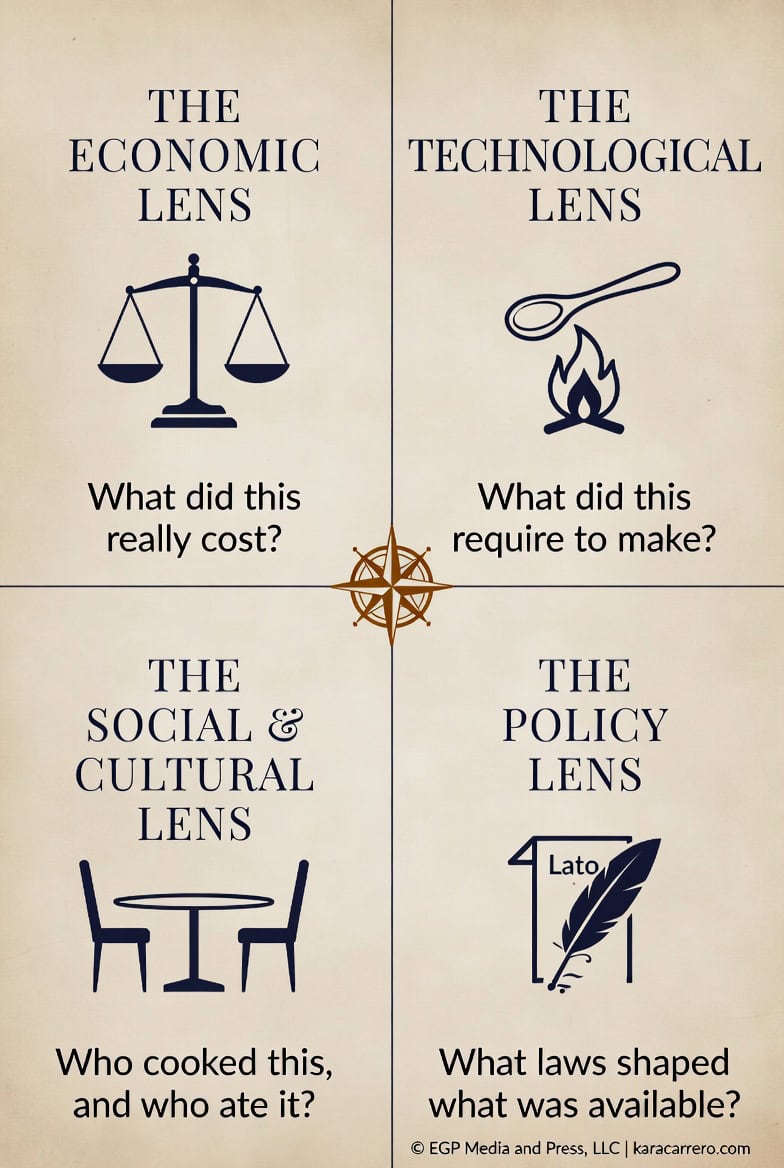
How to Read a Recipe as a Primary Source: The Four Lenses Framework
The approach I use with my own children and have built into my curriculum is organized around four lenses. Think of them as four different sets of questions you bring to the same document. Students do not need to apply all four every time. Even one lens, applied carefully, opens up more genuine historical thinking than a full chapter of textbook reading.
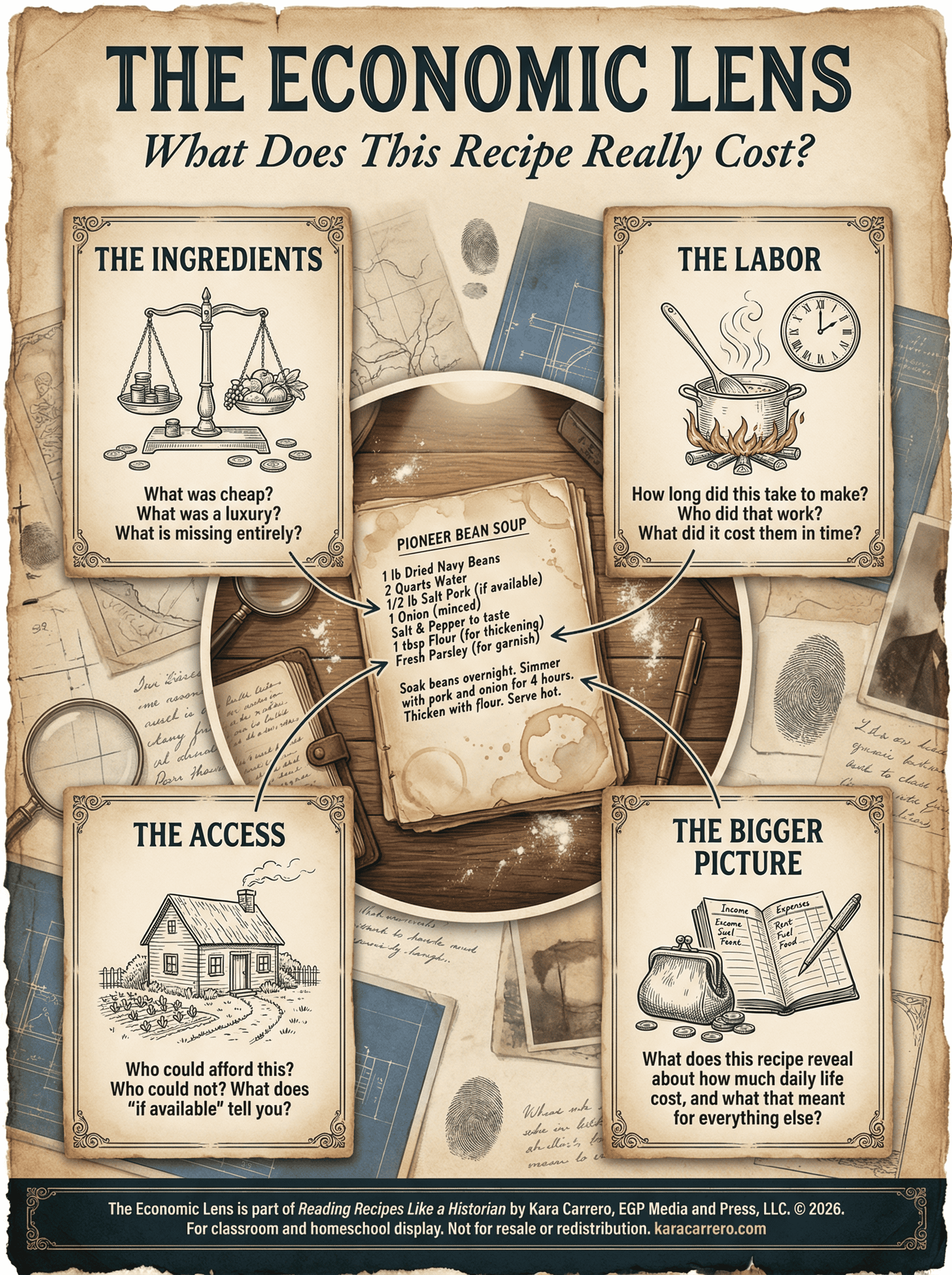
The Economic Lens: What Did This Really Cost?
The Economic Lens asks: what do the ingredients, methods, and choices in this recipe reveal about the financial realities of the people who made it?
Take Colonial hasty pudding. The ingredient list is four items: cornmeal, water, salt, and molasses or butter to serve if available.
That phrase, “if available,” is not a casual aside. It is a window into household economics. Butter and molasses were not everyday staples for most Colonial families. They were purchases. A family with limited means served their pudding plain. A family with more means served it sweetened. The same dish, two completely different economic realities, visible in four words.
The Economic Lens also asks about labor. That recipe calls for constant stirring over an open fire for twenty to thirty minutes. Someone’s morning was organized around that pot. When students understand that Colonial families spent three to five hours every day just preparing food, they understand something about women’s labor and the limits on what else a household could accomplish.
The Technological Lens: What Did This Require?
The Technological Lens asks: what tools, methods, and physical conditions did this recipe assume? And what does that tell us about daily life?
“Bring to a boil over an open fire” is not a cooking note. It describes a specific physical reality. There is no dial to turn. Someone built and maintained that fire, managed the heat by moving the pot closer or further from the coals, and stood over it in a low-ceilinged kitchen in the middle of summer.
When students analyze recipes through the Technological Lens, they begin to understand that historical inconvenience was not just uncomfortable. It was structuring. The tools people had, or did not have, shaped how they spent every hour of every day.
The Social and Cultural Lens: Who Cooked This, and What Did That Mean?
The Social and Cultural Lens asks: who made this food, who ate it, and what does that tell us about community, identity, and the structure of daily life?
Who was stirring that hasty pudding pot? In a Colonial household, almost certainly a woman or girl. That is not a minor detail. It is evidence about whose work was visible and whose was invisible, and about what it meant for women’s lives when cooking consumed hours rather than minutes.
This lens also reveals class dynamics. The same dish appearing on wealthy and working-class tables tells you something about how food functioned as both equalizer and divider. Everyone ate. Not everyone ate the same version.
The Policy Lens: What Laws and Events Shaped This Meal?
The Policy Lens asks: how did government actions, trade restrictions, wars, and policies show up on the dinner table?
Why did molasses appear so frequently in Colonial recipes and then become increasingly scarce in the 1760s? The Sugar Act of 1764 is part of the answer. British trade policy taxed imported molasses, raising prices on a daily staple for thousands of households. Government policy is not abstract. It shows up in what people could afford to eat.
You Do Not Have to Cook a Thing
One of the most common things I hear from both classroom teachers and homeschool parents is some version of: “This sounds amazing, but I don’t have time to add cooking to my lessons.”
Here is the thing: cooking is optional. Powerful when it happens, but entirely optional.
A recipe is a text document. It can be read, analyzed, discussed, and written about without anyone touching a stove. A middle school student can spend forty-five minutes investigating a hasty pudding recipe through the Economic Lens and walk away with a deeper understanding of Colonial economics than they would get from two chapters of a textbook, and no one has to make anything.
Related: “You Don’t Have to Cook to Use Historical Recipes in Your Classroom or Homeschool“
This matters for classroom teachers especially. Bringing food history into a social studies class does not require a kitchen, a field trip, or any special equipment. It requires a printed recipe and the right questions.
A Simple Way to Try This in Your Next Lesson
Here is how to bring the Economic Lens into your classroom or homeschool in about twenty minutes, using hasty pudding as your starting point.
Present this recipe to your student or class:
Colonial Hasty Pudding (c. 1700s) A staple of New England households across the economic spectrum.
➔ 1 cup cornmeal
➔ 4 cups water
➔ 1 teaspoon salt
➔ Molasses or butter to serve (if available)
Method: Bring salted water to a boil. Add cornmeal slowly, stirring constantly. Cook over low heat for 20 to 30 minutes. Serve hot or pour into a mold to cool and slice.
Before anyone analyzes anything, ask your students to read it through once the way a historian would: not as a set of instructions, but as a document. Not to cook it. To investigate it.
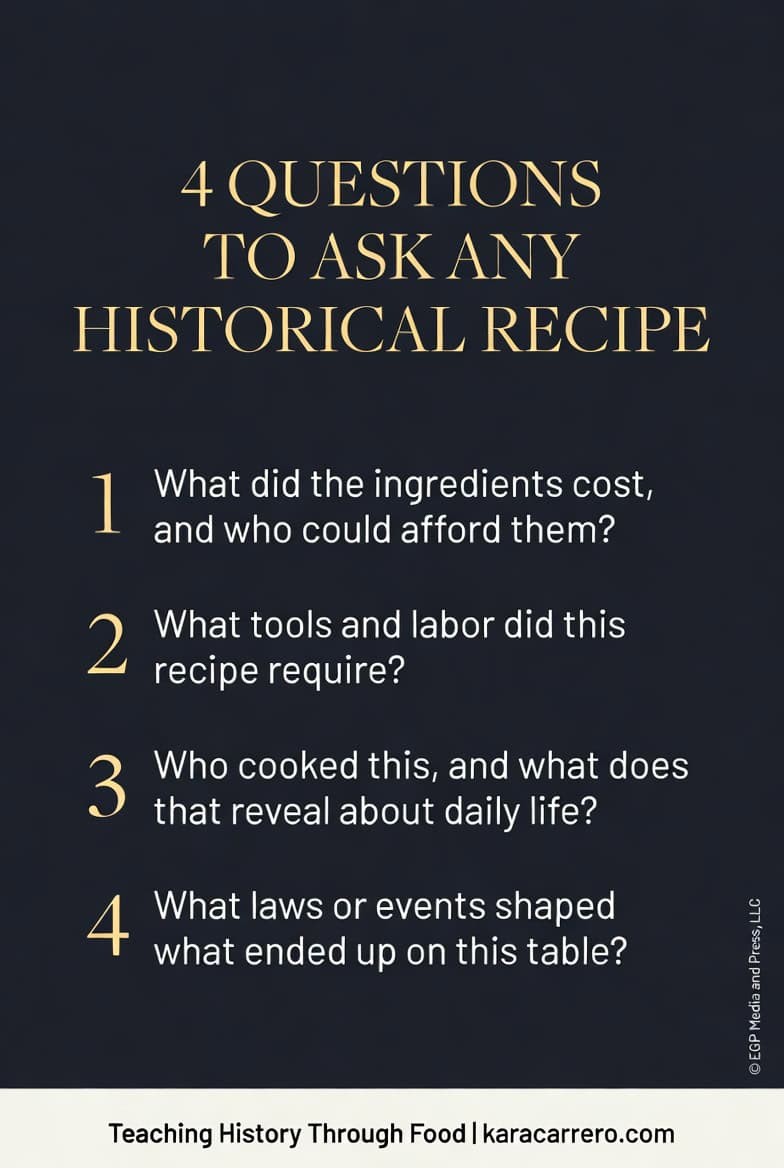
Then try a few questions:
➔ Which ingredients were cheap and widely available? Which were considered luxuries?
➔ This recipe requires constant stirring for up to thirty minutes. What does that tell you about who was doing this work and what their day looked like?
➔ Notice that butter and molasses are listed as optional. What does that single phrase reveal about economic differences between households?
➔ Describe two different families who might have eaten this same dish. What would be the same about their meals? What would be different?
That is the Economic Lens in practice. A student or class that works through those four questions has engaged in real historical analysis, not comprehension recall.
If you want a ready-made lesson packet for exactly this investigation, I put together a free 13-page resource that walks students through the full Economic Lens investigation of this recipe, includes a reusable graphic organizer that works with any historical recipe from any era, and comes in both color and black-and-white versions for different printing situations.
What This Looks Like Across a Full Year
Once students have the Four Lenses framework, they can apply it to any recipe from any era. That is the point. The framework transfers.
A Colonial recipe reveals economic pressure, labor burden, and the effects of British trade policy. A mill girl’s boarding house recipe from the 1840s reveals industrial labor economics and the physical demands of factory work. A Westward Expansion trail recipe reveals what it cost to move a family across a continent with everything they owned in a wagon. A Great Depression substitution chart reveals economic collapse at the household level in a way that no statistic can match.
For homeschool families working through American history chronologically, food history becomes the connective thread running through every era. For classroom teachers, it becomes the primary source investigation that makes abstract historical forces feel concrete and human.
In our family, we pair historical fiction with the cooking and food history of each time period. The books tell us what characters thought and felt. The recipes tell us what their days actually required. The two together create something that sticks.
History Is Not a Series of Events. It Is a Series of Days.
The thing I keep returning to, whether I am teaching my own six children or building resources for other educators, is that history becomes real the moment students stop receiving it and start investigating it.
A textbook paragraph about Colonial food scarcity is forgettable. Sitting with a recipe and asking why butter was listed as optional is not. The question pulls a student into the past in a way that a summary cannot.
One recipe. Four questions. That is the starting point.
Grab the FREE Economic Lens lesson packet and try it in your next lesson


What a fascinating article! I was a teacher for 30+ years and sadly they would not let us do something like this in the most recent years. Food allergies and germs, you know… 👀…but I used to do a food week in every history unit! Then as an admin, I had teams of teachers do a large event! They were such fun and everybody learned so much more than they would from a book! Thank you for sharing your expertise! xoxo
Very interesting!