
Your Freebie Is on Its Way.
Here Is One More Thing for the Trail.
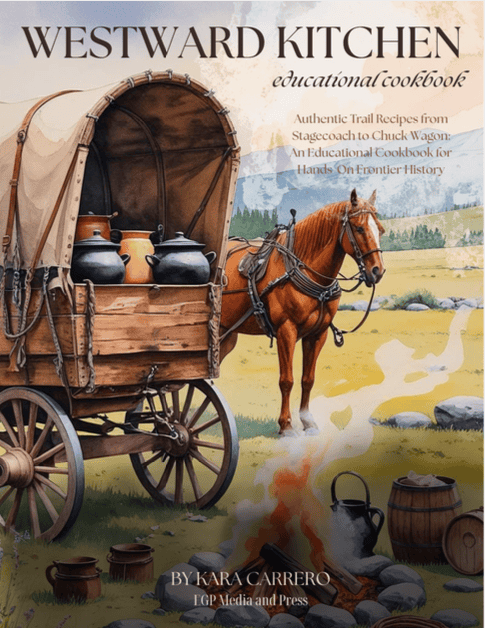
The Westward Kitchen brings authentic frontier recipes and the history behind them straight to your table. Available right now at a reader discount, on this page only.
This offer does not appear in the shop. Once you leave this page, it's gone.
The Same Approach. A Different Era.
The Economic Lens worksheet you just downloaded shows how a single Colonial recipe can reveal financial realities, daily labor, and the gap between households that no textbook captures.
The Westward Kitchen does the same thing on the frontier. Authentic trail recipes adapted for modern kitchens, each one carrying the story of what it actually cost to move a family across a continent with everything they owned in a wagon.
What did a family eat when water was scarce and flour was running low? What does a Dutch oven biscuit recipe tell you about the economics of a three-month overland journey? The same questions you just practiced with hasty pudding apply here too.
Of all the cookbooks in the Historical Kitchen series, this is the most straightforward. The recipes are accessible, the historical notes are concise, and it is designed to get your family cooking and thinking without a heavy lift. Other titles in the series go much deeper, with richer historical context and more robust educational content. But that does not make this one less valuable. Sometimes the best entry point is the one that gets you to the table.
What's Inside the Westward Kitchen
Authentic Trail Recipes
Period-accurate recipes adapted for modern kitchens, drawn from the Westward Expansion era including trail staples, frontier homestead cooking, and camp fire methods.
Historical Notes Per Recipe
Each recipe includes a brief historical note connecting the food to frontier life, explaining why certain ingredients traveled well, where the recipe came from, and what it reveals about daily survival on the trail.
Quick Start Meal Guide
A built-in Quick Start Guide helps you pull together a complete authentic trail meal without cooking every recipe. Pick one from each section: a breakfast, a one-pot meal, a portable food, and a beverage, and you have a full frontier dining experience.
Works With Any Curriculum
Pairs naturally with historical fiction set in the era, standalone history units, or as a companion to the Reading Recipes Like a Historian analytical framework.
One Grain. Two Centuries. One Good Question.
The hasty pudding recipe in your free worksheet is built on cornmeal: a Colonial staple, cheap and practical, grown from Indigenous agricultural knowledge that predated the colonies by centuries.
The Westward Kitchen includes Skillet Cornbread, a frontier staple also built on cornmeal, made roughly a century later in a completely different world. Same grain. Different terrain, different era, different people, different pressures entirely.
Why was cornmeal still a staple food a hundred years on? What changed about how it was prepared and why? What stayed the same about why it was affordable? Those questions are sitting right there waiting for a student who already knows how to ask them. The graphic organizer from your freebie works with the Skillet Cornbread recipe the same way it worked with hasty pudding.
How It Connects to What You Just Downloaded
The Economic Lens freebie gives your student a framework for investigating any historical recipe. The Westward Kitchen gives them a whole new set of sources to investigate with. Use the graphic organizer from the freebie with any recipe in this cookbook and the investigation runs itself.
A Good Fit For...

Families studying American history chronologically who want to move from Colonial into the 19th century with the same food-as-primary-source approach.

Anyone pairing historical fiction set during Westward Expansion with a hands-on cooking component that grounds the story in real daily life.

Families who already use the Historical Kitchen series and want to continue building a connected food history library across eras.