
One Recipe.
Two Centuries. One Bundle.
The Colonial Kitchen and the 1840s Industrial Revolution Kitchen together, because hasty pudding on a Colonial table and hasty pudding in a Lowell mill boarding house are the same dish telling two completely different stories.
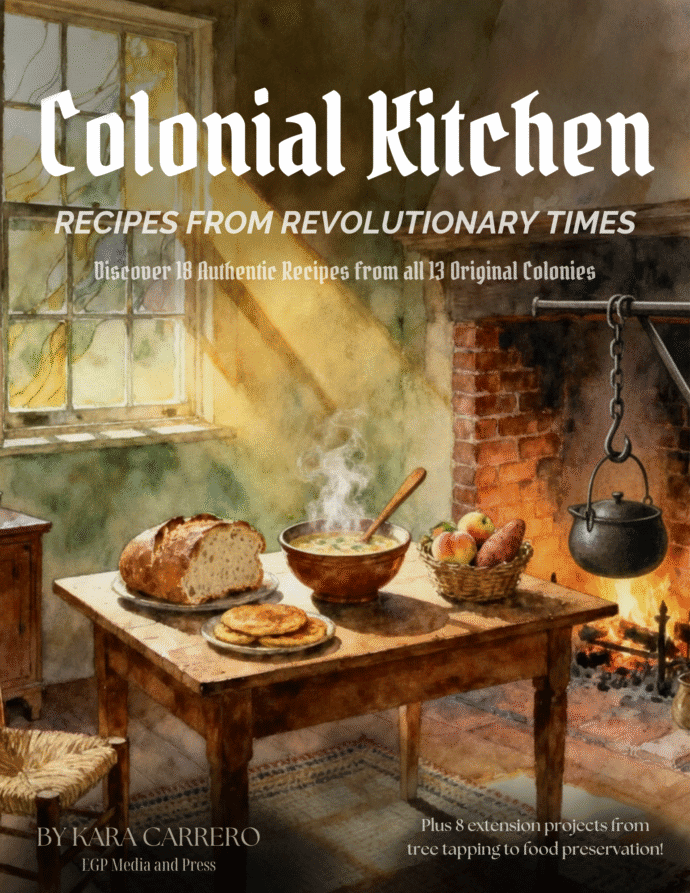
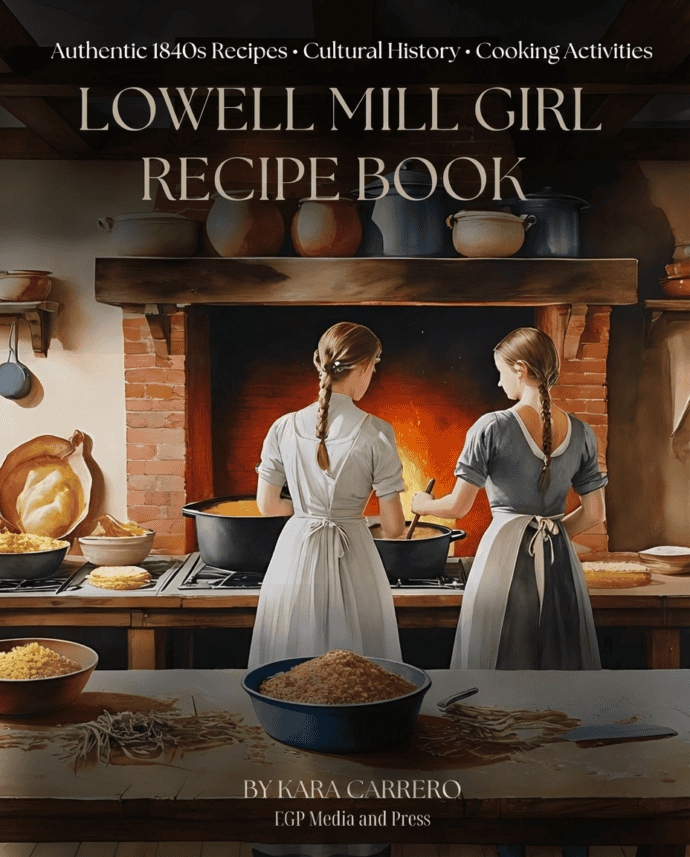
Or purchase each separately: Colonial Kitchen / Industrial Revolution Kitchen
The Same Dish. A Century Apart.
Hasty pudding: cornmeal, water, salt. In Colonial New England, it appeared on tables across the economic spectrum. Families with means served it with butter or molasses. Families without served it plain. It was not a special dish. It was Tuesday.
A century later, the same dish appeared on boarding house tables in Lowell, Massachusetts, eaten quickly by mill girls between factory shifts. Same grain. Completely different world: different labor context, different economic pressure, different reason for eating something that cheap and that filling.
That comparison is one of the most powerful historical thinking exercises you can give a student. The same recipe, two centuries, two completely different stories embedded in the same four ingredients. These two cookbooks were built to be used together.
What You Get
A Colonial Kitchen: Recipes from Revolutionary Times
18 authentic recipes from all 13 original colonies, adapted for modern kitchens. Includes historical context per recipe, literary connections to titles like Johnny Tremain and The Witch of Blackbird Pond, 8 extension projects, and a linked bibliography. Teaches anachronisms and regional foodway differences across colonial America.
The 1840s Industrial Revolution Kitchen: Lowell Mills Boarding House Cookbook
Period-accurate mill girl recipes including hasty pudding, johnnycakes, and boarding house staples. Student materials guide learners through calculating food budgets against mill wages, analyzing the economic impact of ingredient choices, and connecting daily food to the larger narrative of industrialization and labor reform.
Both cookbooks include historical context woven directly into the recipes. You do not have to cook a thing for these to be valuable teaching tools. The historical notes, the economic context, and the student activities work just as well on paper as they do at the stove.
Everything in the Bundle
28 total recipes spanning Colonial America and 1840s industrial New England, all adapted for modern kitchens
Historical notes per recipe in both cookbooks, connecting each dish to the economics, labor, and daily life of its era
8 extension projects in the Colonial Kitchen: tapping trees for sap, salt-preserving vegetables, starting a heritage garden, and more
Student budget activities in the Industrial Revolution Kitchen: calculating food costs against mill girl wages to understand labor economics at the household level
Literary connections in the Colonial Kitchen: designed to pair with Johnny Tremain, The Witch of Blackbird Pond, and other Colonial historical fiction
Anachronism exploration in the Colonial Kitchen: students learn to identify historically inaccurate ingredients and understand why that matters as a historical thinking skill
Both delivered as PDFs, print-and-go for classroom, homeschool, or co-op use
Pairs Naturally with Reading Recipes Like a Historian
If you have the Reading Recipes Like a Historian analytical toolkit, this bundle gives you two of the richest eras to work with. The toolkit walks students through the Four Lenses framework. These cookbooks give you the recipes to investigate with it.
The hasty pudding recipe from the Colonial Kitchen is used in the toolkit's first complete lesson plan. Having the Industrial Revolution Kitchen means your students can apply the exact same investigation to the same dish a century later and do a genuine comparison analysis. That is the kind of historical thinking most curricula never get to.
The toolkit and the bundle were built to work together, but each stands completely on its own.